
Discover the best city to set up office in India...

Dedicated Offshore Teams in India: The Foundation of Future Global Capability Centres
Enterprises that treat offshore capability as a tactical cost lever will fall behind. Those that build dedicated offshore teams in India as a strategic operating model are creating resilient, innovation-led, and scalable global businesses. The shift is no longer about outsourcing. It is about building long-term enterprise capability.
India now hosts more than 5.8 million technology professionals, with the digital workforce growing at ~15% CAGR, and over 1,700+ Global Capability Centres already operating across the country. These centres are driving product innovation, AI engineering, cybersecurity, and global operations.
The message is clear: dedicated offshore teams are the lowest-risk, highest-ROI pathway toward future-ready global capability centre India models.
The Strategic Inflection Point: From Cost Arbitrage to Strategic Arbitrage
The most successful enterprises no longer offshore to save money. They offshore to win.
The early outsourcing model delivered labour cost advantages but often created fragmented governance and innovation gaps. Today’s leaders are replacing vendor-driven delivery with dedicated development team India structures embedded within core strategy.
This shift unlocks three measurable outcomes:
| Outcome | Impact on P&L |
|---|---|
| Faster product cycles | 25–40% reduction in time-to-market |
| Access to scarce skills | Reduced dependency on expensive local hiring |
| Operational resilience | Diversified global delivery and risk mitigation |
A modern enterprise offshore strategy is therefore not a procurement decision. It is a competitive advantage.
Why India Remains the Global Epicentre of Offshore Capability
Talent density, not cost, is India’s biggest differentiator.
India produces more than 1.5 million engineering graduates annually and has become a global hub for AI, cloud, and data engineering. The depth of technology talent in India enables enterprises to scale faster than in most developed markets.
Key structural advantages include:
A large and continuously growing skilled talent India ecosystem
Strong digital and innovation infrastructure
Mature compliance and regulatory frameworks
Time-zone advantage for global operations
Deep experience in large-scale delivery
For many organizations, building an IT offshore team India is no longer optional—it is a survival strategy amid global talent shortages.
The Hard Truth: The First 90 Days Define Success or Failure
Most offshore programs fail not due to capability gaps, but because of leadership misalignment and cultural friction.
In practice, the first 90 days of integration determine long-term ROI. During this period:
Decision rights must be clearly defined
Communication rhythms must be institutionalized
Onshore leaders must shift from control to enablement
Ignoring this “integration window” leads to productivity loss, attrition, and strategic drift.
Organizations that invest early in governance and cultural alignment accelerate value creation.
The GCC Maturity Model: From Pilot to Strategic Global Hub
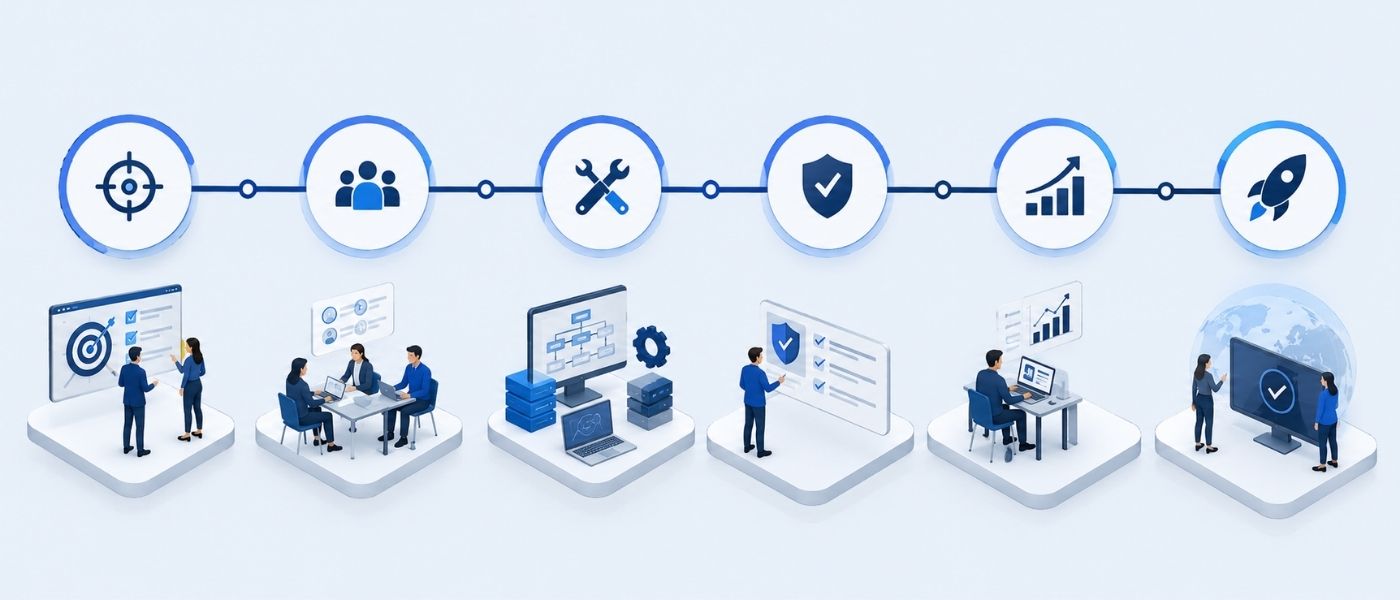
Rather than jumping directly to full ownership, leading enterprises follow a structured pathway.
| Maturity Stage | Strategic Objective | Key Outcomes |
|---|---|---|
| Pilot Stage: Build offshore team India | Validate delivery and culture | Quick wins and cost control |
| Dedicated Offshore Teams | Scale capability and integration | Faster innovation and execution |
| Offshore Capability Centre | Establish governance and leadership | Improved risk and operational resilience |
| Global Capability Centre | Drive enterprise transformation | Strategic innovation and global growth |
This phased approach minimizes risk while maximizing long-term value.

Dedicated Offshore Teams: The Engine of Enterprise Agility
Dedicated teams drive speed, control, and continuity.
Unlike project-based outsourcing, offshore team India models enable organizations to build institutional knowledge and stable delivery.
Key advantages:
1. Time-to-Market Acceleration
Continuous collaboration shortens product development cycles.
2. Strategic Alignment
Teams operate within enterprise frameworks rather than vendor structures.
3. Talent Retention
Long-term engagement reduces attrition and preserves knowledge.
4. Innovation Enablement
Teams support digital transformation offshore initiatives across AI, cloud, and automation.
This explains why leading technology firms increasingly treat offshore units as innovation hubs.
Offshore Development Centre vs GCC: A Strategic Decision
A common leadership question revolves around offshore development centre vs GCC.
An offshore development centre India offers:
Low entry risk
Flexibility
Faster deployment
Reduced capital expenditure
A full GCC setup India offers:
Full control
Deep innovation
Strategic ownership
Global leadership capability
The most successful enterprises begin with dedicated teams and evolve toward captive structures.
Governance Maturity: The True Differentiator
Governance maturity determines long-term ROI.
Enterprises that invest in a strong offshore governance model consistently outperform those that focus only on cost.
Key governance pillars:
Data security offshore and IP protection
Regulatory and compliance offshore India frameworks
Risk diversification and risk management offshore
Transparent performance metrics
Leadership accountability
This builds trust across stakeholders and accelerates executive buy-in.
Operational Resilience and Global Risk Diversification
Recent geopolitical, supply chain, and talent disruptions have reinforced the need for distributed operations.
A well-structured global delivery centre in India strengthens:
Business continuity
Cybersecurity resilience
Talent stability
Multi-region scalability
This approach reduces single-market exposure and strengthens enterprise stability.
The Rise of Offshore Innovation Centres
Offshore is no longer execution—it is innovation.
Many enterprises now build offshore innovation centre models that focus on:
AI engineering
Cloud modernization
Data and analytics
Cybersecurity
Product R&D
India is emerging as a global leader in offshore R&D teams, with innovation centres driving intellectual property and new product development.
ROI Beyond Cost Savings
Leadership conversations increasingly focus on value rather than labour arbitrage.
ROI drivers include:
Faster innovation cycles
Improved product quality
Increased scalability
Talent continuity
Strategic flexibility
This makes cost savings offshore India only one component of the broader value equation.
Offshore Teams for Startups and Enterprises
The offshore team for startups and enterprises model is equally relevant across maturity levels.
- Startups gain speed and specialization.
- Enterprises gain scale and resilience.
- This flexibility explains the rapid adoption across industries.
Scaling Offshore Teams in India
Scale requires leadership, not just hiring.
Organizations that succeed in scaling offshore teams in India invest in:
Leadership pipelines
Cultural integration
Governance frameworks
Digital collaboration
Continuous capability building
Scaling without these elements leads to complexity and diminishing returns.
Conclusion
The next decade will be defined by enterprises that build global capability rather than outsource execution. Dedicated offshore teams in India are the most practical and scalable pathway toward this future.
Organizations that begin this journey now will gain a structural advantage in talent, innovation, and operational resilience.
If you are exploring how to build a dedicated offshore team in India, scale your offshore capability, or design a long-term GCC roadmap, get in touch with our specialists today to create a secure, scalable, and innovation-led offshore strategy aligned with your business priorities.
Recent Post
How to Set Up an Offshore QA Center of Excellence in India: A Practical Guide for Global Teams
Learn how to set up an offshore QA center of...
Managed IT Services for Small Businesses: Complete Guide (2026)
Discover what managed IT services for small businesses actually include,...

iValuePlus Services
iValuePlus is a one-stop solution to address all your needs to access, build and grow your business in the Indian market which is cost-effective & has a huge talent pool. Established in 2019 as a ‘Business Solution provider', our team has delivered successful growth projects in the international market.
Our services include setting up ODC (offshore development center), Staff Augmentation, Talent Acquisition, Digital Marketing, in the IT/ITES domain.