
Discover the best city to set up office in India...
Tags
- and business scalability strategies in 2025–26 are choosing iValuePlus BOT services. Focus areas include BOT vs GCC
- and India as a BOT hub for enterprises.
- BOT outsourcing
- business continuity
- de-risked scaling
- global capability center setup
- innovation-driven GCCs
- offshore development centers
- offshore expansion models
- operational efficiency
- The evolution of Build Operate Transfer (BOT) in India is helping enterprises expand globally while reducing risks. Companies exploring GCC models

From BOT to GCC: How Enterprises Scale Offshore Operations with Lower Risk
The global economy in 2025–26 is defined by uncertainty, digital acceleration, and the need for organizations to expand internationally while staying agile. For many enterprises, the challenge isn’t whether to expand offshore but how to do so without exposing the business to unnecessary risk.
That’s where the Build Operate Transfer (BOT) model has become a game-changer. Once considered a niche approach, BOT is now at the heart of enterprise global expansion strategies. More importantly, BOT is increasingly being used as a gateway to Global Capability Centers (GCCs) — enabling companies to scale rapidly, reduce risks, and eventually transform offshore operations into strategic innovation hubs.
In this article, we’ll explore how BOT has evolved, why enterprises are using it as the first step toward GCCs, and how partners like iValuePlus make this journey seamless.
The New Global Playbook: Why BOT Is Replacing Traditional Outsourcing
For decades, outsourcing was the default offshore strategy. Businesses partnered with third-party vendors to manage IT, support, or back-office processes at lower costs. While effective for cost savings, this approach created limitations:
- Little control over processes and outcomes
- High vendor dependency for innovation and IP
- Difficulties scaling teams as per strategic needs
By contrast, Build Operate Transfer (BOT) offers a middle ground between outsourcing and building a fully owned GCC. Instead of handing everything over to a vendor, enterprises leverage BOT partners to:
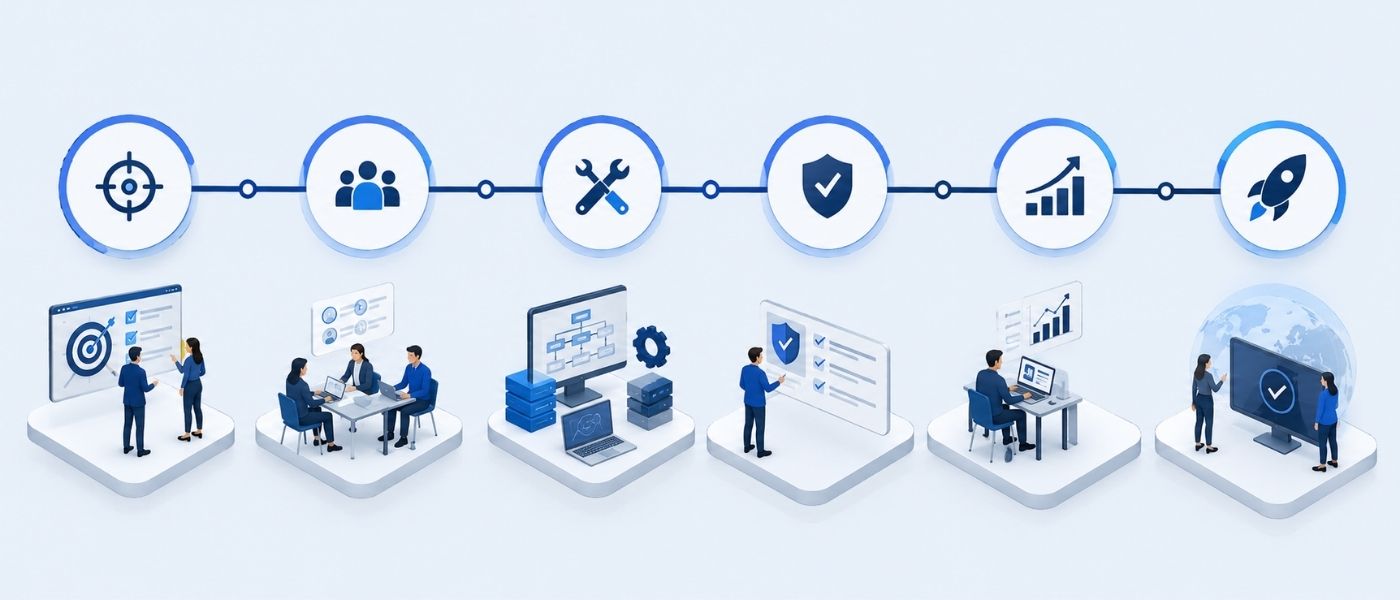
- Build offshore infrastructure and hire local talent
- Operate the unit under agreed KPIs, compliance, and performance standards
- Transfer full ownership when the enterprise is ready
This phased approach has become the new playbook for global expansion because it minimizes upfront risk while setting the stage for eventual full ownership.
BOT as a Risk Hedge: Navigating Market Entry Without Heavy Bets
One of the biggest fears for enterprises entering new geographies is the “unknown unknowns” — legal hurdles, compliance gaps, or cultural mismatches that can derail investments.
BOT helps companies de-risk global expansion by allowing them to:
- Test offshore markets without long-term commitments
- Shift financial risk to the BOT partner during the initial phases
- Adapt quickly if the business strategy or market outlook changes
For example, a SaaS startup expanding to India may worry about compliance and HR complexities. With BOT, iValuePlus handles payroll, benefits, and local labor laws while the startup focuses purely on building its product roadmap. If the venture proves viable, the unit transitions into a GCC. If not, the financial risk remains minimal.
Scaling with Agility: How BOT Enables Rapid Offshore Expansion
Speed is a competitive advantage. In industries like fintech, SaaS, and healthcare tech, waiting 18–24 months to build a fully owned offshore center could mean losing the market to competitors.
BOT enables enterprises to scale operations within months because:
- Talent acquisition is handled by experienced local partners
- Office infrastructure and IT systems are pre-established
- Operational processes are aligned with global standards from day one
This agility is particularly critical for short product cycles and fast-scaling startups, where waiting years for a GCC is simply not an option.
The Innovation Leap: Turning BOT Centers into Capability Hubs
In the past, offshore centers were seen purely as cost-saving units. That mindset has shifted dramatically. Today, BOT centers are expected to add strategic value, not just operational efficiency.
Enterprises increasingly use BOT units as:
- R&D Hubs – experimenting with AI, blockchain, or automation
- Product Development Centers – driving global product roadmaps
- Analytics and Insights Units – generating data-driven decisions
- Customer Experience Labs – testing CX enhancements across markets
This focus on innovation-driven operations means BOT units naturally evolve into GCCs — not just as a matter of structure, but of strategic necessity.
When BOT Becomes a GCC: The Natural Evolution for Enterprises
BOT is not just an outsourcing framework; it’s often the first chapter in a GCC journey.
The transition from BOT → GCC typically looks like this:
- Year 1–2: Partner builds and operates the offshore unit under BOT.
- Year 2–3: Enterprise gains confidence, sees performance stability, and starts absorbing functions internally.
- Year 3+: The offshore unit is transferred and formally established as a GCC — an owned, innovation-driven global capability hub.
This pathway allows enterprises to scale without betting big upfront, while still achieving the long-term benefits of a GCC.
Industries Driving the BOT → GCC Transition in 2025–26
Different sectors are adopting BOT for unique reasons. Some of the most active include:
- Fintech
- Need for fast product launches in competitive markets
- BOT helps access skilled engineers in India without heavy setup costs
- SaaS
- Cloud-native startups use BOT to quickly scale engineering and support
- BOT-to-GCC evolution provides control over IP and product innovation
- Healthcare Tech
- BOT reduces compliance risk in a heavily regulated sector
- Smooth transition into GCCs for clinical data management and R&D
- E-commerce
- BOT helps manage seasonal scalability challenges
- GCC evolution ensures long-term supply chain innovation
India’s Dual Advantage: Why It’s the Perfect BOT-to-GCC Destination
India is the #1 global hub for BOT and GCC models due to its dual advantage:
- Talent Depth: A vast pool of IT engineers, data scientists, and domain experts.
- Cost Efficiency: 40–60% lower operating costs compared to the West.
- Ecosystem Maturity: Over 1,600+ GCCs already operating successfully.
- Government Support: Investor-friendly policies and infrastructure development.
For companies eyeing BOT-to-GCC transitions, India is the de facto first choice.
BOT or Direct GCC? How to Decide Your Offshore Model
Not every enterprise should start with BOT. The decision depends on:
- Size & Maturity – Established Fortune 500 firms may go directly for a GCC.
- Risk Appetite – Startups and SMEs often prefer BOT for risk hedging.
- Strategic Horizon – If innovation is the endgame, BOT offers a smoother runway to GCC.
At iValuePlus, consulting teams guide enterprises through this decision by assessing cost models, scalability needs, and long-term goals.
iValuePlus: The Partner for Your BOT-to-GCC Journey
At iValuePlus, we’ve helped enterprises across fintech, SaaS, healthcare, and e-commerce turn offshore strategies into global success stories.
Our BOT services include:
- End-to-End Setup – Infrastructure, compliance, HR, payroll, and IT
- Operational Excellence – Managing teams with measurable KPIs
- Smooth Transfer – Ensuring a seamless move from BOT to GCC ownership
- Innovation Enablement – Helping enterprises shift focus from cost savings to global value creation
With iValuePlus, BOT isn’t just a service — it’s a strategic roadmap to building a GCC.
Q&A
Why is BOT considered a safer offshore model?
Because BOT shifts the setup and operational risks to a partner during the early stages, allowing enterprises to expand globally without heavy upfront investment.
How does BOT evolve into a GCC?
BOT starts with a partner managing offshore operations. Over time, once stability and performance are proven, the operations are transferred to the enterprise, effectively becoming a GCC.
Which industries benefit most from BOT in 2025–26?
Fintech, SaaS, healthcare tech, and e-commerce are the biggest adopters of BOT due to their need for agility, compliance, and innovation.
Why is India the global leader in BOT-to-GCC transitions?
India offers unmatched talent, cost efficiency, and a mature ecosystem of GCCs, making it the most attractive BOT and GCC destination worldwide.
How does iValuePlus support BOT clients?
iValuePlus manages the entire BOT lifecycle — building, operating, and transferring offshore units — while ensuring clients achieve long-term success with GCC ownership.
Conclusion
The Build Operate Transfer model is no longer just an outsourcing alternative. It’s a strategic risk hedge, a scalability enabler, and the natural gateway to Global Capability Centers.
In a world where speed and resilience define competitive advantage, BOT provides enterprises the flexibility to expand offshore quickly, learn the market, and eventually own a world-class GCC.
For 2025–26 and beyond, BOT-to-GCC transitions will be the blueprint of global expansion — and with the right partner like iValuePlus, businesses can de-risk, scale, and innovate with confidence.
Ready to explore BOT as your pathway to a GCC? Get in touch today.
Recent Post
How to Set Up an Offshore QA Center of Excellence in India: A Practical Guide for Global Teams
Learn how to set up an offshore QA center of...
Managed IT Services for Small Businesses: Complete Guide (2026)
Discover what managed IT services for small businesses actually include,...

iValuePlus Services
iValuePlus is a one-stop solution to address all your needs to access, build and grow your business in the Indian market which is cost-effective & has a huge talent pool. Established in 2019 as a ‘Business Solution provider', our team has delivered successful growth projects in the international market.
Our services include setting up ODC (offshore development center), Staff Augmentation, Talent Acquisition, Digital Marketing, in the IT/ITES domain.