QA Center of Excellence (CoE)

Scalable, Secure & Future-Ready Quality Engineering Services

Scalable, Secure & Future-Ready Quality Engineering Services

In today’s fast-paced digital landscape, software quality is a strategic business enabler. iValuePlus helps organizations establish a QA Center of Excellence (QA CoE) to transform QA into a predictable, automation-driven, and AI-enabled function that accelerates releases, reduces defects, and improves user experience across applications.

Our Quality Engineering Services focus on standardizing QA practices, implementing automation and performance engineering, and embedding security early in the software development lifecycle.

scalable
scalable

Scalable, Secure & Future-Ready Quality Engineering Services

In today’s fast-paced digital landscape, software quality is a strategic business enabler. iValuePlus helps organizations establish a QA Center of Excellence (QA CoE) to transform QA into a predictable, automation-driven, and AI-enabled function that accelerates releases, reduces defects, and improves user experience across applications.

Our Quality Engineering Services focus on standardizing QA practices, implementing automation and performance engineering, and embedding security early in the software development lifecycle.

governance

QA Governance & Operating Model

Operating Structure

  • Central QA CoE for standards, governance, and strategic direction
  • Embedded QA squads aligned with product and development teams
  • Dedicated QA leads for each product line or project
  • Shared services model for specialized testing (performance, security, automation)
  • Cross-functional collaboration with development, DevOps, and product teams
  • Scalable resource allocation based on project needs
  • Global and distributed QA teams for 24/7 coverage
  • Centers of Excellence for specialized domains
  • Matrix reporting structure for better coordination
  • Regular sync between central CoE and embedded teams

QA Governance & Operating Model

Operating Structure

  • Central QA CoE for standards, governance, and strategic direction
  • Embedded QA squads aligned with product and development teams
  • Dedicated QA leads for each product line or project
  • Shared services model for specialized testing (performance, security, automation)
  • Cross-functional collaboration with development, DevOps, and product teams
  • Scalable resource allocation based on project needs
  • Global and distributed QA teams for 24/7 coverage
  • Centers of Excellence for specialized domains
  • Matrix reporting structure for better coordination
  • Regular sync between central CoE and embedded teams
governance

Governance Framework

Manual

Manual Testing & Test Management Services

Structured Testing Methodology

1. Requirement Analysis: Ensure complete understanding of business requirements and translate them into testable specifications.

Our Approach: Requirement Review & Validation, Test Scope Definition, Traceability Matrix Creation, Risk Assessment & Identification, Acceptance Criteria Definition, Test Environment & Data Requirements

Key Deliverables: Requirement Traceability Matrix (RTM), Risk assessment document, Test strategy and approach document, Test environment specifications.

3.Test Design and Execution: Create robust, reusable test cases and execute them systematically to uncover defects and validate functionality.

Key Deliverables: Comprehensive test case repository, Test data sets and generators, Automated test scripts and frameworks, Test execution reports with pass/fail metrics.

2.Test Reporting and Metrics: Provide transparent, data-driven insights into testing progress, quality status, and areas requiring attention.

Real-Time Test Dashboards: (Daily Test Summary Reports – Weekly/Sprint Reports, Test Completion/Exit Reports, Quality Metrics Tracked – Test Effectiveness Metrics, Defect Metrics, Process Metrics, Business Impact Metrics, Reporting Cadence)

Key Deliverables: Real-time dashboards (via Jira, TestRail, Azure DevOps, or custom tools), Daily/weekly test execution reports, Defect trend analysis reports, Test metrics scorecards, Final test summary and release readiness reports.

4.Defect Management and Closure : Defect Logging, Defect Triage and Tracking, Defect Resolution and Verification, Defect Metrics and Analysis

Key Deliverables: Detailed defect logs with traceability to requirements, Defect status reports and dashboards, Root cause analysis documents, Defect closure reports with verification evidence.

test-management.png

Tools Supported:

  • Test Management: Jira, Zephyr, TestRail, Azure DevOps, qTest, PractiTest, TestLink
  • Bug Tracking: Jira, Bugzilla, Mantis, Redmine
  • API Testing: Postman, SoapUI, REST Assured
  • Performance Testing: JMeter, LoadRunner
  • Automation Support: Selenium, Appium, Cypress
  • Collaboration: Confluence, Slack, Microsoft Teams
  • Version Control: Git, GitHub, GitLab, Bitbucket
  • Functional testing
  • Regression testing
  • Exploratory testing
  • User Acceptance Testing (UAT)
  • Smoke testing
  • Sanity testing
  • Integration testing
  • System testing
  • End-to-end testing
  • Usability testing
  • Compatibility testing
  • Performance testing
  • Security testing
  • API testing
  • Database testing
  • Mobile testing (iOS & Android)
  • Cross-browser testing
Test Types Covered

Test Automation Center of Excellence (TA-CoE)

FrameWorks & Tools
web-automation-1.png

Frameworks & Tools:

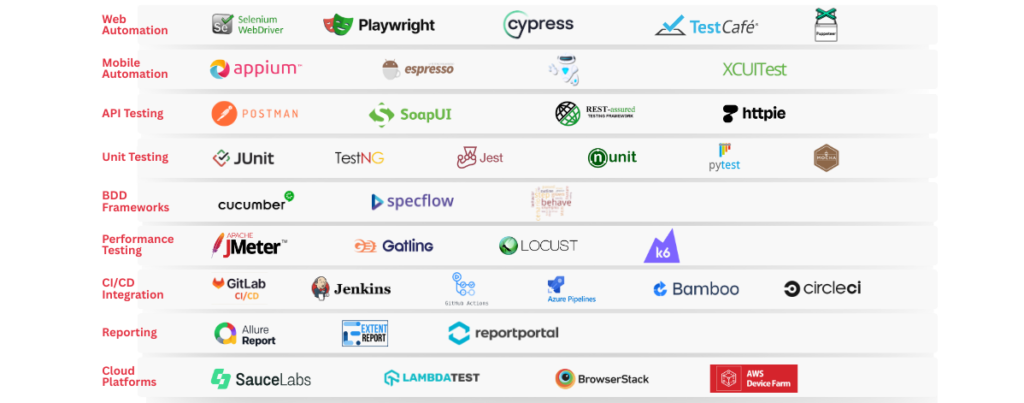
  • Web Automation: Selenium WebDriver, Playwright, Cypress, TestCafe, Puppeteer
  • Mobile Automation: Appium, Espresso, XCUITest, Detox
  • API Testing: REST Assured, Postman, SoapUI, Karate DSL, HTTPie
  • Unit Testing: JUnit, TestNG, NUnit, PyTest, Jest, Mocha
  • BDD Frameworks: Cucumber, SpecFlow, Behave
  • Performance Testing: JMeter, Gatling, Locust, K6
  • CI/CD Integration: Jenkins, GitLab CI/CD, Azure Pipelines, CircleCI, GitHub Actions, Bamboo
  • Reporting: Allure, ExtentReports, ReportPortal
  • Cloud Platforms: BrowserStack, Sauce Labs, LambdaTest, AWS Device Farm
  • Unit testing
  • API & integration testing
  • UI automation (Web & Mobile)
  • End-to-end testing
  • Smoke testing
  • Sanity testing
  • Data-driven testing
  • Keyword-driven testing
  • Cross-browser testing
  • Performance testing
  • Security testing
  • Database testing
  • Visual regression testing
  • Accessibility testing
Coverage
  • Flaky test identification and resolution
  • Framework scalability and optimization
  • Code refactoring and reusability
  • Test data management
  • Regular script updates and maintenance
  • Self-healing automation mechanisms
  • Performance monitoring and tuning
  • Documentation and knowledge transfer
  • Continuous integration and deployment
  • ROI tracking and metrics analysis
Maintenance

Performance Engineering CoE

CI/CD Integration
  • Automated performance testing in build pipelines
  • Performance gates and thresholds
  • Continuous monitoring and alerting
  • Scalability and resilience validation
  • Performance trend analysis
  • Early detection of performance degradation
  • Automated reporting and dashboards
  • Integration with Jenkins, GitLab CI/CD, Azure DevOps, GitHub Actions
  • Version Control Integration
  • Artifact Management
  • Deployment Strategies
  • Multi-Pipeline Orchestration
  • Compliance and Audit
  • Notification Integrations
  • API-First Approach
CI_CD Integration
  • Automated performance testing in build pipelines
  • Performance gates and thresholds
  • Continuous monitoring and alerting
  • Scalability and resilience validation
  • Performance trend analysis
  • Early detection of performance degradation
  • Automated reporting and dashboards
  • Integration with Jenkins, GitLab CI/CD, Azure DevOps, GitHub Actions
CI_CD Integration
  • Response time and latency
  • Throughput (requests per second)
  • CPU utilization
  • Memory utilization
  • Disk I/O
  • Network bandwidth
  • Error rates
  • Concurrent users
  • Transaction success/failure rates
  • Database query performance
  • Cache hit ratios
  • Resource saturation
Performance Metrics
  • Load testing
  • Stress testing
  • Spike testing
  • Endurance (Soak) testing
  • Scalability testing
  • Volume testing
  • Capacity testing
  • Breakpoint testing
  • Configuration testing
  • Isolation testing
  • Baseline testing
  • Benchmark testing
  • Failover and recovery testing
  • Network latency testing
  • Database performance testing
  • API performance testing
  • Mobile application performance testing
  • Cloud elasticity testing
Continuous Performance Validation
  • Load testing
  • Stress testing
  • Spike testing
  • Endurance (Soak) testing
  • Scalability testing
  • Volume testing
  • Capacity testing
  • Breakpoint testing
  • Configuration testing
  • Isolation testing
  • Baseline testing
  • Benchmark testing
  • Failover and recovery testing
  • Network latency testing
  • Database performance testing
  • API performance testing
  • Mobile application performance testing
  • Cloud elasticity testing
Continuous Performance Validation
load-testing.png

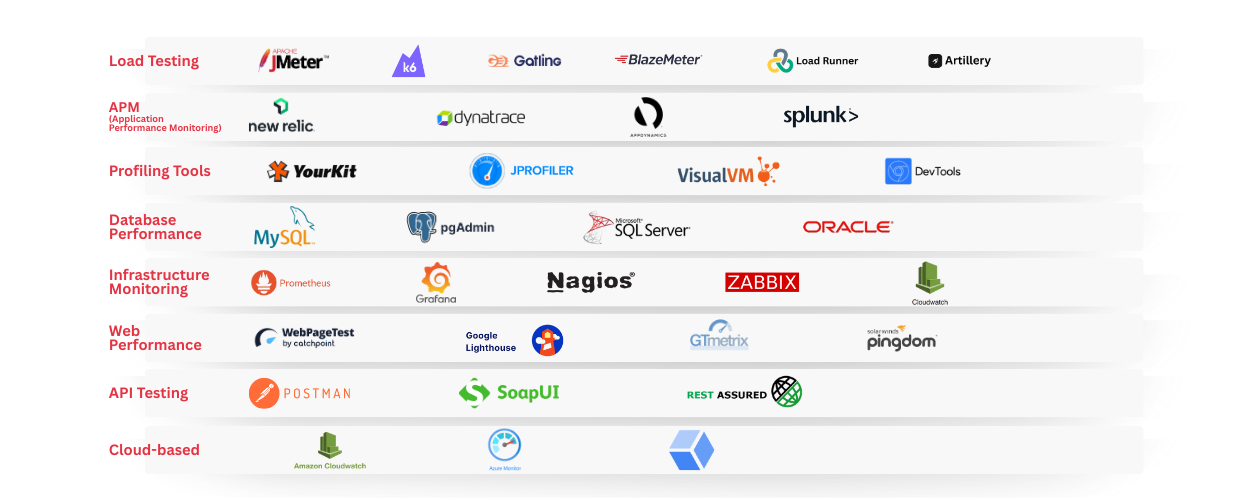
Tools & Technologies:

  • Load Testing: JMeter, K6, Locust, Gatling, LoadRunner, BlazeMeter, Artillery
  • APM (Application Performance Monitoring): New Relic, Dynatrace, AppDynamics, Datadog, Splunk
  • Profiling Tools: YourKit, JProfiler, VisualVM, Chrome DevTools, Xcode Instruments
  • Database Performance: MySQL Workbench, pgAdmin, SQL Server Profiler, Oracle AWR
  • Infrastructure Monitoring: Prometheus, Grafana, Nagios, Zabbix, CloudWatch
  • Web Performance: WebPageTest, Lighthouse, GTmetrix, Pingdom
  • API Testing: Postman, SoapUI, REST Assured
  • Cloud-based: AWS CloudWatch, Azure Monitor, Google Cloud Operations

Security Testing & DevSecOps

Embedded Security
  • Shift-left security (early-stage testing)
  • Shift-right security (production monitoring)
  • Static Application Security Testing (SAST)
  • Dynamic Application Security Testing (DAST)
  • Software Composition Analysis (SCA)
  • Interactive Application Security Testing (IAST)
  • Runtime Application Self-Protection (RASP)
  • Container security scanning
  • Infrastructure as Code (IaC) security testing
  • API security testing
  • Mobile application security testing
  • Cloud security posture management
  • Secrets management and detection
  • Dependency vulnerability scanning
  • Security code reviews
  • Penetration testing
  • Vulnerability assessment
  • Security configuration testing
Embedded Security
  • Shift-left security (early-stage testing)
  • Shift-right security (production monitoring)
  • Static Application Security Testing (SAST)
  • Dynamic Application Security Testing (DAST)
  • Software Composition Analysis (SCA)
  • Interactive Application Security Testing (IAST)
  • Runtime Application Self-Protection (RASP)
  • Container security scanning
  • Infrastructure as Code (IaC) security testing
  • API security testing
  • Mobile application security testing
  • Cloud security posture management
  • Secrets management and detection
  • Dependency vulnerability scanning
  • Security code reviews
  • Penetration testing
  • Vulnerability assessment
  • Security configuration testing
Embedded Security
  • Security Standards: OWASP Top 10, SANS Top 25, CWE/SANS
  • Regulatory Compliance: SOC 2, GDPR, HIPAA, PCI DSS, ISO 27001, ISO 27002, NIST, CCPA, FISMA
  • Industry-Specific: HITRUST, FedRAMP, GLBA, SOX, FERPA
  • Threat Modeling: STRIDE, DREAD, PASTA, VAST
  • Security Testing Types: SQL injection, Cross-Site Scripting (XSS), Cross-Site Request Forgery (CSRF), Authentication/Authorization flaws, Sensitive data exposure, XML External Entities (XXE), Broken access control, Security misconfigurations, Insecure deserialization, Using components with known vulnerabilities
Threat & Compliance Coverage
sast-tools.png

Tools & Technologies:

  • SAST Tools: SonarQube, Checkmarx, Fortify, Veracode, Coverity, Snyk Code
  • DAST Tools: OWASP ZAP, Burp Suite, Acunetix, Nessus, Qualys, AppScan
  • SCA Tools: Snyk, WhiteSource, Black Duck, Dependabot, OWASP Dependency-Check
  • Container Security: Aqua Security, Twistlock, Trivy, Clair, Anchore
  • Secret Scanning: GitGuardian, TruffleHog, Gitleaks
  • Cloud Security: Prisma Cloud, AWS Security Hub, Azure Security Center, Google Cloud Security Command Center
  • API Security: Postman, OWASP API Security, 42Crunch
  • Early detection and remediation of vulnerabilities
  • Reduced security risks and breach potential
  • Regulatory compliance and audit readiness
  • Cost savings through early vulnerability identification
  • Improved security posture and resilience
  • Faster time-to-market with secure code
  • Enhanced customer trust and brand reputation
  • Automated security in CI/CD pipelines
  • Continuous security monitoring and feedback
  • Reduced technical debt
  • Protection against zero-day vulnerabilities
  • Comprehensive security coverage across the SDLC
  • Proactive threat intelligence and response
  • Better collaboration between development, security, and operations teams
Benefits
AI-Based Test Case Generation
  • Automatically create test cases from requirements and user stories
  • Generate test scenarios based on application behavior analysis
  • Create test data using AI algorithms
  • Identify missing test coverage gaps
  • Generate edge case and negative test scenarios
  • Auto-update test cases when application changes
  • Reduce manual effort in test design
  • Learn from past test results to improve future test creation
AI-Based Test Case Generation
  • Automatically identify high-risk areas for testing
  • Prioritize tests based on code changes and impact analysis
  • Run critical tests first for faster feedback
  • Optimize test execution order for efficiency
  • Focus on features most likely to have defects
  • Reduce overall test execution time
  • Smart selection of regression tests
  • Risk-based testing approach using machine learning
Intelligent Test Prioritization
  • Predict potential defects before they occur
  • Analyze historical data to forecast quality trends
  • Assess release readiness and risk levels
  • Identify areas prone to failures
  • Provide early warnings for quality issues
  • Generate risk scores for each release
  • Recommend optimal release timing
  • Data-driven decision making for go/no-go calls
  • Proactive quality management
  • Trend analysis and pattern recognition
Predictive Quality Analytics
  • Test.ai, Testim, Functionize, Mabl
  • Applitools (Visual AI testing)
  • Selenium with AI enhancements
  • TensorFlow, PyTorch for custom AI models
  • Machine learning frameworks
  • Natural Language Processing (NLP) for requirement analysis
  • Predictive analytics platforms
AI Tools & Technologies
  • Faster test creation and execution
  • Reduced manual testing effort
  • Improved test coverage and accuracy
  • Lower maintenance costs
  • Earlier defect detection
  • Better quality predictions
  • Smarter resource allocation
  • Continuous learning and improvement
Ai-benefits

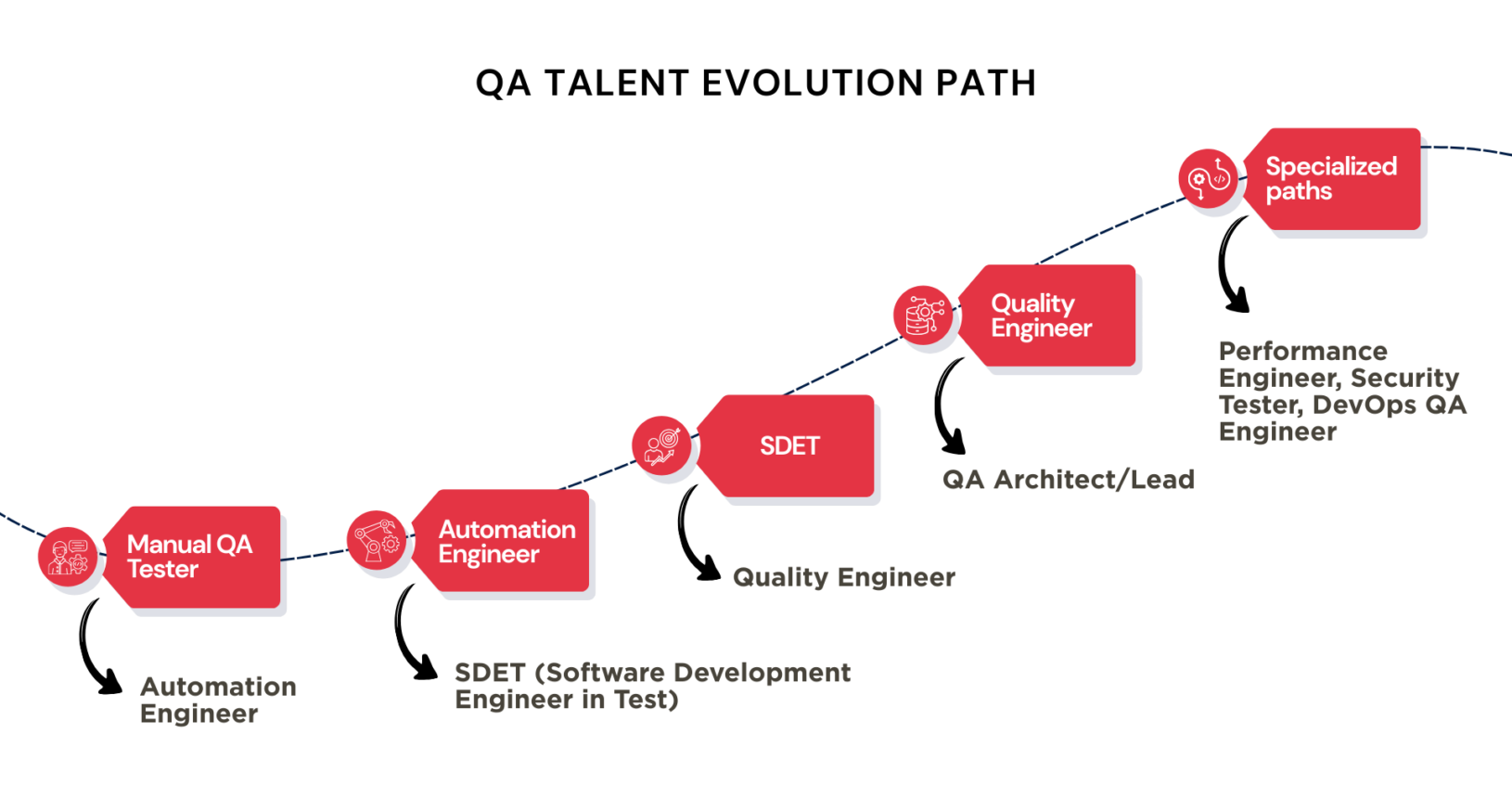
People, Skills & Enablement

QA talent
qa-talent-mobile
why-choose

Why Choose iValuePlus for QA CoE Services

staff-aug-red-banner1

Partner with iValuePlus to implement a scalable, secure, and future-ready QA Center of Excellence today.

Team Snapshot

Automation Engineers
1 +
Manual Testers
1 +
Performance Testers
1 +

Engagement Models

Project-Based Delivery

End-to-end DevOps enablement

Dedicated ODC Teams

Client-branded pods

BOT Model 

Build, Operate & Transfer

FAQs

A QA CoE is a centralized framework that standardizes testing, automation, performance, and security across the organization for predictable releases and improved software quality.

Unlike traditional QA teams working in silos, a QA CoE integrates quality across the SDLC with automation, AI, and enterprise-wide governance.

Organizations facing fragmented QA processes, high defect leakage, slow release cycles, or limited automation can benefit from implementing a QA CoE.

Yes. It supports Agile, DevOps, and CI/CD workflows with shift-left and shift-right testing and in-sprint automation.

No. It enhances existing teams with centralized governance and embedded QA squads aligned to product teams.

We support Selenium, Playwright, Cypress, Appium, JMeter, K6, Jira, Zephyr, TestRail, Azure DevOps, Jenkins, GitHub Actions, and more.

KPIs like defect leakage rate, automation coverage, release predictability, MTTD, MTTR, and cost of quality quantify success.

AI enables test case generation, predictive defect analytics, self-healing automation, and release risk scoring for smarter QA decisions.

Let Us Help Your Business To
Move Forward.

Ivalueplus business services