
Discover the best city to set up office in India...

What is a QA Center of Excellence (QA CoE)? Complete 2026 Guide
This guide covers everything you need to know about QA Centers of Excellence in 2026—from foundational concepts to implementation strategies, real-world results, and the metrics that prove ROI.
What is a QA Center of Excellence (QA CoE)?
A Quality Assurance Center of Excellence (QA CoE) is a centralized, strategic framework that standardizes, scales, and improves software quality assurance across all projects and teams in an organization. A QA CoE replaces siloed testing efforts with unified methods, reusable templates, and consistent workflows—transforming testing from a fragmented cost center into a strategic business capability.
A mature QA CoE includes five essential elements:
- People & Expertise: Dedicated QA specialists including test architects, automation engineers, and performance testers who guide all project teams.
- Standardized Processes: Well-defined testing methodologies covering requirement analysis, test planning, execution, defect management, and reporting.
- Technology & Tools: Centralized, curated toolset for test management, automation, performance testing, and security scanning.
- Governance Framework: Clear policies, quality gates, and metrics that define how testing should be conducted organization-wide.
- Knowledge Management: Centralized repository of automation frameworks, test templates, and best practices.
QA CoE vs. Traditional QA Teams
The Traditional Model: Siloed & Inefficient
In traditional QA setups, each project team has its own QA department. This creates:
- Fragmented processes and inconsistent methodologies
- Tool sprawl with redundant licensing costs
- Knowledge silos preventing best practice sharing
- Duplicate effort rebuilding frameworks repeatedly
- Inconsistent quality without unified standards
- Limited scalability for new projects
- Higher overall testing costs
The QA CoE Model: Unified & Strategic
A QA CoE enables:
- Standardized processes across all teams
- Shared expertise and specialized guidance
- Tool consolidation eliminating redundancy
- Reusable frameworks and accelerators
- Centralized knowledge repository
- Faster new team onboarding
- 25-50% cost reduction
The key difference: Traditional QA is reactive and team-specific; a QA CoE is proactive and organization-wide.

Why Your Organization Needs a QA CoE
Warning Signs You Need One
Consider implementing a QA CoE if you experience:
- Testing Bottlenecks: QA consistently delays releases
- Inconsistent Quality: Different teams produce vastly different outcomes
- Rising Costs: Testing budget grows without clear ROI
- Agile Scaling Issues: 56% of QA leaders struggle in agile environments
- Compliance Challenges: Regulatory audits reveal process gaps
- Tool Chaos: Multiple incompatible tools create integration nightmares
Talent Loss: Critical knowledge leaves when people depart
Proven Business Results
Organizations implementing QA CoEs typically achieve:
- 30-40% reduction in post-release defects
- 40-60% reduction in testing cycle time
- 25-50% reduction in overall testing costs
- 3-5x faster new team onboarding
- CMMI level progression (Level 2 → Level 3)
Faster, safer release velocity
The QA CoE Framework
Governance Structure
- Executive Sponsor: Ensures commitment and allocates budget
- Steering Committee: Aligns priorities across departments
- CoE Leadership: QA leader manages team and drives improvement
- Quality Gates: Defined checkpoints for quality decisions
Standardized Processes
Core process areas include test planning, test design, execution, defect management, and quality reporting with clear standards documented and shared.
Technology Stack
Centrally-managed tools: Test Management (TestRail, Jira), Automation (Selenium, Cypress, Playwright), Performance (JMeter, K6), Security (SonarQube, Snyk), and CI/CD (Jenkins, GitLab).
Knowledge Repository
Centralized assets including automation frameworks, test templates, process documentation, and training materials.
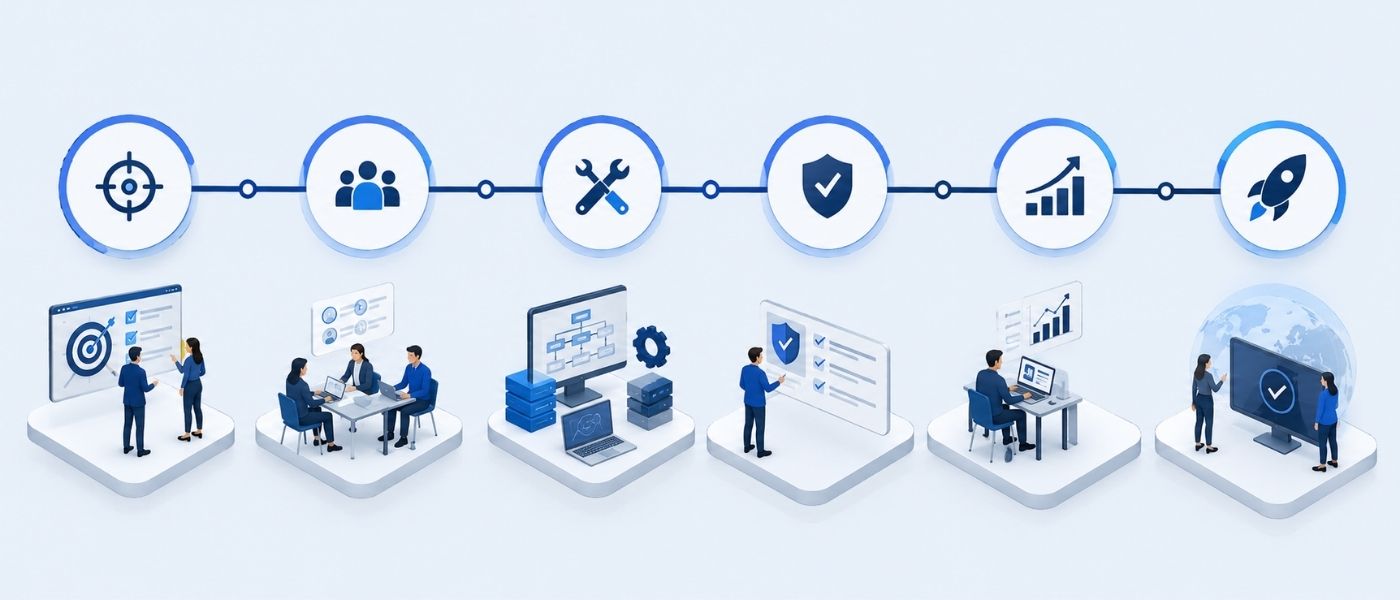
Building Your QA CoE: 5-Phase Roadmap
Phase 1: Define Vision
Conduct QA maturity assessment, define business objectives, and secure executive sponsorship with specific, measurable goals.
Phase 2: Plan Strategy
Document current processes, identify quick wins, define operating model, and build realistic 12-18 month roadmap.
Phase 3: Design & Build
Assemble core team, develop standardized processes, consolidate tools, and create reusable assets.
Phase 4: Pilot & Validate
Select early adopter teams, implement new processes, collect baseline metrics, and demonstrate value.
Phase 5: Scale & Improve (Months 6-18+)
Roll out organization-wide, provide training, implement advanced capabilities, and establish continuous improvement loops.

Real-World Case Study: Energy Company's QA CoE Transformation
The Challenge
A global energy company with 200+ applications faced significant testing challenges:
- Heavy reliance on manual testing limited release velocity
- Different teams used different tools and processes
- No standardized automation framework or best practices
- Difficulty scaling testing to support business growth
- CMMI audits revealed process maturity gaps (Level 2)
The Solution
The company partnered to establish a QA Center of Excellence integrated with a Test Automation First Framework:
- Deployed standardized testing processes and governance
- Built a centralized automation framework using open-source tools (Selenium, REST Assured, Jenkins)
- Consolidated tools and created shared testing infrastructure
- Trained 100+ QA engineers on new processes and frameworks
- Established centralized team to provide guidance and support
The Results
The client successfully progressed from CMMI Level 2 to Level 3, with the TCoE and automation framework playing a key role in demonstrating capability, process discipline, and consistent execution across QA initiatives
Additional benefits:
- 50% reduction in testing cycle time
- 60% improvement in automation coverage
- 35% reduction in post-release defects
- 40% decrease in testing costs
- Faster onboarding for new QA engineers
Key Metrics That Prove QA CoE ROI
Defect Metrics
Defect Escape Rate (Primary KPI)
- Industry Benchmark: 5-15% depending on industry
- Goal with QA CoE: Reduce to <5%
- Impact: Fewer production incidents = higher customer satisfaction and lower support costs
Mean Time to Detect (MTTD)
- Measure: Average time from bug introduction to detection
- Goal: Reduce through earlier testing and CI/CD integration
- Impact: Faster issue resolution and reduced production impact
Speed Metrics
Testing Cycle Time
- Measure: Time from requirement completion to testing completion
- Industry Benchmark: Can range from weeks (traditional) to hours (agile/DevOps)
- Goal with QA CoE: Reduce by 40-60% through standardized processes and automation
Deployment Frequency
- Measure: How often releases go to production
- Industry Benchmark: Traditional (quarterly), Agile (monthly), DevOps (weekly or daily)
- Goal with QA CoE: Enable faster, safer release cadence

Cost Metrics
Cost Per Test Execution
- Measure: Total QA budget ÷ total test executions
- Goal with QA CoE: Reduce through automation and resource optimization
Testing Cost as % of Development Budget
- Industry Benchmark: 20-30%
- Opportunity: Organizations that implement a TCoE can reduce costs and accelerate time to market
Automation ROI
- Measure: Cost savings from automation vs. investment in framework
- Goal: Positive ROI within 6-12 months
Quality Metrics
Automation Coverage
- Measure: Percentage of test cases automated
- Goal: 70-80% for mature organizations
- Impact: More tests executed with fewer manual resources
Test Effectiveness
- Measure: Defects found per test case
- Goal: Increase through better test design and tool utilization
Code Coverage
- Measure: Percentage of code exercised by tests
- Industry Benchmark: 60-80% for well-tested systems
- Goal: Achieve >70% across all critical components
Common Challenges & Solutions
Organizational Resistance: Involve teams in process design and frame CoE as enabling, not restricting.
Balancing Standardization: Define “must-dos” (non-negotiable) vs. “can-dos” (flexible recommendations).
Executive Buy-In: Build clear business case with realistic ROI; start with pilots demonstrating value.
Skills Gaps: Partner with external experts initially; invest in training and certification.
Tool Integration: Prioritize integrable tools; use APIs and webhooks for custom connections.

QA CoE Best Practices for 2026
1. Embed AI & Automation Into Your DNA
Rather than bolting AI on top of existing processes, design your QA CoE with AI integration as a core component:
- AI-assisted test case generation from requirements
- Predictive defect analytics to identify high-risk areas
- Self-healing automation that adapts to UI changes
- Intelligent test prioritization based on code changes and risk
- Automated anomaly detection in production
2. Design for Agile & Continuous Deployment
Modern QA CoEs must support rapid release cycles:
- In-sprint testing with clear definition of done
- Automated testing gates in CI/CD pipelines
- Feature flag testing strategies
- Canary and blue-green deployment testing
- Production monitoring and shift-right testing
3. Make API Testing First-Class
82% of organizations have adopted some level of API-first practices, and 25% are “fully API-first”
Implement API testing as a core QA capability:
- API contract testing to enable parallel development
- Comprehensive API security and performance testing
- Mock services for isolated testing
- API documentation and versioning management
- OpenAPI/Swagger integration
4. Implement DevSecOps From Day One
Security shouldn’t be an afterthought; integrate it into your QA CoE:
- SAST scanning in code repositories (pre-commit)
- DAST and API security testing in pipelines
- Container and infrastructure scanning
- Dependency vulnerability scanning
- Compliance automation for regulations (HIPAA, PCI-DSS, GDPR)
5. Focus on Actionable Metrics
Rather than vanity metrics, track metrics that drive business decisions:
- Business-aligned metrics: Deployment velocity, feature delivery time, customer satisfaction
- Quality metrics: Defect escape rate, test effectiveness, coverage
- Operational metrics: Resource utilization, tool adoption, process compliance
- Financial metrics: Cost per release, automation ROI, budget efficiency
Visualize these on executive dashboards that connect QA performance to business outcomes.
6. Build for Distributed Teams
Modern organizations have distributed QA teams spanning geographies and time zones:
- Asynchronous collaboration tools and practices
- 24/7 testing coverage through multiple shifts
- Clear communication protocols and documentation
- Automated knowledge capture and sharing
- Video training and live sessions at accessible times
7. Continuously Innovate
A successful QA CoE doesn’t stagnate—it evolves:
- Dedicate 10-15% of CoE time to innovation and R&D
- Pilot emerging tools and techniques in controlled environments
- Share learning across teams through communities of practice
- Send team members to conferences and training
- Encourage experimentation and calculated risk-taking
How iValuePlus Can Help You Establish Your QA Center of Excellence
At iValuePlus, we’ve helped dozens of enterprises across healthcare, fintech, telecom, and energy industries establish and scale QA Centers of Excellence. Our QA CoE services cover the complete spectrum:
Our Approach
Assessment & Roadmap We begin with a comprehensive QA maturity assessment, identifying gaps, opportunities, and realistic timelines for your organization’s specific context.
Design & Implementation Our team of certified QA architects and seasoned test leads design and implement your QA CoE governance framework, standardized processes, and technology infrastructure.
Tool Selection & Integration We evaluate, select, and implement best-in-class testing tools—from test management and automation frameworks to performance testing and security scanning solutions—with full CI/CD integration.
Framework Development We develop reusable automation frameworks, test templates, process documentation, and knowledge assets tailored to your technology stack and business domains.
Team Enablement & Training We train your teams on standardized processes, tools, and best practices through hands-on workshops, certification programs, and ongoing mentoring.
24/7 Managed Support Through our IVPHUB managed services platform, we provide continuous monitoring, support, and optimization of your QA operations.
Why Choose iValuePlus
- Proven Frameworks: We bring battle-tested QA CoE frameworks refined across dozens of implementations
- Industry Expertise: Deep experience across healthcare, fintech, telecom, and enterprise industries
- Certified Professionals: Team of AWS-certified, ISTQB-certified, and industry-recognized QA leaders
- Multi-Cloud & Multi-Tool Expertise: Platform-agnostic approach supporting AWS, Azure, GCP, and any technology stack
- Vendor-Neutral: Unbiased tool selection based on your specific needs, not vendor relationships
- Transparent Governance: Real-time dashboards and regular reporting that connect QA performance to business metrics
- Cost Optimization: Our approach typically delivers 25-40% reductions in total testing costs within 12 months
Conclusion
Establishing a QA Center of Excellence is a strategic decision that transforms quality assurance from a reactive cost center into a proactive business enabler. While the journey requires investment in people, processes, and tools, the ROI is significant and measurable.
A mature TCoE doesn’t just reactively find bugs; it proactively embeds quality into every stage of the development lifecycle, transforming QA from a bottleneck into a powerful business accelerator
The organizations winning in 2026 aren’t those with the biggest QA teams—they’re those with the most strategic, standardized, and intelligent testing approaches.
Get in touch with us to learn how our tailored outsourcing solutions can support your business objectives and drive long-term
Recent Post
How to Set Up an Offshore QA Center of Excellence in India: A Practical Guide for Global Teams
Learn how to set up an offshore QA center of...
Managed IT Services for Small Businesses: Complete Guide (2026)
Discover what managed IT services for small businesses actually include,...

iValuePlus Services
iValuePlus is a one-stop solution to address all your needs to access, build and grow your business in the Indian market which is cost-effective & has a huge talent pool. Established in 2019 as a ‘Business Solution provider', our team has delivered successful growth projects in the international market.
Our services include setting up ODC (offshore development center), Staff Augmentation, Talent Acquisition, Digital Marketing, in the IT/ITES domain.