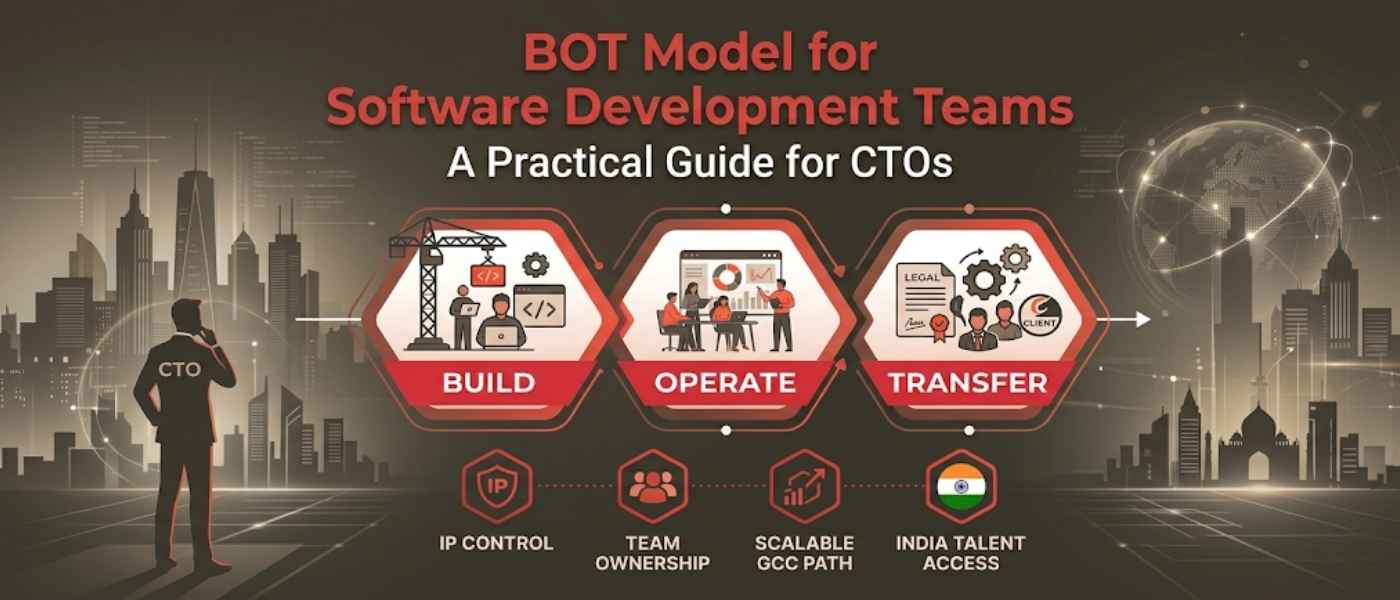

Learn how the BOT Model for Software Development Teams helps...

Staff Augmentation for Startups: Can You Hire 2–3 Developers Without Setting Up an Office?
Most founders who discover staff augmentation assume it’s built for enterprise — a 50-person offshore team, long contracts, dedicated HR departments. The reality is very different. Some of the most efficient use cases we see at iValuePlus involve a US or UK startup that needs two backend engineers and a QA lead, within three weeks, at a third of local cost — with zero intention of ever leasing office space in India.
If that sounds like your situation, this guide is written specifically for you. We’ll cover what staff augmentation actually means for a small startup team, how developers get onboarded, and the questions you should ask any vendor before signing anything.
What "Staff Augmentation" Actually Means
Staff augmentation is a model where you extend your internal team with external professionals who work exclusively for you — but are employed, insured, and managed (from a compliance standpoint) by a third-party vendor.
You control: what they work on, how they work, and what tools they use.
The vendor controls: their employment contract, payroll, statutory compliance, and physical workspace.
This is fundamentally different from outsourcing (where a vendor owns the deliverable and you see only the output) or building an Offshore Development Centre / GCC (where you eventually own the Indian entity and infrastructure). Staff augmentation sits in between — you get the control of direct employment without the legal and administrative overhead of an Indian subsidiary.
Why this matters for startups: Setting up a legal entity in India — a Private Limited company or a branch office — typically takes 4–8 weeks, requires a local director, and comes with ongoing compliance obligations (GST, ROC filings, payroll tax, PF/ESI contributions). For a startup hiring 2 developers, this overhead is completely disproportionate to the need. Staff augmentation bypasses all of it.
Is There a Minimum Headcount for Staff Augmentation?
Technically, no. Practically, most reputable providers will work with teams as small as one person. At iValuePlus, we regularly onboard augmented professionals in batches of 1–3 for early-stage startups before those teams scale into larger ODC or BOT structures.
The economics work at small scale because staff augmentation vendors already carry the fixed overhead (office space, HR systems, compliance infrastructure, equipment procurement). When you hire through them, you’re essentially renting a slice of that infrastructure.
Staff augmentation has no standard minimum headcount. A startup can hire a single developer through a staff augmentation vendor. The model is specifically designed to be flexible — you scale up or down based on project needs without worrying about employee headcount obligations, severance, or long-term overhead. Most vendors offering India-based staff augmentation work with teams from 1 to 200+ people under the same model.
The 7-Step Journey: From "We Need a Developer" to Day 1 Onboarding
- Define the role and tech stack
Write a brief covering experience level, tech stack, timezone overlap requirements, and whether the role is full-time or part-time. The more specific you are (e.g., “Node.js + AWS Lambda, 5+ years, 4-hour overlap with US-Central”), the faster the shortlist.
- Vendor sources and shortlists candidates
A good vendor already has a bench of pre-vetted professionals. iValuePlus, for instance, presents a shortlist within 48–72 hours for standard profiles. Niche roles (e.g., Rust engineers, HIPAA-compliant healthcare tech) may take 5–7 days.
- You interview and select
You interview exactly like a direct hire — technical round, culture fit, communication assessment. You have full veto power. You’re not assigned someone; you choose them.
- Contract signed (with vendor, not the developer)
Your agreement is with the vendor. The contract covers rate, notice period, IP ownership (critical — ensure your contract explicitly assigns all IP to you), replacement terms, and exit clauses.
- Developer provisioned and onboarded
Laptop, internet, software licenses, access credentials — the vendor handles the physical setup. You provision access to your GitHub, Jira, Slack, and other tools. Most teams are productive within 2–3 days of start.
- Integration into your team’s workflow
Augmented developers attend your stand-ups, join your sprint planning, and communicate directly with your internal team. There’s no “project manager layer” between them and your engineering lead.
- Ongoing: you direct, vendor manages compliance
You manage the work. The vendor manages everything else: monthly payroll, performance reviews (jointly), statutory filings, equipment refresh, and HR escalations.
The Honest Trade-offs: What You Gain and What You Give Up
What you gain
- Access to vetted talent in 7–14 days
- No Indian legal entity required
- Scale from 2 to 20 with same model
- 60–80% cost reduction vs. local hiring
- Replacement guarantee on bad fits
- Zero severance / exit risk
- IP stays with you contractually
- Vendor absorbs compliance burden
What you give up
- Less cultural ownership vs direct employee
- Premium rates vs own-entity at 10+ people
- Vendor dependency (manage exit clause)
- Timezone gap requires process discipline
- Communication lag vs. co-located teams
- No physical presence / culture building
The trade-offs above aren’t deal-breakers — they’re just design constraints to plan around. A startup that invests in async communication discipline (written specs, clear tickets, recorded stand-ups) consistently outperforms one that relies on hallway conversations even with a fully co-located team.
Staff Augmentation vs. ODC vs. Freelancer: Which One Is Right for an Early-Stage Startup?
Staff Augmentation is best for startups hiring under 8–10 people, needing to move fast, and not ready to invest in entity setup. Offshore Development Centre (ODC) makes sense at 10–20+ headcount when long-term cost savings justify infrastructure investment. Freelancers work for short, well-defined tasks but carry IP risk, availability uncertainty, and no accountability structure. For a startup’s first offshore hires (2–5 people), staff augmentation is almost always the right starting point.
When freelancers are not enough
Freelancers hired via Upwork or Toptal are useful for a defined 2-week task. But if you want someone inside your sprint, responding in your Slack, owning a feature end-to-end for 12 months — a freelancer model creates friction fast. No SLA. No replacement. No accountability structure. And IP ownership in freelance contracts is routinely poorly drafted, creating risk later.
When an ODC is too much
An Offshore Development Centre means you’re eventually setting up a legal structure, signing office leases, managing Indian HR compliance yourself, and building a local management layer. The economics become favorable at around 15–20 people. For a Series A startup hiring 3 engineers, it’s over-engineering the solution.
The transition path
The most common pattern we see: startup starts with 2–3 people via staff augmentation → team proves its value → startup scales to 8–10 people still via augmentation → at 15–20 people, transitions to an ODC or BOT model with iValuePlus managing the transition. You’re not locked into one model forever. Think of staff augmentation as the entry point.

Five Things to Verify Before Signing with Any Staff Augmentation Vendor
- IP ownership clause. Your contract must explicitly state that all work product, code, and deliverables created by the augmented developer are assigned to your company. Some vendors use vague language here. Insist on specificity.
- Replacement guarantee terms. How quickly will they replace a non-performing developer? At what cost to you? 30-day replacements at no charge is a reasonable baseline. Longer timelines or replacement fees are red flags.
- Notice period for exit. Can you exit the engagement with 30 days’ notice? Or are you locked in for 6–12 months? Early-stage startups need flexibility. Avoid agreements where the exit notice exceeds 60 days.
- Vetting methodology. How are developers screened before being presented to you? What does “vetted” mean — are they testing for communication skills, not just technical ability? Ask for their assessment framework.
- Timezone overlap and communication setup. If your team is in New York (UTC-5) and your developers are in Gurugram (UTC+5:30), that’s a 10.5-hour gap. Most India-based developers working for Western startups shift their hours to deliver a 3–5 hour overlap window. Confirm this is part of the arrangement.
What iValuePlus Does Differently for Startup Clients
Most staff augmentation firms are optimized for large enterprise clients — minimum contract sizes of $50K, 6-month commitments, layers of account management. iValuePlus was designed from the beginning to serve global businesses of all sizes, including early-stage startups that need to move fast and stay lean.
- Onboarding in 7 days for standard tech profiles — not 4–6 weeks.
- No minimum team size. We onboard single hires and scale with you.
- IVPHUB platform gives you real-time visibility into your augmented team — attendance, performance tracking, project alignment — without you needing to build internal management overhead.
- Replacement guarantee built into every engagement as standard.
- Free 40-hour Virtual Assessment — we assess your needs before you commit to any engagement model.
- ISO-certified operations: ISO 27001 (information security), ISO 9001 (quality management), and ISO 20000 (IT service management).
FAQ
Can a startup hire just 2 or 3 developers through staff augmentation?
Yes. Staff augmentation has no minimum headcount. Unlike an ODC or GCC which makes economic sense at 10+ people, staff augmentation works for even a single hire. Most providers, including iValuePlus, can onboard 2–3 vetted developers within 7–14 days with no minimum contract value imposed.
Do I need to register a company in India to hire developers there?
No. When you use a staff augmentation model, the developers are legally employed by the vendor (iValuePlus), not by your company. You don’t need an Indian legal entity, PAN card, GST registration, or any Indian company structure. You pay a single monthly invoice in USD, GBP, AUD, or CAD — your currency of choice.
What is the typical cost of augmenting 2–3 developers from India?
The cost varies based on role, experience level, and tech stack — but the consistent finding across our clients is a 60–80% reduction compared to fully-loaded hiring costs in the US, UK, or Australia. The rate is all-inclusive: salary, benefits, workspace, equipment, and vendor overhead are bundled into a single monthly invoice with no hidden costs.
How do I manage developers I’ve never met in person?
Augmented developers join your Slack, Jira, GitHub, or whatever tools your team already uses. They work inside your sprints, attend your stand-ups, and report directly to your tech lead or CTO. The vendor handles HR, payroll, and compliance in India; you handle day-to-day technical direction. iValuePlus additionally provides IVPHUB, a real-time platform showing attendance, performance, and project alignment.
What happens if a developer isn’t a good fit?
Most staff augmentation agreements include a replacement guarantee (typically 30–60 days). If a developer isn’t meeting expectations, the vendor replaces them at no additional cost. Unlike a direct hire, there’s no severance, no legal risk, and no months-long re-hiring cycle. iValuePlus includes a replacement guarantee as part of its standard engagement terms.
Who owns the code written by an augmented developer?
You do — if your contract is drafted correctly. All IP, code, and work product must be explicitly assigned to your company in the augmentation agreement. This is standard in iValuePlus contracts. Always verify this clause before signing with any vendor, as some use ambiguous language that can create disputes later.
Is staff augmentation or an ODC better for a startup?
For a startup hiring under 8–10 people, staff augmentation is almost always the better starting point. It’s faster to initiate, requires lower upfront commitment, and doesn’t demand the infrastructure investment an ODC requires. As your offshore team grows past 10–15 people, evaluating a transition to an ODC or BOT model becomes financially worthwhile. The two models aren’t mutually exclusive — many companies start with augmentation and graduate into an ODC.
How do time zones work with an India-based augmented team?
India Standard Time (IST) is UTC+5:30. For US East Coast teams, this means a 10.5-hour gap — which sounds daunting but works well in practice. Most Indian developers working for Western startups shift their hours to a 12:30 PM – 9:30 PM IST window, giving a 3–5 hour overlap with US business hours. For UK teams, the gap is just 4.5 hours, making synchronous collaboration very manageable.
Ready to Hire Your First 2–3 Developers?
Tell us your tech stack, experience level, and timeline. We’ll shortlist vetted candidates within 48–72 hours — no obligation, no upfront cost. Get in touch with us today
Recent Post
Offshore Development Team for Startups: Benefits, Risks & Costs
Should your startup hire an offshore development team? Explore real...
Staff Augmentation for Startups: Can You Hire 2–3 Developers Without Setting Up an Office?
Hire 2–3 offshore developers from India without setting up an...

iValuePlus Services
iValuePlus is a one-stop solution to address all your needs to access, build and grow your business in the Indian market which is cost-effective & has a huge talent pool. Established in 2019 as a ‘Business Solution provider', our team has delivered successful growth projects in the international market.
Our services include setting up ODC (offshore development center), Staff Augmentation, Talent Acquisition, Digital Marketing, in the IT/ITES domain.