
Discover the best city to set up office in India...
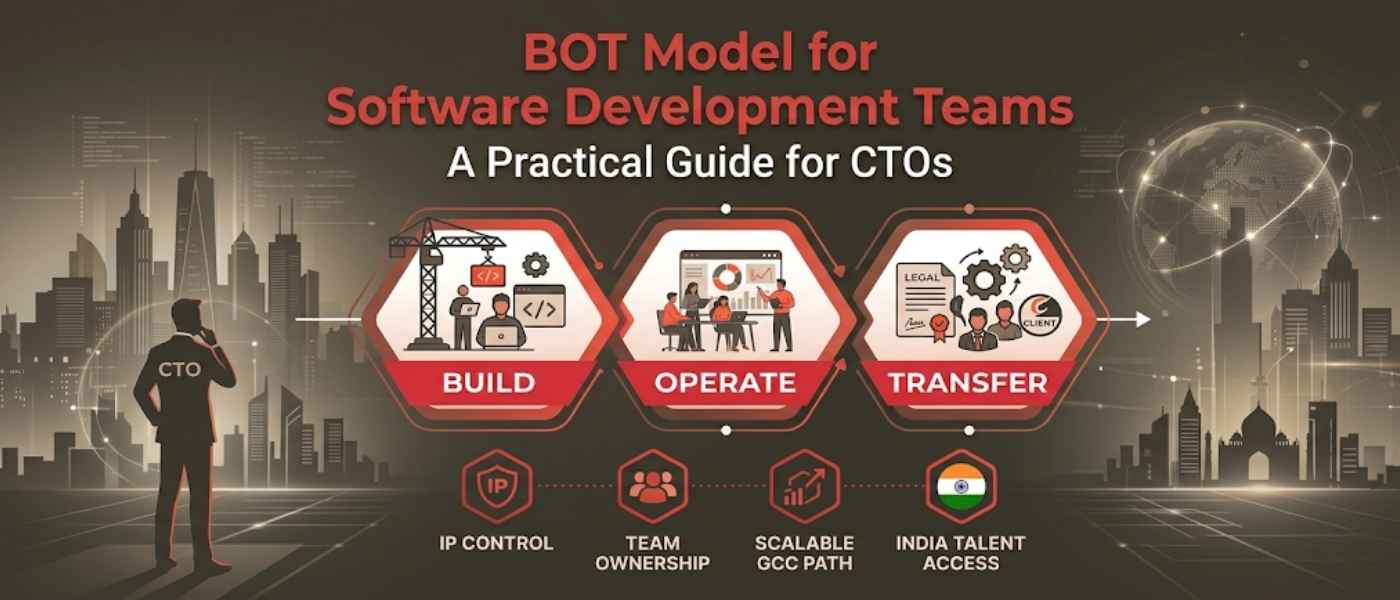
BOT Model for Software Development Teams: A Practical Guide for CTOs
The BOT model for software development teams is a three-phase engagement strategy, Build, Operate, Transfer, that enables CTOs and engineering leaders to establish a fully functional offshore software team in India without upfront legal entity formation, then progressively take complete ownership. It combines the speed of outsourcing with the long-term control of a captive center, making it the preferred model for scalable offshore engineering center setup.
Key Takeaways
- The BOT model lets you build and own an offshore software team in India without setting up a legal entity first.
- Typical BOT engagements run 18–24 months before full operational and legal transfer to the client company.
- BOT outperforms traditional outsourcing on IP control, team retention, and long-term cost efficiency.
- It is the most pragmatic path to a Global Capability Center (GCC) for companies with 10–200 engineers in scope.
- Compliance, hiring, payroll, and infrastructure are vendor-managed during the Build and Operate phases.
- Choosing the right BOT partner in India is the single most critical success factor.
- BOT is equally effective for product engineering, DevOps, QA, cloud, and full-stack software teams.
Why CTOs Are Rethinking Offshore Software Development
Offshore software development has been the default cost-play for engineering leaders for over two decades. But in 2025, the conversation has evolved beyond cost. CTOs at product companies, SaaS businesses, and global enterprises are asking harder questions: Who owns the team? Who holds the IP? What happens when the vendor relationship ends?
Traditional outsourcing models often leave engineering leaders with a fundamental tension: they get delivery speed, but they lose team ownership, institutional knowledge, and operational control. On the other side, setting up a fully independent captive center in India – a Global Capability Center (GCC), requires 12–18 months, significant capital, legal entity formation, and deep operational expertise in Indian employment law and compliance.
The BOT model for software development teams resolves this tension elegantly. It offers a structured path to offshore team ownership, starting with a managed, vendor-operated delivery center and ending with a fully owned, India-based engineering arm that reports entirely to you.
This guide is written specifically for CTOs, VP Engineering, and engineering leaders who are evaluating offshore expansion, GCC setup, or a scalable delivery center in India and want to understand how the build operate transfer model works in practice – not in theory.
What Is the BOT Model for Software Development Teams?
The Build-Operate-Transfer model is a managed offshore engagement framework in which a specialized BOT services provider builds a dedicated software development team on behalf of the client, operates it under agreed SLAs and governance structures, and then transfers full ownership of the team, its people, processes, infrastructure, and intellectual property to the client organization after a predefined period.
The Three Phases Explained
Phase | Key Activities | Typical Duration |
BUILD | Requirements scoping, talent acquisition, onboarding, tool/infra setup, process definition, initial sprint delivery | Months 1–3 |
OPERATE | SLA governance, team ramp-up, KPI tracking, culture integration, IP development, compliance management, DevOps/CI-CD maturation | Months 4–18 |
TRANSFER | Legal entity setup, employment transfer, payroll migration, knowledge handover, operational independence, BOT partner exit | Months 19–24 |
How the BOT Model Differs From What Most CTOs Expect
Most engineering leaders initially assume the BOT model is just a sophisticated form of outsourcing. It is not. In traditional outsourcing, you are paying for output deliverables, sprints, and code shipped. In the BOT model, you are investing in team formation. The vendor is building an asset that will belong to you.
That distinction changes everything: how you select engineers, how you define culture, what tools and processes you standardize, and how you manage knowledge. The BOT model is infrastructure-building for your engineering organization, not project delivery.
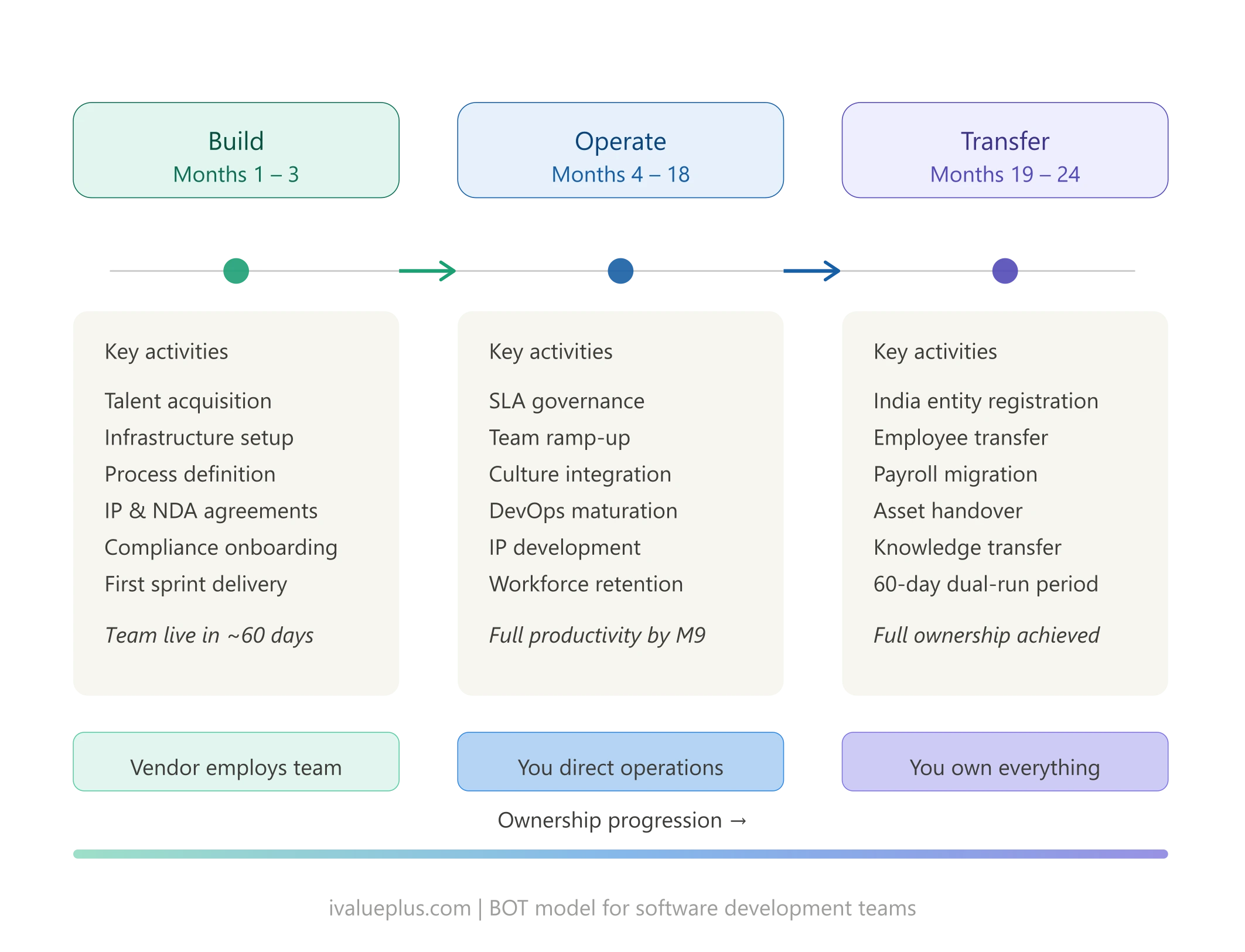
How the BOT Model Works for Software Companies: A Phase-by-Phase Breakdown
Phase 1: BUILD (Months 1–3)
The Build phase is where the BOT partner earns its fee. This is the execution-heavy, operationally complex period that most companies underestimate when attempting to set up an offshore development center independently.
During this phase, the BOT partner executes the following on your behalf:
- Talent acquisition: sourcing, screening, and onboarding engineers through specialized models to hire dedicated software engineers in India aligned to your technology stack and engineering culture.
- Infrastructure setup: provisioning cloud environments, development tooling, CI/CD pipelines, security protocols, and communication infrastructure
- Process definition: implementing your engineering rituals – sprint planning, standup cadence, PR review workflows, incident management
- Compliance setup: employment contracts, IP assignment agreements, NDAs, payroll registration, and local regulatory compliance
- Manager-in-place: an on-ground delivery manager or engineering lead who interfaces with your team daily
At the end of the Build phase, you should have a functional, productive engineering team shipping code – not a team still learning how to work together.
Phase 2: OPERATE (Months 4–18)
The Operate phase is where the BOT model proves its value over traditional outsourcing. This is where the team matures from a staffed unit to a high-performance engineering squad with your culture, your processes, and your domain knowledge baked in.
The BOT partner remains legally responsible for employment, payroll, and compliance. But operationally, your engineering leadership increasingly owns the team’s direction. Key activities during this phase:
- SLA governance and performance KPI tracking (velocity, quality, deployment frequency, MTTR)
- Team ramp-up and capability expansion – adding engineers as scope grows
- Culture integration – embedding your engineering values, code standards, and decision-making frameworks
- IP development – all code, systems, and documentation created belong contractually to you from day one
- Cybersecurity compliance – SOC 2 readiness, GDPR data handling, ISO 27001 adherence if required
- Workforce retention – identifying and mitigating attrition risk through compensation benchmarking and career progression frameworks
The Operate phase is also when your CTO or VP Engineering should be investing time in the India team – joining quarterly planning sessions, conducting skip-level conversations, and building direct relationships with senior engineers. The more engaged you are, the smoother the transfer.
Phase 3: TRANSFER (Months 19–24)
The Transfer phase is the culmination of the BOT model – and the most legally complex. This is where your offshore software team transitions from the BOT partner’s legal and operational umbrella into a fully owned, India-registered entity that you control.
A well-structured transfer includes:
- Legal entity formation: Registering a Private Limited Company or wholly owned subsidiary under Indian company law
- Employee transfer: Migrating engineers from the BOT partner’s payroll to your India entity, with SEBI/MCA-compliant employment agreements
- Payroll migration: Transitioning statutory contributions (PF, ESIC, professional tax, TDS) to your entity’s accounts
- Asset transfer: Handing over servers, software licenses, domain registrations, and infrastructure access
- Knowledge handover: Documenting systems, architecture, runbooks, vendor contracts, and operational procedures
- Dual-run period: Running operations under both the BOT partner and the new entity in parallel for 60–90 days to eliminate handover risk
A high-quality BOT partner will have executed this process multiple times and will have playbooks, templates, and legal counsel in place. This is a key vetting question to ask any prospective partner.
BOT Model vs. Outsourcing vs. Captive Center
Factor | BOT Model | Traditional Outsourcing | Captive Center (DIY) |
IP Ownership | Full ownership on transfer | Shared or vendor-held | Full ownership always |
Setup Time | 3–6 months | 2–4 weeks | 9–18 months |
Upfront Cost | Low to medium | Low | Very high |
Operational Risk | Low (vendor-managed) | Medium–High | High (self-managed) |
Team Control | High after transfer | Low | Full always |
Legal Entity Needed | No (initially) | No | Yes (from day 1) |
Talent Hiring | Handled by BOT partner | Vendor team | Self-managed |
Compliance Mgmt | Vendor handles | Vendor handles | Self-managed |
Exit Flexibility | High | Medium | Low |
Best For | CTOs scaling offshore with future ownership | Short-term projects | Large enterprises with 100+ HC |
Why CTOs Choose the BOT Model for Offshore Software Development in India
India’s Tech Talent Pool: The Structural Advantage
India produces over 1.5 million engineering graduates annually. The country is home to the world’s largest pool of English-speaking software engineers with deep expertise in cloud architecture, full-stack development, data engineering, DevOps, and AI/ML. Major cities – Bengaluru, Hyderabad, Pune, Chennai, Delhi-NCR – have mature software ecosystems with an embedded startup-to-enterprise hiring continuum.
For CTOs evaluating offshore software development, India is not a cost play. It is a talent strategy. The cost differential (60–75% versus US/EU equivalent roles) is a byproduct of talent density, not talent scarcity.
Why the BOT Model Is Specifically Suited for India
India’s employment environment, while rich in talent, has specific legal, regulatory, and operational complexities that make the BOT model particularly valuable:
- Employment law in India requires registration under multiple statutes – Provident Fund, ESIC, Professional Tax, Shops and Establishments Act – all of which require in-country expertise
- Statutory compliance in India is ongoing, with quarterly and annual filings, making a vendor-managed period essential for companies without India operations
- Talent acquisition in competitive engineering hubs requires active employer branding, referral networks, and campus relationships – all of which a seasoned BOT partner already has
- Cultural alignment between a global CTO and an India-based team requires deliberate onboarding, not just a Slack channel and a Zoom link
The BOT model handles all of these complexities during the Build and Operate phases, allowing CTOs to focus on engineering outcomes while the partner manages operational infrastructure.
BOT Model for Software Development Teams: The GCC Connection
The Global Capability Center (GCC) model has experienced extraordinary growth in India. As of 2025, over 1,700 GCCs operate in India, according to the NASSCOM GCC India Report, employing more than 1.9 million knowledge workers. Software engineering is the dominant function across these centers.
The BOT model is, structurally, the most pragmatic entry path into the GCC ecosystem for companies that:
- Have not previously operated in India
- Do not want to commit capital to a legal entity before validating the talent model
- Need to move faster than the 12–18 months typically required for an independent GCC setup
- Lack HR, legal, and compliance infrastructure to support Indian employment from day one
Effectively, a well-executed BOT engagement is a GCC setup – one that defers complexity, reduces capital exposure, and transfers a fully operational center to the client rather than asking the client to build one from scratch.
BOT as a GCC Validation Strategy
For CTOs at SaaS companies or product organizations exploring India for the first time, the BOT model also serves as a GCC proof-of-concept. By operating a BOT engagement for 12–18 months before committing to a legal entity, engineering leaders can validate:
- Whether India-based engineers can effectively own product domains and not just execute tickets
- Which engineering functions (cloud, QA, data, frontend) perform best in an offshore structure
- What management overhead the CTO organization needs to invest to make the team truly autonomous
- Whether the talent density in a specific city (e.g., Hyderabad vs. Pune) suits your engineering profile
Compliance, Legal, and Operational Considerations for CTOs
IP Ownership and Protection in the BOT Model
Intellectual property protection is the most frequently raised concern by CTOs when evaluating offshore engagement models. In the BOT model, IP ownership is a contractual construct established from the very first day of the Build phase.
A well-drafted BOT agreement should include:
- Work-for-hire clauses confirming all code, documentation, and inventions created by the team are client property
- Individual IP assignment agreements signed by each engineer at onboarding
- Restricted access controls preventing unauthorized data egress
- Regular IP audit rights for the client company
- Non-compete and non-solicitation provisions for senior engineers post-transfer
Companies operating under GDPR, HIPAA, or SOC 2 frameworks should require their BOT partner to maintain corresponding compliance postures throughout the engagement.
Compliance Framework for India-Based BOT Engagements
- Employment Law: BOT partner operates as the legal employer under Indian labour law until transfer
- Payroll & Statutory: PF (Provident Fund), ESIC, TDS, Professional Tax — managed by BOT partner
- Data Privacy: GDPR-aligned data handling agreements, India’s DPDP Act (Digital Personal Data Protection Act) compliance
- Information Security: ISO 27001 or SOC 2 Type II certified infrastructure, regular vulnerability assessments
- Tax Structure: Transfer pricing documentation required if India entity bills to US/EU parent post-transfer
India-Specific Hiring and Legal Insights
India’s talent market is candidate-driven at the senior engineer level. Companies entering the market without brand recognition need their BOT partner’s employer brand as a proxy until the captive entity is established. Key operational insights:
- Notice periods in India run 30–90 days for senior engineers; plan hiring timelines accordingly
- Background verification (BGV) in India typically takes 2–3 weeks and should be built into the onboarding timeline
- Variable pay structures, ESOPs, and performance bonuses are critical retention tools for senior engineers
- Bengaluru and Hyderabad have the highest talent density for cloud, product, and AI/ML engineering; Pune and Chennai are strong for QA and enterprise software
- Engineering managers in India respond well to autonomy, ownership, and direct CTO engagement – not just task execution
Risk Mitigation Framework for BOT-Based Software Team Setup
Every offshore engagement carries risk. The BOT model is designed to reduce – not eliminate – those risks. Here is a structured risk mitigation framework for engineering leaders considering a BOT engagement:
Risk | Likelihood | Mitigation Strategy |
Talent attrition during operate phase | Medium | Retention bonuses, culture alignment, fast career pathing, direct engagement from CTO |
IP leakage before transfer | Low–Medium | NDA/IP assignments from day 1, SOC 2 compliance, restricted data access controls |
BOT partner lock-in | Medium | Contractual transfer rights, milestone-based exit clauses, independent audit rights |
Poor knowledge transfer | Medium | Documentation sprints, shadowing periods, dual-running operations for 60–90 days |
Legal/compliance gaps in India | Low | Use a BOT partner with Employer of Record (EOR) capability and India employment law expertise |
Delayed entity setup | Low–Medium | Begin legal entity setup in month 12, not month 18; use pre-incorporated shell if needed |
How to Choose a BOT Partner for Engineering Team Setup in India
Selecting the right BOT partner is the most consequential decision in a BOT engagement. A competent partner accelerates your path to a world-class India engineering team. An incompetent one will cost you 18 months and a team you cannot rely on.
Criteria | What to Look For | Red Flags |
Domain Experience | 10+ years in BOT/ODC/GCC setups in India | Only project outsourcing history |
Hiring Infrastructure | Existing talent networks, recruiter bench, ATS tools | Starts recruiting only after you sign |
Legal Capability | EOR, entity setup, payroll, employment law expertise | Outsources legal to unknown third parties |
Compliance Posture | ISO 27001, SOC 2, GDPR-ready processes | No documented compliance frameworks |
Transfer Track Record | Can name clients they have transferred to full ownership | Vague or evasive about past transfers |
Cultural Alignment | Operates as extension of your team, not a vendor | Treats you as just another account |
Questions to Ask a Prospective BOT Partner
- How many BOT-to-captive transfers have you completed, and can you provide client references?
- What is your average time-to-hire for senior engineers in our target technology stack?
- How do you handle employment transfer compliance under Indian company law?
- What is your attrition rate across all managed teams in the past 24 months?
- Do you have ISO 27001 or SOC 2 certifications? Can we audit your infrastructure?
- What does your dual-run period look like, and how do you ensure operational continuity during transfer?
- How do you align the India team’s culture with the client’s remote-first engineering culture?
Is the BOT Model Right for Your Organization?
You are a Good BOT/GCC Candidate If… | BOT May Not Be Right If… |
You need 10–200 engineers in India within 12–24 months | You need 1–3 developers for a short project |
You want full ownership eventually but lack India presence | You have no intent to own the team long-term |
IP protection and data governance are critical | Cost alone is the only driver |
You want to build domain-specific product/DevOps teams | You want generic body-shopping |
You have 18–24 months horizon for full captive transition | You need results in under 3 months |
When BOT Supports Product Engineering and DevOps Teams
A common misconception is that the BOT model only works for large-scale service delivery. In practice, the model is highly effective for:
- Product engineering teams owning specific microservices, APIs, or platform modules
- DevOps and platform engineering teams managing CI/CD, infrastructure-as-code, and cloud cost optimization
- QA engineering centers running automated test suites, performance testing, and regression pipelines
- Data engineering teams owning pipelines, warehouses, and ML feature stores
- Full-stack squads working directly in your product roadmap
The BOT model works for any engineering function that can be clearly scoped, performance-managed via SLAs, and given a defined transfer path. If the function is too ambiguous or too project-like, a different engagement model may be more appropriate.
Operational Best Practices: What Successful BOT Engagements Look Like
What Effective CTO Engagement Looks Like During a BOT Engagement
- Bi-weekly video calls with the India engineering lead — not just status reports, but architectural discussions
- Quarterly visits to the India delivery center during the Operate phase
- Including India engineers in global all-hands, roadmap planning, and architecture reviews
- Using shared Jira boards, Confluence spaces, and Slack channels — not separate tooling for the offshore team
- Providing performance feedback directly to engineers, not only through the BOT partner account manager
Governance Structure During the Operate Phase
- Weekly: Sprint reviews, SLA check-ins, blockers, and delivery metrics
- Monthly: BOT steering committee — client CTO, BOT delivery head, HR, finance review
- Quarterly: OKR alignment, team satisfaction survey review, compensation benchmarking, and transfer readiness assessment
- Annually: Strategic review — team expansion plan, captive entity timeline, BOT contract renewal or transfer trigger
FAQ
Q1. What is the BOT model for software development teams?
The BOT (Build-Operate-Transfer) model for software development teams is an offshore engagement framework in which a specialized partner builds a dedicated engineering team, manages its operations under defined SLAs, and then transfers complete legal, operational, and financial ownership of the team to the client company — typically within 18–24 months.
Q2. How does the build operate transfer model work for software companies?
In the Build phase (months 1–3), the BOT partner recruits engineers, sets up infrastructure, and establishes processes. During the Operate phase (months 4–18), the team delivers under the client’s direction while the partner manages compliance and HR. In the Transfer phase (months 19–24), the client registers an India entity and all team members, tools, and IP transfer to the new company.
Q3. Is the BOT model better than outsourcing for software development?
For companies with a 2-year+ horizon and a goal of owning their offshore team, yes. Traditional outsourcing delivers project output but does not build client-owned assets. The BOT model builds a team you will own, with IP, processes, and institutional knowledge embedded in your organization — not the vendor’s.
Q4. Can I hire developers in India without opening an entity first using BOT?
Yes. This is one of the primary advantages of the BOT model. The BOT partner acts as the legal employer during the Build and Operate phases, handling all Indian employment law obligations. You engage with the team operationally without being the legal employer until you are ready to transfer.
Q5. How long does it take to build and transfer a software team in India?
A typical BOT engagement runs 18–24 months from initial scoping to full transfer. The Build phase takes 2–3 months, the Operate phase runs 12–18 months, and the Transfer phase requires 3–6 months for legal entity setup, employment migration, and handover.
Q6. What are the risks of the BOT model in software development?
Key risks include: talent attrition during the operate phase, over-dependency on the BOT partner, inadequate knowledge transfer, and delays in legal entity setup. These risks are mitigated through contractual safeguards, retention programs, documentation requirements, and early initiation of the transfer process — ideally starting entity setup in month 12, not month 18.
Q7. How does ownership transfer work in the BOT model?
Ownership transfer involves registering an India legal entity (Private Limited or wholly owned subsidiary), obtaining regulatory approvals, migrating each engineer’s employment agreement to the new entity, transferring payroll and statutory accounts, and completing an asset handover of tools, infrastructure, IP repositories, and documentation.
Q8. What is the difference between BOT and staff augmentation?
Staff augmentation adds temporary contractors to your existing team. The BOT model builds a permanent offshore team that will be yours after transfer. In augmentation, the engineers belong to the vendor indefinitely. In the BOT model, the engineers become your employees at transfer — with your culture, your codebase, and your IP fully retained.
Q9. How does the BOT model support GCC setup for software teams?
The BOT model is the most efficient entry path to a GCC in India. It allows companies to build and validate a full delivery center under vendor management before committing to the fixed costs and legal complexity of an independent captive. After transfer, the BOT engagement effectively becomes a fully operational GCC owned and operated by the client.
Q10. What is the cost of the BOT model for software development teams?
Senior Indian software engineers cost USD 20,000–35,000 annually, versus USD 120,000–180,000 for equivalent US/EU roles. BOT management fees typically add 10–20% on top of team costs. Even with the fee, total offshore costs run 60–75% below Western market rates. The management fee eliminates upon transfer, reducing ongoing costs further.
Q11. Why do global companies use the BOT model for software development in India?
Global companies choose BOT for India because it combines operational speed (team live in 60–90 days) with long-term ownership (full captive control after transfer), eliminates the need for immediate India legal entity formation, and offloads HR, compliance, payroll, and talent acquisition to a specialized partner — while retaining IP ownership from day one.
Q12. Can the BOT model work for product engineering and DevOps teams?
Yes. The BOT model is highly effective for product engineering squads, DevOps and platform engineering teams, QA automation centers, data engineering, and cloud infrastructure teams. It works for any function where clear domain ownership, SLA-based performance management, and a long-term headcount commitment are feasible.
Conclusion
The BOT model for software development teams resolves the central tension in offshore engineering strategy: how to move fast without sacrificing ownership. It gives CTOs the speed of outsourcing, the IP protection of a captive, and the operational simplicity of a managed service – all on a predefined path to complete team ownership.
For engineering leaders at SaaS companies, product organizations, or global enterprises evaluating India as an engineering hub, the BOT model is not a compromise. It is the most strategically sound approach to building a scalable, compliant, and deeply integrated offshore software team — one that will operate as an extension of your engineering culture, not as an external vendor.
The critical success variables are selecting the right BOT partner in India, maintaining direct CTO engagement with the team throughout the Operate phase, and beginning legal entity preparation well before the Transfer phase kicks off.
Executed well, a BOT engagement delivers a world-class India engineering team that is indistinguishable – in culture, output, and ownership – from your headquarters team. That is the promise of the build operate transfer model for software development. And increasingly, it is the reality for companies that get the execution right.
Ready to Build Your Offshore Software Team in India?
iValuePlus helps CTOs and engineering leaders set up BOT-based offshore development centers and global capability centers in India-— from talent acquisition and compliance management through to full operational transfer. Get in touch with us today!
Recent Post
How to Set Up an Offshore QA Center of Excellence in India: A Practical Guide for Global Teams
Learn how to set up an offshore QA center of...
Managed IT Services for Small Businesses: Complete Guide (2026)
Discover what managed IT services for small businesses actually include,...

iValuePlus Services
iValuePlus is a one-stop solution to address all your needs to access, build and grow your business in the Indian market which is cost-effective & has a huge talent pool. Established in 2019 as a ‘Business Solution provider', our team has delivered successful growth projects in the international market.
Our services include setting up ODC (offshore development center), Staff Augmentation, Talent Acquisition, Digital Marketing, in the IT/ITES domain.