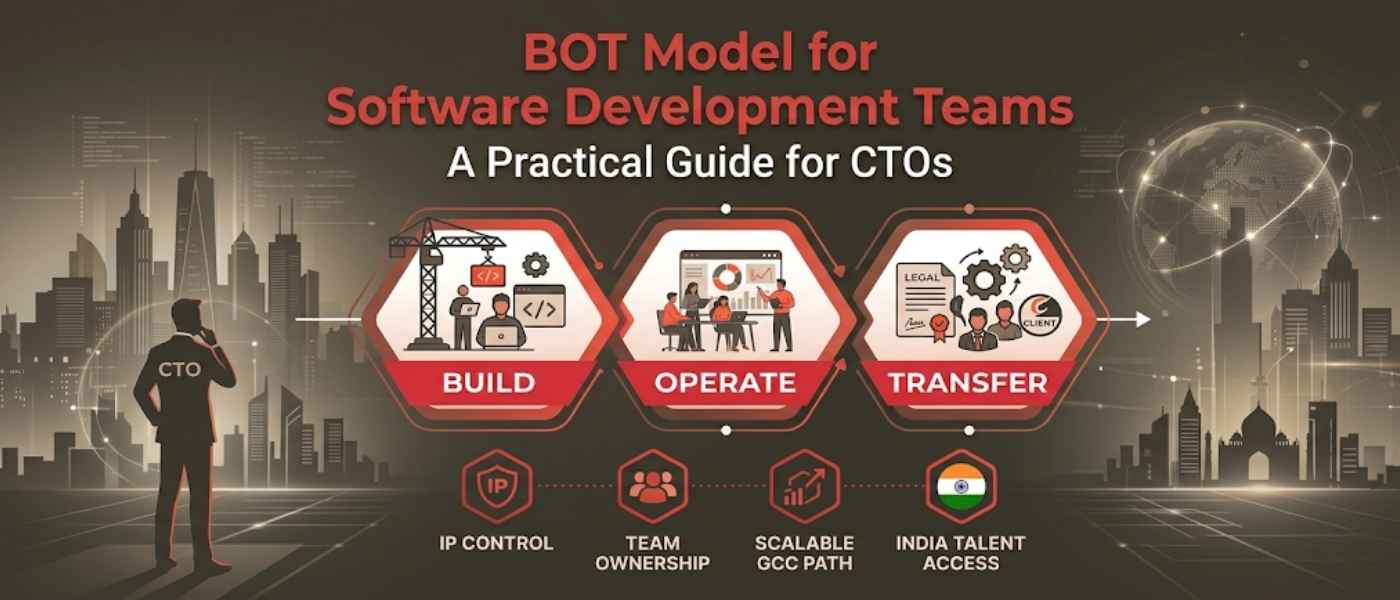

Learn how the BOT Model for Software Development Teams helps...

Offshore Development Team for Startups: Benefits, Risks, and Costs
An offshore development team is a dedicated group of software engineers, designers, and tech specialists based in another country, hired to build or scale your product. For startups, it offers significantly lower development costs, faster team assembly, and access to a global talent pool — but requires strong communication systems, clear contracts, and realistic expectations around time zones and cultural alignment.
Every startup founder considering offshore development has the same underlying question: Is this going to work, or am I going to lose six months and a significant budget on a product that doesn’t reflect what I asked for?
It’s a fair concern. Offshore development horror stories are real — missed deadlines, communication breakdowns, products that don’t match the spec, teams that vanish mid-project. But so are the success stories: startups that built production-ready MVPs in under four months, scaled engineering teams from 2 to 20 without the overhead of local hiring, and shipped global products from day one without a single in-house developer.
The difference between those two outcomes isn’t geography. It’s preparation, structure, and choosing the right model for your stage.
This guide gives you the honest, complete picture — what offshore development actually costs, where the risks live, what the benefits are for early-stage startups specifically, and how to make an informed decision before you sign anything.
What Is an Offshore Development Team?
An offshore development team is a group of software professionals — engineers, QA specialists, UI/UX designers, DevOps engineers, product managers — employed or contracted through a company or staffing model in another country, working exclusively or primarily on your product.
The key distinction from freelancing: an offshore team operates as a coordinated unit, not a collection of independent contractors. There’s project management structure, defined deliverables, and a relationship built around your product — not just individual tasks.
How It Differs from Nearshore and Onshore Models
- Onshore development: Team is in the same country. Highest cost, easiest collaboration.
- Nearshore development: Team is in an adjacent or same-timezone country (e.g., a US startup using a team in Mexico or Eastern Europe). Moderate cost, minimal time zone friction.
- Offshore development: Team is in a distant geography — commonly India, Eastern Europe, Southeast Asia, or Latin America. Highest potential cost savings, requires more deliberate communication infrastructure.
Common Offshore Engagement Models for Startups
Dedicated Team Model: A full-time team works exclusively on your product. Best for long-term builds, complex products, and startups that need consistent velocity.
Project-Based Model: A fixed scope of work is contracted at a fixed price. Best for well-defined MVPs or specific feature builds where requirements won’t change.
Staff Augmentation: Individual developers or specialists are added to your existing team. Best for filling specific skill gaps rather than building an entire product.
For most startups building a core product, the dedicated team model delivers the best outcomes.
Why Startups Consider Offshore Development Teams
The conversation usually starts with cost. But the founders who get the most value from offshore development are thinking about three things simultaneously: cost, speed, and talent access.
Access to a Global Talent Pool
The technical talent shortage in the US, UK, and Australia is well-documented. Senior full-stack engineers, machine learning specialists, and experienced mobile developers are both scarce and expensive in these markets. Offshore development opens access to highly qualified engineering talent in markets where the same skill level is available at a significantly lower compensation point — not because the talent is inferior, but because cost of living, currency exchange, and market dynamics differ.
Faster Team Assembly
Hiring a senior developer in-house can take three to five months from job posting to productive output. Assembling an equivalent offshore team through an established provider typically takes two to four weeks. For startups where speed-to-market is a competitive variable, this difference matters.
Cost Structure Advantages
Offshore development allows startups to convert large, fixed people-costs into more flexible, project-aligned expenditure. You’re not paying for office space, equipment, employer NIC contributions, or equity dilution to attract local technical talent. The financial model is more predictable and more aligned to delivery milestones.
We’ll cover cost structures in detail in a dedicated section below — without quoting figures that change by month and market.
Scalability Without Structural Overhead
Scaling an in-house engineering team requires recruiter time, onboarding cycles, equity allocation, and sometimes office space. Scaling an offshore team means a conversation with your provider and a contract amendment. For startups moving fast, this operational flexibility is often as valuable as the cost saving.
Benefits of an Offshore Development Team for Early-Stage Startups
- Significant cost reduction — access senior engineering talent at a fraction of local market rates
- Faster team assembly — operational in weeks, not months
- Global talent access — hire for skill and fit, not geography
- Scalability on demand — scale up or down without restructuring your org
- 24-hour development cycles — time zone differences can accelerate delivery when managed well
- Reduced hiring risk — no long-term employment commitments in early uncertainty
- Focus on core business — founders spend time on product vision and growth, not HR and tech recruitment
The Real Costs of an Offshore Development Team
What Drives the Cost of an Offshore Development Team?
Geography: Development rates differ substantially between India, Eastern Europe (Poland, Ukraine, Romania), Southeast Asia (Vietnam, Philippines), and Latin America (Brazil, Argentina, Colombia). Each market has different rate bands, talent depth, and risk profiles.
Seniority mix: A team of senior engineers costs more than a team of mid-level developers — but often delivers faster and with less rework. Optimizing purely for the lowest rate often increases total project cost through delays and quality issues.
Tech stack: Specialized skills (React Native, blockchain, AI/ML, DevOps) command a premium in any geography. The more niche your stack, the less the offshore rate advantage compresses relative to the onshore market.
Engagement model: Dedicated teams have a different cost structure than project-based contracts. Dedicated teams are typically better value for six-plus month engagements; project-based models can be more economical for shorter, well-defined scopes.
Provider type: Direct hire vs. through an offshore development company vs. through a managed services provider all carry different cost structures, risk profiles, and overhead levels.
Hidden Costs Startups Don’t Factor In
The sticker rate is rarely the full cost. Factor in:
- Onboarding time — even experienced offshore teams need two to four weeks to understand your codebase, architecture, and product context
- Communication tooling — project management software, video conferencing, async documentation tools
- Management overhead — someone on your side needs to own the relationship, review work, and maintain alignment
- Rework budget — misunderstood requirements produce work that needs to be redone; clear specs reduce this, but don’t eliminate it
- IP protection — proper contracts, NDAs, and IP assignment clauses have legal costs
- Time zone management — overlap windows require schedule adjustments that affect productivity
How to Evaluate Whether a Quote Is Reasonable
Ask for a breakdown by role and seniority. Compare team composition to what you’re being charged. Understand whether the quote includes project management or whether that’s extra. Ask what happens when a team member leaves — replacement timelines and cost implications should be specified in the contract.
Benefits of Offshore Development for Startups — In Depth
Build Your MVP Without Burning Through Runway
For pre-revenue startups, capital preservation is existential. Offshore development allows you to build a production-quality MVP at a fraction of the cost of a local engineering team, preserving runway for go-to-market, iteration, and the next funding milestone.
The key is having a clearly defined MVP scope before you engage an offshore team. Scope creep in an offshore context is expensive and hard to reverse.
Continuous Development Cycles
When your offshore team is in a significantly different time zone, work happens while you sleep — if you set it up correctly. This requires strong async communication, documented daily handoffs, and clear acceptance criteria for every task. When it works, it effectively doubles your development capacity without doubling your headcount.
Specialized Skills, On Demand
Need a machine learning engineer for a three-month feature build? A senior DevOps specialist to set up your infrastructure? These roles are expensive and difficult to hire full-time in most markets. Offshore teams allow you to access specialized skills for the duration you actually need them.
Lower Risk at Early Stage
Before product-market fit, your technical requirements will change — sometimes dramatically. Offshore engagement models (particularly dedicated teams with rolling contracts) give you the flexibility to pivot technical direction without the legal and financial complexity of redundancy processes for permanent hires.
Risks of Offshore Development Teams — And How to Manage Them
Risk 1: Communication Breakdown
What actually goes wrong: Requirements get lost in translation. Developers build what they understood, not what you meant. By the time the disconnect surfaces, weeks of development time are wasted.
How to prevent it: Write specifications, not conversations. Every feature should have a written spec with acceptance criteria before development starts. Use tools like Notion, Linear, or Jira consistently. Schedule structured check-ins at least twice a week — not to micromanage, but to surface blockers early.
Risk 2: Quality Below Expectations
What actually goes wrong: Code is functional but not maintainable. No tests. No documentation. Technical debt that costs more to fix than it would have cost to build correctly.
How to prevent it: Define quality standards explicitly in your contract. Require code reviews, test coverage minimums, and documentation as part of your definition of done — not as optional extras. Conduct periodic code audits, especially in the first three months.
Risk 3: IP and Data Security Exposure
What actually goes wrong: Source code, customer data, or proprietary business logic sits with a third party in a jurisdiction with different IP protection frameworks.
How to prevent it: Work with a lawyer to draft a robust NDA and IP assignment agreement before any work begins. Ensure contracts specify that all work product belongs to you, not the development company. Understand the data protection laws in the team’s jurisdiction.
Risk 4: Dependency on a Single Provider
What actually goes wrong: Your entire product knowledge lives with the offshore team. If the relationship deteriorates or the provider shuts down, you have no continuity.
How to prevent it: Maintain internal documentation of architecture, decisions, and codebase. Ensure you always have full access to your repositories, cloud environments, and credentials — never let a provider hold these.
Risk 5: Cultural and Working Style Misalignment
What actually goes wrong: Different expectations around hierarchy, feedback, deadlines, and proactivity create friction that erodes both productivity and relationship quality.
How to prevent it: Choose a provider whose team has experience working with startups from your region. Ask specifically about their communication style and how they handle pushback, changing requirements, and missed deadlines. References from similar startup clients are invaluable here.
Risk 6: The “Cheapest Option” Trap
What actually goes wrong: A startup optimizes for the lowest hourly rate, gets a junior team with minimal product experience, and ends up rebuilding the product after six months of poor output.
How to prevent it: Evaluate cost per outcome, not cost per hour. A team that costs more per hour but delivers faster, with better quality, and requires less management is almost always cheaper in total.
Offshore Development Team vs. In-House Team: The Startup Comparison
| Factor | Offshore Team | In-House Team |
|---|---|---|
| Time to Operational | 2–4 weeks | 3–6 months |
| Cost Structure | Variable, scope-aligned | Fixed, regardless of output |
| Talent Access | Global, specialized | Local market only |
| Cultural Alignment | Requires active management | Natural |
| IP Control | Contractual (needs care) | Full, immediate |
| Scalability | High — adjust scope on demand | Low — hiring cycles |
| Code Ownership Risk | Moderate (manageable) | None |
| Best Suited For | MVP, rapid scaling, specialist builds | Core team post-PMF, culture-critical roles |
For most startups at the seed stage, offshore wins on economics and speed. For startups post-Series A with product-market fit and a need to build strong engineering culture, a hybrid model — offshore for execution, in-house for leadership and architecture — tends to deliver the best outcomes.

How to Hire an Offshore Development Team for Your Startup
Step 1: Define Before You Search
Document your product requirements, tech stack preferences, team size estimate, and engagement timeline before approaching any provider. Offshore teams that receive vague briefs produce vague outputs.
Step 2: Choose the Right Engagement Model
Match the model to your situation. Dedicated team for products with evolving requirements. Fixed-price project for clearly scoped MVP builds. Staff augmentation for filling specific gaps in an existing team.
Step 3: Evaluate Providers on Startup-Specific Criteria
Ask every shortlisted provider:
- How many startup clients do you currently work with?
- What’s your process when requirements change mid-sprint?
- Who is my day-to-day point of contact — a project manager or the tech lead?
- What happens if a key developer leaves our team?
- Can we speak to two current startup clients as references?
Step 4: Pilot Before You Commit
A two-to-four week paid pilot — a well-defined, non-critical feature or component — tells you more about communication quality, delivery speed, and technical approach than any sales call will.
Step 5: Structure the Contract Carefully
Before any work begins: NDA, IP assignment agreement, milestone-based payment schedule, clear definition of done, SLAs for response times, and exit terms that protect both parties. Never begin development without this in place.
Step 6: Build the Management Infrastructure
Assign one person on your side to own the offshore relationship. Set up your project management tooling, define your sprint rhythm, establish your async communication norms. The offshore team’s performance is directly correlated with the quality of direction they receive.
Is Offshore Software Development Worth It for Startups?
When Yes Makes Clear Sense
- You have a defined product scope and need to build fast without the cost of a local team
- Your CTO or technical co-founder can manage offshore developers effectively
- You’re building for a global market and timeline matters more than geography
- You need access to specialized technical skills not available locally
- You’re pre-revenue and capital efficiency is critical
When to Pause and Reconsider
- You don’t have a technical lead internally who can review work and manage delivery
- Your product requirements are still highly undefined and change weekly
- Your product handles sensitive data and you haven’t yet structured robust legal protections
- You’ve had a previous offshore relationship fail and haven’t diagnosed why
The Honest Bottom Line
Offshore development is worth it when the startup has done the preparation work. The failure cases almost always trace back to starting before the groundwork was laid — unclear requirements, weak contracts, no internal technical ownership, and choosing a provider on price alone.
Get those four things right, and offshore development is one of the most powerful tools available to capital-efficient startups.
How to Manage Offshore Developers in a Startup
Managing offshore developers effectively is a skill set — and it’s learnable.
Async-first documentation: Every decision, every requirement, every piece of context should be written down. Don’t rely on verbal communication for anything that affects development.
Sprint-based rhythm with real accountability: Two-week sprints with clear deliverables, a mid-sprint check-in, and a sprint review where work is demonstrated (not just reported) keeps teams on track.
Radical clarity on acceptance criteria: “Build a user registration flow” is not a requirement. “Build a user registration flow with email + Google OAuth, email verification, password reset, and error states for all edge cases — with these acceptance criteria” is a requirement.
Feedback speed: The offshore team’s velocity is partly a function of how quickly you respond to blockers and questions. Slow feedback loops on your side create idle time on theirs.
Invest in relationship, not just process: The offshore team will put in extra effort for founders they respect and who respect them. Regular recognition, context about why decisions are made, and treating them as part of the product team — not a vendor — directly improves output quality.
FAQ
Q1. Is an offshore development team good for startups?
Yes — with conditions. Offshore development works well when startups have defined requirements, a technical lead to manage delivery, and choose a provider with startup-specific experience. It’s not a plug-and-play solution, but when structured correctly, it’s one of the most cost-efficient ways to build a tech product.
Q2. What are the biggest risks of hiring offshore developers?
The top risks are communication breakdown from unclear requirements, code quality issues, IP exposure without proper contracts, and over-dependence on the provider. All are manageable with the right preparation — documentation, contracts, code audits, and consistent access to your own repositories and infrastructure.
Q3. How much does an offshore development team cost for a startup? Costs vary significantly by geography, team seniority, tech stack, and engagement model. Rather than quoting rates that shift quarterly, evaluate providers by asking for a detailed breakdown by role and seniority, understanding what’s included in the fee, and comparing the total cost of the engagement — not just the hourly rate.
Q4. What’s better for a startup: offshore team or in-house hiring? For seed-stage startups, offshore typically wins on cost, speed, and talent access. For post-PMF startups building engineering culture, a hybrid model — offshore execution team plus in-house technical leadership — tends to be most effective. The choice depends on stage, capital position, and whether you have internal technical management capacity.
Q5. How do I hire an offshore development team for a startup MVP? Define your MVP scope clearly first. Then evaluate providers on startup experience, communication quality, and technical depth — not just rate. Run a short paid pilot before committing to full engagement. Ensure all legal protections (NDA, IP assignment) are in place before work begins.
Q6. What is the best offshore development model for startups? For most startups building a core product, the dedicated team model delivers the best outcomes — consistent team, ongoing velocity, and a team that builds genuine product knowledge over time. Project-based models suit well-defined, shorter-scope builds.
Q7. How can startups reduce costs with offshore development? Choose the right seniority mix — you don’t need senior engineers for every role. Invest in clear specifications upfront to reduce rework. Use milestone-based contracts to align payment with delivery. Avoid scope creep by documenting and approving all requirement changes formally.
Ready to build your product without the overhead of local hiring?
Whether you’re scoping your first MVP or scaling an existing product, the right offshore development partner makes the difference between a build that drains your runway and one that accelerates it. Talk to the iValuePlus team about how we support startup tech and operations from day one. Get in touch with us today!
Recent Post
Offshore Development Team for Startups: Benefits, Risks & Costs
Should your startup hire an offshore development team? Explore real...
Staff Augmentation for Startups: Can You Hire 2–3 Developers Without Setting Up an Office?
Hire 2–3 offshore developers from India without setting up an...

iValuePlus Services
iValuePlus is a one-stop solution to address all your needs to access, build and grow your business in the Indian market which is cost-effective & has a huge talent pool. Established in 2019 as a ‘Business Solution provider', our team has delivered successful growth projects in the international market.
Our services include setting up ODC (offshore development center), Staff Augmentation, Talent Acquisition, Digital Marketing, in the IT/ITES domain.