
Discover the best city to set up office in India...

Best Payroll Outsourcing Model for Startups, SMEs, and Enterprises
Payroll becomes operationally difficult much earlier than most businesses expect. A company with 20 employees may still manage payroll internally with spreadsheets and manual compliance tracking. But once hiring accelerates, teams expand across states, or statutory requirements become more demanding, payroll quickly shifts from an administrative task to a business risk.
That is where selecting the right payroll outsourcing model becomes important.
The challenge is not simply deciding whether to outsource payroll. The real challenge is choosing a payroll operating model that aligns with business size, workforce complexity, compliance exposure, reporting expectations, and future growth plans.
A startup hiring aggressively has very different payroll requirements from a manufacturing SME operating across multiple states or an enterprise managing multi-country payroll operations.
Why Businesses Are Reconsidering Payroll Operations
Payroll used to be viewed as a backend finance activity. Today, it sits at the intersection of compliance, employee experience, governance, and operational scalability.
Several factors are driving businesses toward outsourced payroll management.
According to research from Deloitte, organizations are increasingly outsourcing operational functions like payroll to improve compliance control, reduce administrative overhead, and support workforce scalability across distributed business environments.
Increasing Compliance Complexity
Indian payroll regulations involve:
- PF compliance
- ESIC calculations
- Professional tax
- TDS management
- Labour law updates
- State-specific statutory requirements
For businesses operating across multiple states, payroll compliance management becomes significantly more complicated.
Even small filing errors can create:
- penalties
- employee disputes
- audit exposure
- reputational risk
Industry organizations like NASSCOM have repeatedly highlighted the growing need for operational standardization and compliance readiness as Indian businesses scale across regions and workforce structures.
Workforce Expansion Across Locations
Remote hiring and distributed teams have changed payroll structures.
Businesses now commonly manage:
- remote employees
- contractual workforce
- consultants
- gig workers
- offshore teams
- international employees
Traditional in-house payroll processes often struggle to support this level of operational diversity.
Payroll Errors Directly Affect Employee Trust
Delayed salaries, inaccurate deductions, and compliance mistakes impact employee confidence faster than many operational issues.
For growing companies, payroll accuracy becomes part of employer credibility.
Leadership Teams Need Operational Focus
Founders, CFOs, and HR heads increasingly recognize that payroll administration consumes disproportionate operational bandwidth.
That is one reason many organizations are evaluating:
- managed payroll services
- payroll processing services
- end-to-end payroll management
- offshore payroll support
What Is a Payroll Outsourcing Model?
A payroll outsourcing model defines how payroll responsibilities are divided between a business and its payroll service provider.
Different models allocate ownership differently across:
- payroll processing
- employee data management
- statutory compliance
- salary disbursement
- reporting
- employee support
- audits
- tax filings
The right payroll outsourcing model depends on:
- workforce size
- business maturity
- compliance exposure
- operational complexity
- geographic footprint
- internal HR capabilities
Some businesses outsource only payroll processing. Others outsource the entire payroll operations management function.
This distinction matters because payroll is not just about salary calculation. It also includes:
- compliance accountability
- reporting governance
- data security
- audit readiness
- scalability
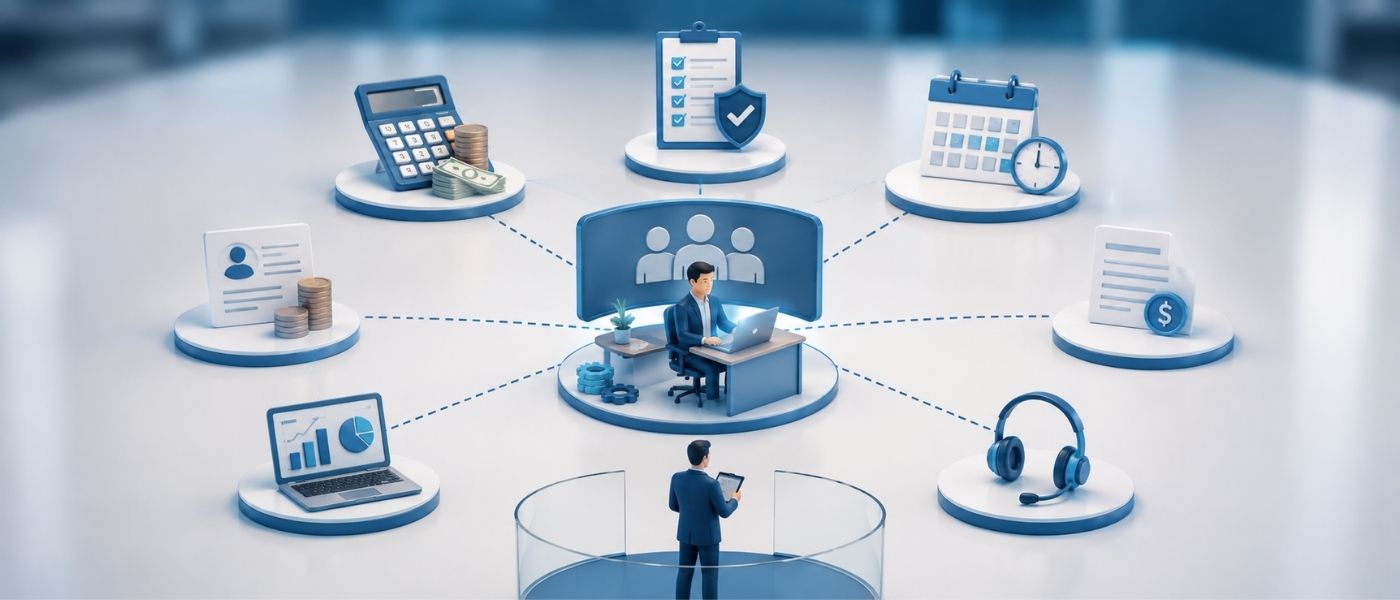
Common Payroll Outsourcing Models Businesses Use
Fully Managed Payroll Model
In a fully managed payroll model, the payroll partner handles nearly all payroll operations.
Typically, the provider manages:
- payroll processing
- statutory compliance
- salary calculations
- payslip generation
- tax deductions
- filing support
- reporting
- employee payroll queries
Best Fit For
- startups
- fast-growing SMEs
- companies without dedicated payroll teams
- businesses expanding rapidly
Advantages
- Lower operational burden
- Reduced compliance risk
- Better process standardization
- Easier scalability
- Predictable payroll operations
Limitations
- Less direct operational control
- Dependency on provider responsiveness
- Requires strong data-sharing processes
Operational Reality
This model works well when internal HR teams are lean. However, businesses still need governance oversight. Outsourcing payroll does not remove employer accountability.
Co-Managed Payroll Model
In a co-managed payroll structure, responsibilities are shared.
The internal HR or finance team may handle:
- attendance inputs
- employee master data
- approvals
The payroll provider manages:
- calculations
- statutory processing
- compliance
- payroll execution
Best Fit For
- operationally mature SMEs
- companies with existing HR teams
- businesses wanting partial control
Advantages
- Better visibility
- Shared operational ownership
- Flexible support structure
- Easier transition from in-house payroll
Limitations
- Requires process discipline internally
- Errors can occur if ownership boundaries are unclear
Payroll Software + Managed Support Model
This payroll processing model combines software automation with outsourced support services.
The business uses a payroll platform while external specialists assist with:
- compliance management
- troubleshooting
- filings
- payroll reviews
Best Fit For
- digitally mature businesses
- SMEs with internal HR teams
- companies seeking automation with advisory support
Advantages
- Improved payroll visibility
- Better reporting access
- Process automation
- Reduced manual errors
Limitations
- Software adoption challenges
- Internal dependency on process accuracy
- Requires HR system maturity
Global Payroll Partner Model
This model is designed for businesses managing employees across multiple countries.
The payroll provider coordinates:
- country-specific compliance
- payroll consolidation
- reporting standardization
- currency management
- tax alignment
Best Fit For
- multinational companies
- global capability centers
- offshore delivery organizations
- international expansion teams
Advantages
- Centralized payroll visibility
- Reduced cross-border compliance risk
- Better reporting governance
- Improved payroll consistency
Limitations
- Higher operational complexity
- Country-specific compliance dependencies
- Integration challenges
Global payroll operations have become significantly more complex as companies expand across jurisdictions with different tax systems, labour laws, and reporting structures. Reports from McKinsey & Company frequently emphasize the importance of centralized governance and standardized operational processes in globally distributed organizations.
Hybrid Payroll Operations Model
In a hybrid payroll operating model, businesses retain strategic payroll functions internally while outsourcing transactional operations.
Internal teams may control:
- approvals
- payroll policy
- compensation governance
External providers handle:
- payroll execution
- statutory compliance
- reporting support
Best Fit For
- large enterprises
- regulated industries
- governance-heavy organizations
Advantages
- Strong governance control
- Operational flexibility
- Reduced administrative burden
- Better reporting alignment
Limitations
- Requires mature process coordination
- Higher governance dependency
- Integration management complexity
Best Payroll Outsourcing Model for Startups
Startups typically underestimate payroll complexity until hiring accelerates.
Most early-stage businesses operate with:
- lean HR teams
- limited compliance expertise
- founder-led operations
- evolving compensation structures
For startups, payroll mistakes create operational distraction at the worst possible stage.
The best payroll outsourcing model for startups is usually a fully managed payroll structure.
Why?
Because founders benefit most from:
- reduced compliance exposure
- lower administrative workload
- predictable payroll timelines
- scalable support
A startup with 25 employees today may become a 150-person company within 18 months. Payroll systems that work manually at an early stage rarely scale effectively.
Businesses evaluating payroll outsourcing services in India should also consider:
- onboarding support
- compliance advisory
- scalability flexibility
- employee self-service capabilities
Companies expanding quickly should also review guidance on how startups can manage payroll compliance.
Best Payroll Outsourcing Model for SMEs
SMEs usually face a different challenge.
The problem is rarely basic payroll execution. The challenge is operational consistency.
Common SME payroll issues include:
- fragmented payroll processes
- state-wise compliance complexity
- inconsistent reporting
- approval bottlenecks
- growing audit exposure
As businesses cross 100 to 500 employees, payroll becomes more process-driven.
The best payroll outsourcing model for SMEs is often:
- co-managed payroll
or - payroll software with managed support
This gives SMEs:
- operational visibility
- better reporting
- process standardization
- scalability without building large payroll teams
SMEs expanding across locations particularly benefit from:
- centralized payroll administration services
- payroll compliance services
- standardized payroll workflows
Best Payroll Outsourcing Model for Enterprises
Enterprise payroll structures are fundamentally different.
Large organizations often manage:
- multiple legal entities
- diverse employee categories
- global payroll operations
- complex compensation structures
- enterprise ERP integrations
Payroll becomes a governance function, not just an HR process.
The best payroll outsourcing model for enterprises is usually:
- hybrid payroll operations
or - global payroll partner models
Enterprise priorities typically include:
- reporting transparency
- integration capability
- audit readiness
- security standards
- governance frameworks
- multi-country compliance management
Enterprises should also evaluate whether providers can support:
- API integrations
- ERP connectivity
- centralized reporting
- advanced analytics
- custom workflows
For many enterprises, payroll outsourcing is not primarily about cost reduction. It is about operational control and compliance resilience.
In-House Payroll vs Outsourced Payroll
Businesses comparing payroll models should evaluate operational realities, not just service fees.
Area | In-House Payroll | Outsourced Payroll |
Compliance Management | Internal responsibility | Shared expert support |
Scalability | Limited by team size | Easier scaling |
Technology Investment | Internal cost | Included or shared |
Error Risk | Higher manual dependency | Process-driven accuracy |
Reporting | Depends on internal systems | Structured reporting |
Multi-location Payroll | Operationally difficult | Better centralized support |
HR Bandwidth | High administrative burden | Reduced operational load |
Audit Readiness | Internal dependency | Compliance support available |
Businesses evaluating in-house payroll vs outsourced payroll services should assess long-term operational efficiency, not only short-term cost comparison.

How to Choose the Right Payroll Outsourcing Model
There is no universally perfect payroll model.
The right choice depends on operational maturity and business objectives.
Key Factors to Evaluate
- Business Size
A 20-person startup does not need the same payroll structure as a 5,000-employee enterprise.
- Geographic Complexity
Multi-state and international payroll operations require stronger compliance infrastructure.
- Workforce Diversity
Permanent employees, consultants, contractors, and offshore teams increase payroll complexity.
- Compliance Risk
Industries with heavy regulatory oversight should prioritize compliance strength over low pricing.
- Internal HR Capability
Businesses with mature HR operations may prefer co-managed models.
Lean teams may benefit more from fully managed payroll services.
- Reporting Expectations
Some organizations require:
- advanced payroll analytics
- department-level reporting
- cost-center visibility
- integrated dashboards
- Growth Plans
A payroll operating model should support future workforce expansion, not just current headcount.
Common Mistakes Businesses Make While Choosing Payroll Providers
Choosing Based Only on Price
Low-cost payroll services often lack:
- compliance depth
- reporting quality
- scalability
- operational support
Payroll errors usually become more expensive than payroll fees.
Ignoring Scalability
Many businesses choose payroll systems designed only for current operations.
Rapid hiring later creates:
- migration problems
- reporting gaps
- workflow inefficiencies
Weak Compliance Support
Payroll providers should actively support:
- statutory filings
- compliance alerts
- documentation
- audit readiness
Poor Integration Capability
Disconnected payroll systems create manual operational overhead.
This becomes a major issue for enterprises using:
- HRMS platforms
- ERP systems
- accounting software
- attendance systems
Organizations evaluating providers should also review how payroll companies improve efficiency across scaling operations.
Why Indian Businesses and Global Companies Are Outsourcing Payroll
India presents unique payroll complexity.
Businesses must navigate:
- state-level labour regulations
- evolving compliance frameworks
- frequent statutory changes
- workforce diversity
- multi-location operations
As companies expand, payroll management becomes increasingly process-intensive.
This is one reason payroll outsourcing services in India continue to grow across:
- startups
- SMEs
- GCCs
- multinational companies
Global organizations operating in India also require:
- offshore payroll support
- local compliance expertise
- payroll standardization
- scalable support models
A reliable payroll partner helps businesses reduce operational friction while maintaining compliance discipline.
Businesses evaluating should prioritize providers capable of supporting long-term operational scalability.
Conclusion
Choosing the right payroll outsourcing model is ultimately a business operations decision.
The ideal structure depends on:
- workforce scale
- compliance exposure
- geographic footprint
- reporting needs
- internal operational maturity
Startups typically benefit from fully managed payroll support that reduces administrative burden. SMEs often need structured payroll processes with better visibility and scalability. Enterprises require governance-focused payroll operating models that support compliance, integrations, and global reporting.
Payroll should not become a growth bottleneck.
A well-designed payroll model improves:
- operational efficiency
- compliance resilience
- employee experience
- reporting accuracy
- organizational scalability
Businesses evaluating managed payroll services should look beyond processing capability alone and assess whether the provider can support long-term operational evolution.
A payroll partner should not simply run payroll. They should help businesses build stable, scalable payroll operations that can grow alongside the organization.
Looking for scalable payroll outsourcing services that align with your business growth?
Explore how our payroll services helps startups, SMEs, and enterprises simplify payroll operations while maintaining compliance accuracy, operational visibility, and long-term scalability.
FAQ
What is a payroll outsourcing model?
A payroll outsourcing model defines how payroll responsibilities are divided between a business and an external payroll provider.
Which payroll outsourcing model is best for startups?
Startups usually benefit most from a fully managed payroll outsourcing model because it reduces compliance burden and administrative workload.
What is the difference between in-house payroll and outsourced payroll?
In-house payroll is managed internally by a company’s HR or finance team, while outsourced payroll involves an external payroll service provider handling payroll processing and compliance.
How do SMEs choose payroll outsourcing services?
SMEs should evaluate payroll providers based on scalability, compliance expertise, reporting capability, integration support, and operational flexibility rather than selecting purely on cost.
Why do enterprises outsource payroll operations?
Enterprises outsource payroll to improve compliance management, streamline reporting, support global payroll operations, and reduce operational complexity.
Are payroll outsourcing services in India suitable for global businesses?
Yes. Many global companies use payroll outsourcing services in India to manage local compliance requirements and multi-location payroll administration efficiently.
Recent Post
How to Set Up an Offshore QA Center of Excellence in India: A Practical Guide for Global Teams
Learn how to set up an offshore QA center of...
Managed IT Services for Small Businesses: Complete Guide (2026)
Discover what managed IT services for small businesses actually include,...

iValuePlus Services
iValuePlus is a one-stop solution to address all your needs to access, build and grow your business in the Indian market which is cost-effective & has a huge talent pool. Established in 2019 as a ‘Business Solution provider', our team has delivered successful growth projects in the international market.
Our services include setting up ODC (offshore development center), Staff Augmentation, Talent Acquisition, Digital Marketing, in the IT/ITES domain.