
Discover the best city to set up office in India...

A CTO’s Guide to Setting Up an Offshore Software Development Center in India
A Canadian CPA firm needed six specialised finance and technology roles filled within four months. Their domestic hiring timeline made this impossible. Within the same four-month window, an offshore development center in India had delivered all six roles — Accountants, Bookkeepers, a QuickBooks Specialist, a Tax Consultant, and a Financial Analyst — with a comprehensive training programme aligned to Canadian accounting standards already underway. Processing speed increased by 25 percent. Operational costs dropped by 15 percent. Client satisfaction reached 90 percent.
This is not a technology-only story. It illustrates the core value proposition that how to set up an offshore software development center in India is really asking: how do you build a permanent, governed, scalable offshore capability that performs like an internal team, at a cost structure your domestic market cannot replicate?
This guide is written for CTOs, VPs of Engineering, and COOs who have moved past “should we explore India” and are now asking how to do it correctly, what operating model to choose, which city fits which function, what governance looks like, and how to avoid the setup mistakes that delay productive operation by six to twelve months.
How do you set up an offshore software development center in India?
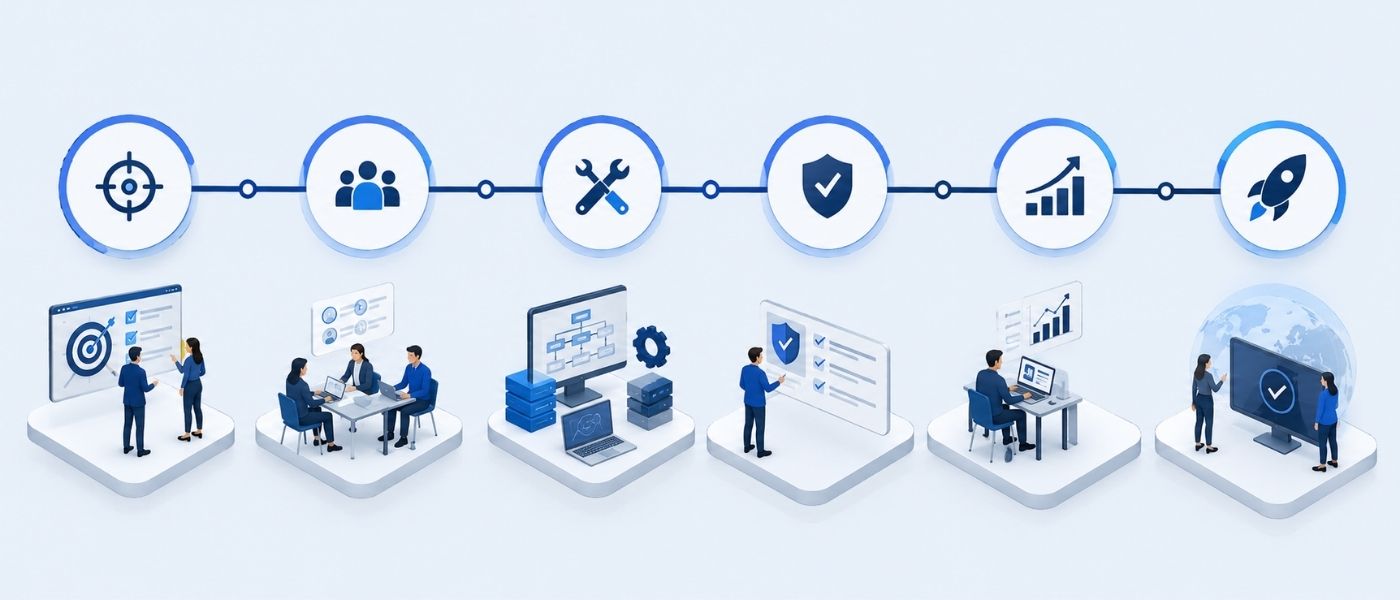
Setting up an offshore software development center in India requires six decisions made in sequence: define the ODC function and scope, select the operating model (BOT, managed ODC, or captive), choose the right city based on your talent requirements, establish governance and IP frameworks before hiring begins, hire the ODC lead first, and run a structured onboarding phase before expanding scope. The full setup typically takes 12 to 20 weeks from decision to operational go-live.
Why India Remains the Primary Destination for Offshore Software Development Centers
India remains the primary destination for offshore software development centers because it combines the world’s deepest pool of English-speaking engineering graduates with a mature delivery ecosystem, competitive cost structures, and a government policy environment that actively supports foreign technology investment. No other single market replicates this combination at a comparable scale.
The Talent Depth That Drives the Decision
India produces approximately 1.5 million engineering graduates annually according to NASSCOM, with deep specialisation across software engineering, cloud architecture, AI/ML, DevOps, and full-stack development. The relevant differentiator in 2026 is not the volume of graduates but the maturity of the mid-career cohort: India now has a significant pool of engineers with 6 to 15 years of experience, trained inside scaled product companies and the established GCCs of Microsoft, Google, Walmart, Amazon, and Goldman Sachs.
For CTOs evaluating India against other offshore destinations, the practical question is not whether engineers are available. It is whether the specific seniority and specialisation profile you need can be sourced within your hiring timeline. India’s talent market answers this question more often than any alternative market.
The Commercial Case
A fully loaded senior software engineer in the US costs $200,000 to $280,000 annually. The equivalent in India costs $35,000 to $60,000. The ratio is approximately 4 to 1 at senior level and 5 to 1 at mid-level. For a 20-person development team, this differential changes the economics of product development, platform engineering, and digital transformation programmes in ways that affect what a business can build, not just what it spends.
How to Set Up an Offshore Software Development Center in India: 6 Steps
Setting up an offshore software development center in India in 2026 takes 12 to 20 weeks through a managed or BOT model and 16 to 28 weeks through a fully captive structure. The six steps below are the execution sequence that experienced ODC builders follow to reach productive operation faster and with fewer preventable delays.
- Define ODC scope and function. Determine precisely what the ODC will own: product engineering, QA and testing, DevOps, data engineering, or a combination. ODCs that attempt to run all engineering functions simultaneously from day one consistently underperform on all of them. Start narrower than feels comfortable and expand as delivery capability is demonstrated.
- Select the operating model. Choose between a fully captive model (own India entity), a Build-Operate-Transfer arrangement, or a managed ODC where the provider operates the centre under your governance. Each model has different implications for timeline, cost, and long-term IP ownership.
- Choose the right city. Bengaluru for product engineering and AI/ML. Hyderabad for cost-optimised operations and SEZ tax benefits. Pune for embedded systems and enterprise platforms. Gurugram for analytics, financial technology, and corporate functions. City selection should be driven by your specific talent requirements, not by general India brand recognition.
- Establish governance before hiring begins. Define decision rights, communication cadences, KPIs, tooling standards, and IP assignment provisions before the first hire joins. Governance retrofitted after problems surface costs significantly more than governance designed upfront.
- Hire the ODC Lead first. The India-based ODC Lead or Engineering Manager must be on the ground before mass hiring begins. This person participates in governance design, sets the cultural standard for the team, and compresses hiring timelines by providing local credibility to candidates evaluating the opportunity.
- Run a structured onboarding and pilot phase. The first 30 to 60 days should be a defined phase focused on knowledge transfer, tooling setup, codebase onboarding, and process alignment. Expanding scope before this phase is complete is the single most common cause of slow ramp to productive delivery.
Choosing the Right Operating Model for Your ODC
The three primary operating models for an offshore software development center in India are the fully captive model, the Build-Operate-Transfer (BOT) model, and the managed ODC model. Each has a different risk profile, cost structure, and control level. The right model depends on your headcount timeline, India management bandwidth, and long-term ownership intent.
Fully Captive Model
You incorporate an Indian Private Limited Company, hire directly, lease your own space, and manage HR, payroll, and compliance internally. This gives you maximum control, the cleanest IP ownership, and the lowest long-term cost per engineer. The trade-off is the highest setup complexity and the longest time to first hire — typically 14 to 20 weeks.
Best for: Companies planning 100 or more engineers, with a defined India management plan and 18 to 24 months of patience for full ramp.
Build-Operate-Transfer (BOT)
A specialist partner builds the centre, handles entity setup, hiring, infrastructure, and governance for 18 to 36 months, then transfers full ownership to you. This compresses the time to first hire to 6 to 10 weeks, reduces setup risk, and preserves the long-term ownership model. The trade-off is a higher short-term cost than pure captive, and the quality of the transfer agreement is critical.
Best for: Mid-market companies planning 50 to 200 engineers who need speed now but want long-term ownership.
Managed ODC
Engineers work on a partner’s payroll and infrastructure under your strategic direction, with a defined path toward captive or BOT status. This is the fastest model to market — 4 to 8 weeks to first engineer — with minimal compliance burden for the client. The trade-off is less cultural differentiation in the talent market and a higher per-head cost because the provider’s operational margin is included.
Best for: Companies entering India for the first time, teams of 10 to 50 engineers, or organisations validating the India model before committing to a captive structure.
For a detailed breakdown of how the offshore development centre model works operationally across all three structures, including what clients typically retain control of and what the provider manages, that resource covers the full model comparison.
Selecting the Right Indian City for Your ODC
The right Indian city for your offshore software development center depends on your engineering function, seniority mix, and cost parameters. Bengaluru leads for product engineering and AI/ML. Hyderabad offers the best SEZ tax structure and cost efficiency for large teams. Pune suits embedded systems, automotive technology, and enterprise platforms. Gurugram fits financial technology and analytics-heavy engineering.
City Cost and Talent Benchmarks
| City | Primary Engineering Strength | Mid-Level Engineer Monthly Cost (USD) | Grade A Office Cost (USD/seat/month) | Attrition Rate |
|---|---|---|---|---|
| Bengaluru | Product engineering, AI/ML, full-stack | $2,500 to $4,500 | $250 to $420 | 14 to 18% |
| Hyderabad | Cloud, BFSI tech, chip design | $2,200 to $4,000 | $190 to $340 | 13 to 17% |
| Pune | Embedded, automotive, enterprise | $2,000 to $3,500 | $165 to $280 | 15 to 20% |
| Gurugram | Fintech, analytics, enterprise support | $2,000 to $3,800 | $310 to $520 | 20 to 26% |

Team Structure and Roles for an Offshore Development Center
A functional offshore software development center requires a minimum of five distinct roles at launch: an ODC Lead or Engineering Manager, senior engineers in the primary technology stack, mid-level engineers for delivery velocity, a QA engineer, and a DevOps or infrastructure engineer. The ODC Lead must be hired first and must be India-based.
Foundation Team (Months 1 to 3)
- ODC Lead or Senior Engineering Manager (1): Governance, client-facing communication, sprint participation, hiring leadership
- Senior Engineers (2 to 3): Architecture decisions, code quality standards, junior mentoring
- Mid-Level Engineers (2 to 4): Primary delivery velocity
- QA Engineer (1): Test coverage, quality standards, automation foundations
Expanded Team (Months 4 to 9)
- Additional mid-level and junior engineers as delivery scope expands
- DevOps / Infrastructure Engineer (1): CI/CD pipeline ownership, environment management
- Technical Lead for second product stream if applicable
Scaling (Month 10 and Beyond)
The ODC should add specialisations as the engineering scope expands: data engineers, security specialists, mobile engineers, and platform architects are common additions in the 10 to 24 month window for growing ODCs.
Onshore vs Offshore Responsibility Split
Client side retains: strategic product direction, roadmap prioritisation, final architecture sign-off, budget ownership.
ODC side owns: sprint execution, test coverage, code quality, documentation, daily delivery velocity.
Governance, IP Protection, and Compliance Frameworks
Governance and IP protection must be established before the first ODC hire joins, not after problems surface. IP created by India-based employees belongs to the employing entity by default under Indian law unless employment agreements explicitly assign it to the parent company. GDPR, HIPAA, and other data protection obligations apply to offshore teams handling relevant data regardless of their location.
IP Ownership
Every employment agreement in an ODC must include explicit IP assignment clauses — assigning all work product, code, designs, and innovations created during employment to the designated parent or subsidiary entity. These clauses must be drafted under Indian law by qualified Indian employment counsel. Templates adapted from UK or US employment law do not provide equivalent protection under Indian jurisdiction.
Data Protection Compliance
Offshore development teams handling personal data of UK or EU individuals fall within GDPR scope. The client company remains the data controller. Compliance requirements include:
- Data processing agreements covering the offshore team’s access to personal data
- Data transfer mechanisms such as the UK IDTA or EU SCCs for data transfers to India
- Access restricted to data necessary for the specific role
- Background verification for all team members handling sensitive data
India’s DPDP Act 2023 creates additional obligations for how the India-based employer manages employee data. Confirm your ODC partner has DPDP-compliant HR data handling practices before engagement.
Transfer Pricing
Every transaction between your India ODC and the parent company, service fees, IP licensing, and management charges fall under India’s transfer pricing regulations. Engage a specialist transfer pricing firm before the first inter-company invoice. Retroactive TP restructuring is significantly more expensive than initial documentation.
Infrastructure Setup for Your Offshore Development Center
ODC infrastructure setup covers physical office, network architecture, endpoint management, cloud connectivity, and security configuration. Infrastructure must be ready before the first engineer starts; retrofitting after onboarding creates security gaps, reduces productivity during the ramp phase, and damages early team confidence in the organization’s operational readiness.
Core Infrastructure Components
- Network infrastructure: Structured cabling, enterprise switching, Wi-Fi, firewall configuration with VPN access for secure parent company connectivity
- Cloud architecture: Decision on India-hosted versus parent-company-routed cloud workloads, with appropriate data residency compliance
- Endpoint management: MDM or Intune-based device provisioning before first engineer joins
- Communication and collaboration: Shared instances of Slack, Jira, Confluence, GitHub — not parallel systems that signal the ODC is a separate tier
- Physical security: Access control, CCTV, server room security where applicable
The infrastructure setup for offshore development centres in India guide covers the specific network, IT, and physical security decisions that experienced ODC operators make at the setup stage, including the sequencing of cabling, active equipment installation, and endpoint provisioning that determines how quickly a new ODC reaches operational readiness.

Managing an Offshore Software Development Team Effectively
Managing an offshore software development center effectively requires structured communication across time zones, full integration of ODC engineers into sprint ceremonies and architecture discussions, clearly defined KPIs, and deliberate investment in retention from the first hire. The governance model defines the structure; leadership practices determine whether it works.
Time Zone Management
India Standard Time is 5.5 hours ahead of GMT and 10.5 hours ahead of US Eastern time. For UK clients, this creates a usable overlap of approximately 12:30 pm to 5:30 pm UK time. For US clients, the 1 to 2 hour overlap in late afternoon EST requires async-first communication for daily work, with live interaction reserved for weekly sprint reviews and escalations.
The practical application of follow-the-sun development — India teams progressing work overnight relative to the US client’s working day — works well for QA regression cycles, build pipelines, and infrastructure monitoring, but requires disciplined handoff documentation to avoid rework at the transition point.
For CTOs managing the communication complexity of distributed engineering teams across significant time zone gaps, the 5 tips for bridging time zone gaps with your offshore team covers the specific communication protocols that experienced offshore team managers use to maintain delivery velocity without burning out either side of the team.
KPIs That Work for ODC Performance Management
- Sprint velocity over rolling 4-sprint average (tracks ramp and steady-state productivity)
- Defect escape rate (signals quality without penalising delivery speed)
- Deployment frequency (reflects CI/CD integration and team rhythm)
- On-time delivery rate against sprint commitments
- Automation coverage percentage for QA-heavy ODCs
Cost of Setting Up an Offshore Software Development Center in India
Setting up an offshore software development center in India involves one-time setup costs of $15,000 to $60,000 and monthly operational costs of $25,000 to $120,000 depending on team size, seniority mix, and operating model. This represents 55 to 70 percent savings compared to equivalent engineering capacity in the US or UK on a fully loaded basis.
Cost Breakdown by Operating Model
| Cost Component | Managed ODC | BOT Model | Fully Captive |
|---|---|---|---|
| One-time setup cost | $5,000 to $15,000 | $20,000 to $50,000 | $40,000 to $100,000 |
| Monthly team cost (10 engineers) | $35,000 to $55,000 | $28,000 to $45,000 | $22,000 to $38,000 |
| Compliance management | Provider-managed | Shared | Client-managed |
| Time to first engineer | 4 to 8 weeks | 6 to 10 weeks | 14 to 20 weeks |
| Long-term cost per head | Highest (margin included) | Medium | Lowest |
What Monthly Rates Include
A professionally structured ODC monthly rate covers the engineer’s salary and employment costs, statutory contributions (PF, ESI, Professional Tax where applicable), HR administration, payroll processing, workspace or managed office costs, and basic IT provisioning. What it typically does not include: client-side tooling licences, any travel costs, or specialised certifications beyond role-specific onboarding.
Real-World Case Study: Canada-Based CPA Firm
The Challenge
A Canada-based CPA firm experienced a significant surge in client demand for accounting and tax services. The firm needed to fill six specialised roles within four months, Accountant, Bookkeeper, QuickBooks Specialist, Tax Consultant, and Financial Analyst, to maintain service quality and meet filing deadlines. Domestic hiring in Canada could not deliver within this timeline.
The Solution
An offshore development centre model was implemented in India, structured specifically for accounting and bookkeeping support rather than software engineering. A six-person team was recruited, onboarded, and integrated into a comprehensive training programme aligned with Canadian accounting standards and practices. The ODC model provided the governance structure, defined roles, clear reporting lines, and quality review processes, that a traditional outsourcing arrangement would not have delivered.
The Outcomes
Within four months:
- 6 specialised roles filled covering the full requirement within the timeline
- 25 percent increase in processing speed for client accounts and tax filings through structured workflow and dedicated capacity
- 15 percent reduction in operational costs compared to domestic staffing equivalent
- 90 percent client satisfaction rate achieved through timely and accurate delivery
- Enhanced peak-season scalability allowing the firm to take on additional clients during tax season without capacity constraints
This case illustrates a point that many technology-focused ODC discussions miss: the offshore development centre model is not limited to software engineering. The governance structure, managed hiring, and training integration that make it effective for code apply equally to finance, analytics, customer operations, and professional services functions.
Common Mistakes CTOs Make When Setting Up an ODC
The most common mistakes when setting up an offshore software development center are hiring before governance is defined, appointing a remote India lead with no in-country authority, using outdated salary benchmarks, assigning only maintenance work to the ODC, and skipping structured onboarding in favour of immediate full-scope delivery.
Starting hiring before governance is ready. Teams assembled before IP assignment, decision rights, and tooling standards are defined default to task execution without strategic alignment. The ODC Lead should be hired first and should participate in governance design.
Remote India leadership. Appointing a US or UK-based manager to “lead” an India ODC without a named in-country ODC Head creates a management vacuum that manifests as high attrition, poor cultural integration, and slow hiring. The India-based ODC Lead must have real operational authority and budget visibility.
Salary benchmarking against general market data. GCC and ODC employers pay 15 to 25 percent above general market rates for comparable roles. Benchmarking against the Indian market average rather than the ODC/GCC segment produces offer rejection rates of 40 to 60 percent, extending hiring cycles by 4 to 8 weeks per role.
Giving the ODC only maintenance and support work. Engineers who are assigned bug fixing and ticket resolution without product ownership or architecture participation leave within 18 months at significantly higher rates than those given genuine delivery ownership. The quality of work assigned to an India ODC is the single most powerful retention lever available.
Skipping the pilot phase. Expanding ODC scope before the foundation team has completed knowledge transfer and established delivery rhythm consistently produces the worst early-stage performance outcomes. Thirty to sixty days of deliberately limited scope is not lost time — it is the fastest route to sustained productive delivery.
Offshore Development Center Checklist for CTOs
Before You Begin
- ODC scope and function defined — specific technology domains and product areas
- Operating model selected — managed ODC, BOT, or fully captive
- Client-side ODC sponsor assigned with budget ownership
- City selected based on talent requirements, not general reputation
- India entity or provider engagement decision confirmed
Governance and Legal (Before Hiring Begins)
- IP assignment clauses in all India employment agreements, validated by Indian counsel
- Data protection compliance confirmed — GDPR, DPDP Act 2023, HIPAA where relevant
- Transfer pricing structure documented before first inter-company invoice
- Decision rights documented — what ODC decides autonomously vs what requires client approval
- Communication cadence defined — standups, sprint reviews, strategic alignment
Infrastructure and Tooling
- Office or managed workspace provisioned before first hire
- Endpoint management configured and devices provisioned
- Shared tooling instances provisioned, same tools as parent team, not parallel systems
- VPN and secure access configured before Day 1
- CI/CD pipeline access established
Hiring and Onboarding
- ODC Lead or Engineering Manager hired first
- Salary benchmarked against GCC/ODC segment rates, not general market
- Background verification process confirmed as standard for all hires
- Pilot phase scope defined, limited to knowledge transfer and tooling alignment
- KPIs communicated explicitly at onboarding, not after first missed expectation
Final Thoughts
Knowing how to set up an offshore software development center in India is the difference between building a high-performing engineering extension and spending 18 months fixing preventable operational problems. The operating model, city selection, governance structure, and hiring sequence decisions made in the first eight weeks determine the trajectory of the ODC far more than the talent quality of individual engineers.
India’s engineering talent depth, cost structure, and ecosystem maturity make it the strongest offshore development destination available in 2026. The companies that extract the most value are not those that move fastest — they are those that front-load governance, hire their India Lead before mass recruiting begins, invest in onboarding before expanding scope, and treat their ODC as a strategic engineering function rather than a cost reduction mechanism.
iValuePlus works with technology companies and professional services firms across every stage of offshore development center setup in India, from operating model selection and city recommendation through team recruitment, infrastructure setup, and operational management. Get in touch to discuss your specific requirements and receive a structured proposal covering model, team composition, timeline, and transparent cost breakdown.
FAQ
How do you set up an offshore software development center in India?
Set up an offshore software development center by defining ODC scope, selecting an operating model (managed ODC, BOT, or captive), choosing the right city based on talent requirements, establishing governance before hiring begins, hiring the ODC Lead first, and running a structured 30 to 60 day pilot before expanding scope. Full setup takes 12 to 20 weeks.
How much does it cost to set up an offshore software development center in India?
One-time setup costs range from $15,000 to $60,000 depending on operating model. Monthly operational costs for a 10-engineer team run $25,000 to $55,000 depending on seniority mix and model. This represents 55 to 70 percent savings compared to equivalent US or UK engineering capacity fully loaded.
What is the best city in India for an offshore software development center?
Bengaluru leads for product engineering, AI/ML, and full-stack development. Hyderabad offers lower costs and SEZ tax benefits for large teams. Pune suits embedded systems and enterprise platforms. Gurugram fits financial technology and analytics-heavy engineering. The right city depends on your specific talent requirements, not general India ranking.
What operating model should a CTO choose for an India ODC?
Choose a managed ODC for fastest deployment (4 to 8 weeks) and smallest teams. Choose BOT for mid-market companies (50 to 200 engineers) wanting speed now with long-term ownership. Choose a fully captive model for 100 or more engineers with a defined India management plan and patience for a longer setup timeline.
How do you protect IP when setting up an offshore development center in India?
Protect IP through employment agreements with explicit IP assignment clauses drafted under Indian law, repository access controls and off-boarding protocols, confidentiality obligations that survive employment termination, and DPDP Act 2023 compliant data handling practices. IP created by India employees belongs to the employing entity by default unless contracts explicitly assign it otherwise.
How long does it take to set up an ODC in India?
A managed ODC can deploy the first engineers in 4 to 8 weeks. A BOT model reaches initial operation in 8 to 12 weeks. A fully captive model takes 14 to 20 weeks from entity incorporation to first hire. The pilot phase before full-scope delivery adds a further 30 to 60 days regardless of operating model.
What roles are needed in an offshore software development center?
A foundation ODC needs an India-based ODC Lead or Engineering Manager, senior engineers in the primary stack, mid-level engineers for delivery velocity, a QA engineer, and a DevOps engineer. The ODC Lead must be the first hire and must participate in governance design before other recruiting begins.
How do you manage an offshore software development team across time zones?
Use async-first communication for daily work, reserve the live overlap window for sprint ceremonies and escalations, document decisions in Confluence or Notion within 24 hours, and run weekly sprint reviews synchronously. Follow-the-sun development for QA cycles and build pipelines works well when disciplined handoff documentation is in place.
Recent Post
How to Set Up an Offshore QA Center of Excellence in India: A Practical Guide for Global Teams
Learn how to set up an offshore QA center of...
Managed IT Services for Small Businesses: Complete Guide (2026)
Discover what managed IT services for small businesses actually include,...

iValuePlus Services
iValuePlus is a one-stop solution to address all your needs to access, build and grow your business in the Indian market which is cost-effective & has a huge talent pool. Established in 2019 as a ‘Business Solution provider', our team has delivered successful growth projects in the international market.
Our services include setting up ODC (offshore development center), Staff Augmentation, Talent Acquisition, Digital Marketing, in the IT/ITES domain.