
Discover the best city to set up office in India...
Categories

The Evolution of Staff Augmentation Services in India | From Cost to Capability
Staff augmentation services in India embed skilled professionals directly into your existing teams under your management — without the overhead of permanent hiring. Businesses gain on-demand access to specialists in cloud, AI, data, and engineering, typically deployed within 2–6 weeks, at 40–60% lower cost than equivalent Western hiring markets.
Key Takeaways
- India’s staff augmentation market has evolved through three distinct phases: cost arbitrage (2000–2010), skill access (2010–2018), and capability delivery (2019–present).
- Unlike outsourcing, augmentation preserves full IP ownership and direct team control while delivering outsourcing-level speed.
- The most common failure mode is treating augmentation transactionally — as vendor staffing rather than a strategic workforce extension.
- Leading enterprises use capability-driven augmentation pods with embedded governance, defined KPIs, and low-attrition practices.
- India produces over 1.5 million STEM graduates annually, creating the world’s deepest pipeline for technology talent across cloud, AI/ML, SAP, cybersecurity, and QA.
- CFOs favour augmentation because it converts fixed headcount costs into variable, outcome-linked expenditure.
Why the Global Talent Equation Has Fundamentally Changed
Skill scarcity is now structural, not cyclical
Advanced technical skills — cloud architecture, AI/ML engineering, cybersecurity, ERP modernisation, data platform development — are in chronic short supply across the US, UK, and Europe. This is not a temporary hiring market imbalance. It is a structural gap between the pace of technological change and the speed of talent formation.
According to the U.S. Bureau of Labor Statistics, technology occupations are projected to grow roughly twice as fast as the overall US job market through 2033. Meanwhile, average time-to-hire for senior engineering roles in North America now ranges from 3 to 9 months — and that window is lengthening, not shortening.
By the time a niche hire is onboarded, business priorities have often shifted. This is not a recruitment problem. It is a structural capability access problem, and it demands a structural solution.
Speed is the decisive competitive variable
In software-driven industries, execution velocity determines market position. Every month of delayed product development, under-resourced digital transformation, or stalled data initiative translates directly into lost revenue, weakened customer trust, and ceded competitive ground. Traditional permanent hiring simply cannot keep pace with the velocity modern enterprises require.
Cost arbitrage alone stopped being a strategy in 2015
Enterprises that approach India as a labour cost play are operating on a decade-old framework. The conversation has moved. Today’s sophisticated buyers want outcomes, accountability, domain alignment, and the ability to scale without friction — not simply a lower rate card.
This is the inflection point at which modern staff augmentation services in India have fundamentally repositioned themselves.
What Staff Augmentation Actually Means in 2026
Staff augmentation is a flexible workforce model in which external professionals are embedded directly into a client’s internal teams, operating under the client’s management, processes, and governance. Unlike outsourcing, the client retains full control of deliverables, intellectual property, and team direction. Unlike traditional hiring, there is no permanent headcount commitment.
Modern staff augmentation extends well beyond “adding developers.” It includes:
Role-precise specialists — hired against outcome requirements, not generic job descriptions
Outcome-aligned metrics — KPIs tied to business objectives, not activity
Embedded governance — integrated into client sprint cadence, tooling, and reporting
Scalable delivery pods — structured for skill expansion or contraction without disruption
Knowledge continuity — low attrition design, structured handovers, and documentation practices
The Three Phases of Staff Augmentation in India
Phase 1: Cost Arbitrage Era (2000–2010)
The first wave was entirely cost-driven. Western enterprises discovered they could access qualified engineers at 60–70% lower cost by engaging Indian vendors. The model delivered significant savings, but quality control was inconsistent, attrition was high, and business alignment was almost non-existent. Vendors optimised for placement volume, not client outcomes.
Phase 2: Skill Access Era (2010–2018)
As Indian engineering institutions matured and global delivery experience deepened, the conversation shifted to capability. Buyers began specifying technology domains rather than just developer headcount. Vendors built vertical practices around ERP, Java, mobile, and then cloud. Business alignment improved, but the model remained vendor-driven — partners filled requested roles rather than challenging the underlying capability strategy.
Phase 3: Capability Engine Era (2019–Present)
The current era is defined by strategic partnership. Leading augmentation providers now operate as capability delivery partners — diagnosing workforce gaps, designing pod structures, embedding governance, and co-owning delivery outcomes. India’s talent ecosystem has deepened accordingly: the country now has over 5 million technology professionals and the world’s second-largest STEM graduate output, according to NASSCOM.
The differentiator is no longer “can you provide developers?” It is “can you build a resilient, scalable capability engine aligned to our business strategy?”
The Evolution of Staff Augmentation Services in India
Phase 1: Cost Arbitrage Era (2000–2010)
- Focus: Reduce labor costs
- Outcome: Savings, but limited quality control
- Risks: High attrition, weak accountability
Phase 2: Skill Access Era (2010–2018)
- Focus: Access to IT and engineering skills
- Outcome: Better talent, limited business alignment
- Risks: Vendor-driven, not strategy-driven
Phase 3: Capability Engine Era (2019–Present)
- Focus: Business-aligned, outcome-driven teams
- Outcome: Speed, flexibility, and resilience
- Differentiator: Strategic partners vs staffing vendors
India now offers one of the deepest, most diversified talent ecosystems globally, supported by:
- World-class STEM education
- Mature delivery governance
- Strong English communication
- Time-zone advantage for global collaboration
Staff Augmentation vs Hiring vs Outsourcing: The Decision Matrix
| Criteria | Traditional Hiring | Outsourcing | Staff Augmentation (India) |
|---|---|---|---|
| Speed to start | 3–9 months | 4–8 weeks | 2–6 weeks |
| Management control | Full | Low | Full |
| IP ownership | Full | Often shared | Full |
| Cost structure | Fixed + benefits | Contractual | Variable |
| Flexibility | Low | Rigid | On-demand |
| Cultural integration | High | Low | High |
| Scalability | Limited | Rigid | Immediate |
| Best fit | Stable, long-term roles | Defined, bounded projects | Dynamic, growth-driven teams |
Staff augmentation delivers the control of permanent hiring, the deployment speed of outsourcing, and a flexibility level neither model can match independently. For a detailed breakdown of how augmentation compares to offshore development, BOT, and GCC structures, see Staff Augmentation vs Offshore Development vs BOT vs GCC.
Why India Remains the World's Leading Hub for Staff Augmentation
Unmatched talent depth and domain breadth
India’s talent pipeline is not just large — it is specialised across every high-demand technology domain:
- Cloud & DevOps — AWS, Azure, GCP architects and SREs
- Data & AI/ML — data engineers, MLOps specialists, analytics engineers
- Enterprise platforms — SAP, Oracle, Salesforce, ServiceNow
- Cybersecurity — SOC analysts, penetration testers, GRC specialists
- Product engineering — full-stack, mobile, embedded systems
- QA automation — Selenium, Cypress, Playwright, performance testing
- Digital transformation — RPA, API integration, legacy modernisation
Enterprise-grade delivery maturity
Modern Indian augmentation partners operate with ISO-certified processes, SOC 2 compliance frameworks, Agile and DevOps fluency, and outcome-based governance models that meet the expectations of Fortune 500 procurement teams. This is not emerging market infrastructure — it is enterprise-grade delivery capability that has been refined across two decades of global engagements.
ROI-per-capability, not cost-per-hour
The economic advantage of India-based staff augmentation is real but is best understood as ROI acceleration, not cost cutting. Enterprises typically achieve 40–60% cost efficiency compared to equivalent Western hiring — but the more significant advantage is the ability to deploy five specialists in the time it would take to hire one domestically. That is a capability compounding effect that drives material competitive advantage.
Where Most Companies Fail with Staff Augmentation
Despite the model’s potential, a significant proportion of enterprises fail to extract full value. The root causes are consistent:
Treating it like transactional staffing. Augmented professionals integrated without clear role scope, team context, or success metrics underperform — not because of capability gaps, but because of integration failure.
Prioritising rate over fit. Selecting partners on hourly rate alone systematically produces higher attrition, weaker domain alignment, and longer ramp times — erasing the cost benefit within one engagement cycle.
Weak onboarding. Without structured onboarding — access provisioning, codebase orientation, team introductions, sprint context — even senior augmented professionals take 6–8 weeks to become productive rather than 1–2.
No governance layer. Without defined KPIs, delivery cadence, and reporting structures, augmented teams drift from business priorities and create accountability gaps that erode confidence in the model.
High attrition from poor partner selection. Vendors who treat augmented professionals as bench placeholders generate churn rates of 30–40% annually. Knowledge loss at that rate destroys any efficiency gain.
The organisations that extract maximum value from staff augmentation treat it as a strategic workforce extension — governed, integrated, and aligned — rather than a vendor relationship.
The Capability-Driven Augmentation Model: What High-Performers Do Differently
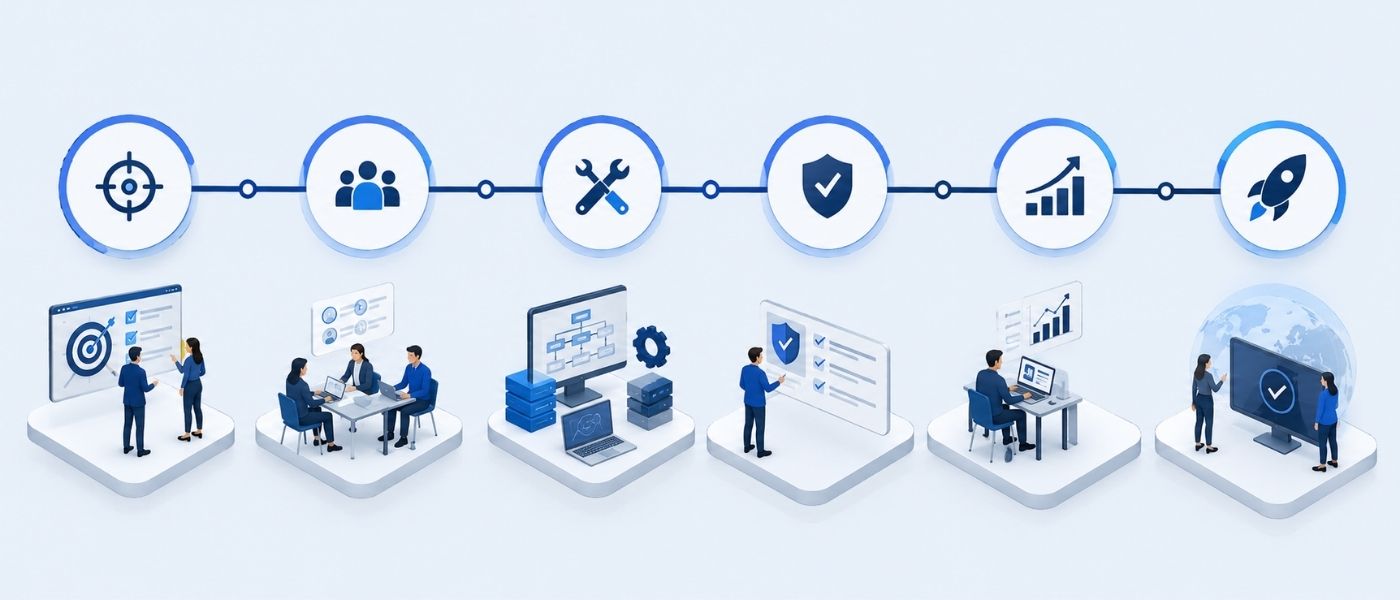
Leading enterprises have moved beyond transactional staffing to deploy augmentation as a systematic capability platform. The architecture of that platform has five components:
1. Role precision over headcount. Roles are defined against specific business outcomes — “reduce data pipeline latency by 40%” — not generic job descriptions. This alignment starts at the scoping stage and determines every subsequent hiring and governance decision.
2. Embedded governance. KPIs are set at engagement initiation, progress is reviewed in weekly delivery cadences, and escalation paths are defined before they are needed. Governance is not a quarterly review — it is built into the operating rhythm.
3. Scalable delivery pods. Teams are structured as modular pods — typically 3–6 professionals with complementary skills — that can be extended or contracted without disrupting delivery continuity. Pod design replaces individual headcount requests.
4. Knowledge retention by design. Low attrition is engineered, not hoped for. This means partner selection that includes attrition metrics as a criterion, documentation requirements in delivery governance, and role continuity provisions in contracts.
5. Strategic alignment reviews. Quarterly business reviews connect augmented team output to business KPIs — not just project status. This creates the feedback loop that elevates augmentation from tactical to strategic.
Why Leading Enterprises Choose iValuePlus
iValuePlus operates at the intersection of talent precision, delivery governance, and business outcome alignment. The differentiation is structural:
- Capability-first talent screening — candidates are assessed against the specific technical and business context of each engagement, not matched from a generic bench
- Domain-aligned teams across cloud, data, enterprise applications, digital transformation, and operations
- Seamless integration into client tooling, Agile frameworks, and governance models from day one
- Transparent performance reporting tied to agreed KPIs throughout the engagement lifecycle
- Flexible engagement structures — from individual specialists to full delivery pods — with enterprise-grade compliance and security standards
The result is not a resource placed on a client timesheet. It is a ready-to-perform professional contributing measurable output within the first sprint.
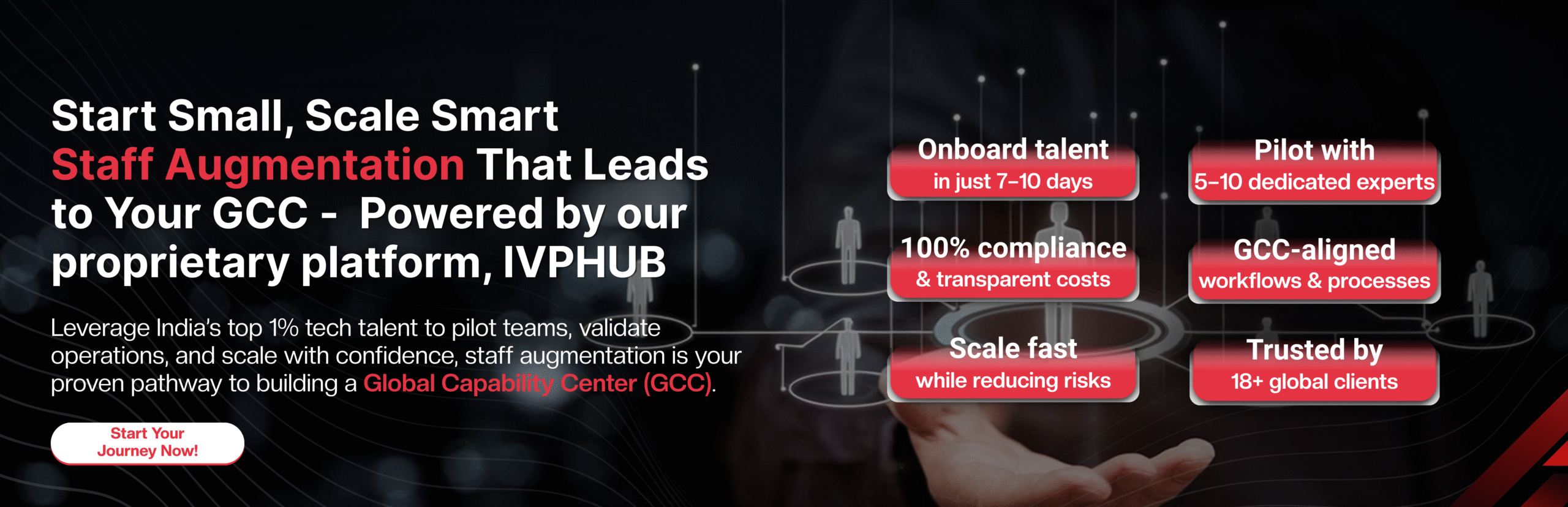
iValuePlus is also a recognised partner for enterprises building global capability centres in India — an adjacent model for organisations ready to move beyond augmentation into permanent capability infrastructure.
Where Staff Augmentation Delivers Maximum Business Impact
Scaling product engineering without slowing core teams
When engineering roadmaps expand faster than internal hiring capacity, augmentation allows the core team to maintain architectural ownership while specialist pods deliver feature velocity in parallel. This avoids the hidden cost of context-switching and talent dilution that comes from overloading permanent staff.
Accelerating digital transformation programmes
Cloud migration, data platform builds, and automation initiatives require combinations of specialist skills that are expensive to maintain permanently post-programme. Augmentation provides the surge capacity to execute transformation sprints and then scales back without redundancy risk.
Supporting growth-stage companies
Funded technology companies face the specific challenge of scaling talent in line with capital deployment timelines. Staff augmentation provides the speed and flexibility to build teams at the pace of funding cycles, without the long-term fixed cost commitments that erode runway.
De-risking innovation initiatives
Testing new technologies — AI/ML integration, edge computing, new data architectures — without permanent headcount commitment reduces the cost of learning. Failed experiments are closed cleanly; successful ones can be transitioned to permanent capability investment.
The CFO's Case for Staff Augmentation
From a capital efficiency standpoint, staff augmentation addresses several persistent problems with traditional workforce models:
- Converts fixed costs to variable — headcount cost scales with business demand rather than being locked to peak-load assumptions
- Reduces time-to-productivity cost — the multi-month onboarding drag of permanent hiring is eliminated when partners deploy pre-vetted specialists
- Eliminates redundancy risk — engagement closure carries none of the legal, financial, or cultural overhead of permanent layoffs
- Accelerates ROI on technology investment — capability gaps that delay programme delivery are the single largest source of technology ROI erosion; augmentation directly addresses this
According to Deloitte’s 2024 Global Outsourcing Survey, 70% of organisations cite cost reduction as a driver of workforce flexibility strategies, but 58% now rank access to skills and capabilities as equally or more important — a signal that the CFO and CTO views on augmentation are converging.
How to Choose the Right Staff Augmentation Partner in India
Evaluation must go beyond rate card comparison. The questions that separate strategic partners from transactional vendors:
- Do they understand your business objectives, not just the role specifications? Partners who ask about business outcomes before technology requirements signal strategic orientation.
- What is their attrition rate, and how do they measure it? Best-in-class partners track and disclose attrition by client and role type. Anything above 15% annually warrants scrutiny.
- How do they ensure knowledge continuity? Ask specifically about documentation standards, handover protocols, and bench depth for critical roles.
- Can they demonstrate outcome-based governance? Request examples of KPI frameworks and delivery reporting from existing engagements.
- Are they experienced with your scale of operations? Partners with predominantly SME experience may lack the compliance infrastructure, security standards, and delivery maturity required by enterprise clients.
iValuePlus is selected by enterprises not on price, but on reliability, domain depth, governance maturity, and demonstrated track record of long-term capability alignment.
FAQ
Q1: What are staff augmentation services in India?
Staff augmentation services in India provide skilled professionals who integrate directly into your existing team, working under your management and governance. Unlike outsourcing, you retain full control, IP ownership, and team direction, while gaining access to India’s deep talent pool across technology, data, and enterprise applications.
Q2: How is staff augmentation different from outsourcing?
Outsourcing delegates a defined scope to an external vendor who manages delivery independently. Staff augmentation embeds professionals within your team under your direction. The key differences are control (full in augmentation, limited in outsourcing), IP ownership (retained vs often shared), and integration depth (high vs low).
Q3: How quickly can augmented teams be deployed in India?
With a capability-aligned partner, deployment timelines range from 2 to 6 weeks depending on role complexity and security requirements. Senior specialist roles with niche certifications may take closer to 6–8 weeks. This compares to 3–9 months for equivalent domestic permanent hiring.
Q4: Is staff augmentation suitable for non-technology roles?
Yes. Modern staff augmentation encompasses finance and accounting operations, digital marketing, data analytics, HR operations, legal support, and customer experience roles. The model is not limited to software development — it applies wherever specialist capability gaps exist.
Q5: What domains does India’s talent pool cover for staff augmentation?
India offers deep, specialised talent across cloud and DevOps, AI/ML, data engineering, SAP/Oracle/Salesforce, cybersecurity, QA automation, product engineering, RPA, and digital transformation. Breadth of specialisation — not just scale — is the defining characteristic of India’s current talent ecosystem.
Q6: What are the biggest risks in staff augmentation, and how are they mitigated?
The primary risks are poor role-to-business-outcome alignment, weak onboarding, governance gaps, and high attrition. These are mitigated by selecting partners with disclosed attrition metrics, structured onboarding protocols, outcome-aligned KPI frameworks, and contractual knowledge continuity provisions.
Q7: How does staff augmentation compare to building a Global Capability Centre?
Staff augmentation is appropriate for dynamic, scalable, project-driven capability needs. A Global Capability Centre (GCC) is suited for organisations ready to invest in permanent, self-owned offshore infrastructure. GCCs offer deeper integration and long-term cost advantages but require 12–18 months to operationalise. Augmentation can bridge the gap while GCC strategy is developed.
Ready to build a capability engine, not just a headcount roster?
iValuePlus deploys domain-aligned professionals — cloud, data, AI, ERP, QA, and digital transformation — embedded directly into your team within 2–6 weeks. Every engagement comes with defined KPIs, transparent governance, and a low-attrition delivery model built for long-term strategic alignment. Get in touch today!
Recent Post
How to Set Up an Offshore QA Center of Excellence in India: A Practical Guide for Global Teams
Learn how to set up an offshore QA center of...
Managed IT Services for Small Businesses: Complete Guide (2026)
Discover what managed IT services for small businesses actually include,...

iValuePlus Services
iValuePlus is a one-stop solution to address all your needs to access, build and grow your business in the Indian market which is cost-effective & has a huge talent pool. Established in 2019 as a ‘Business Solution provider', our team has delivered successful growth projects in the international market.
Our services include setting up ODC (offshore development center), Staff Augmentation, Talent Acquisition, Digital Marketing, in the IT/ITES domain.