
Discover the best city to set up office in India...
Categories
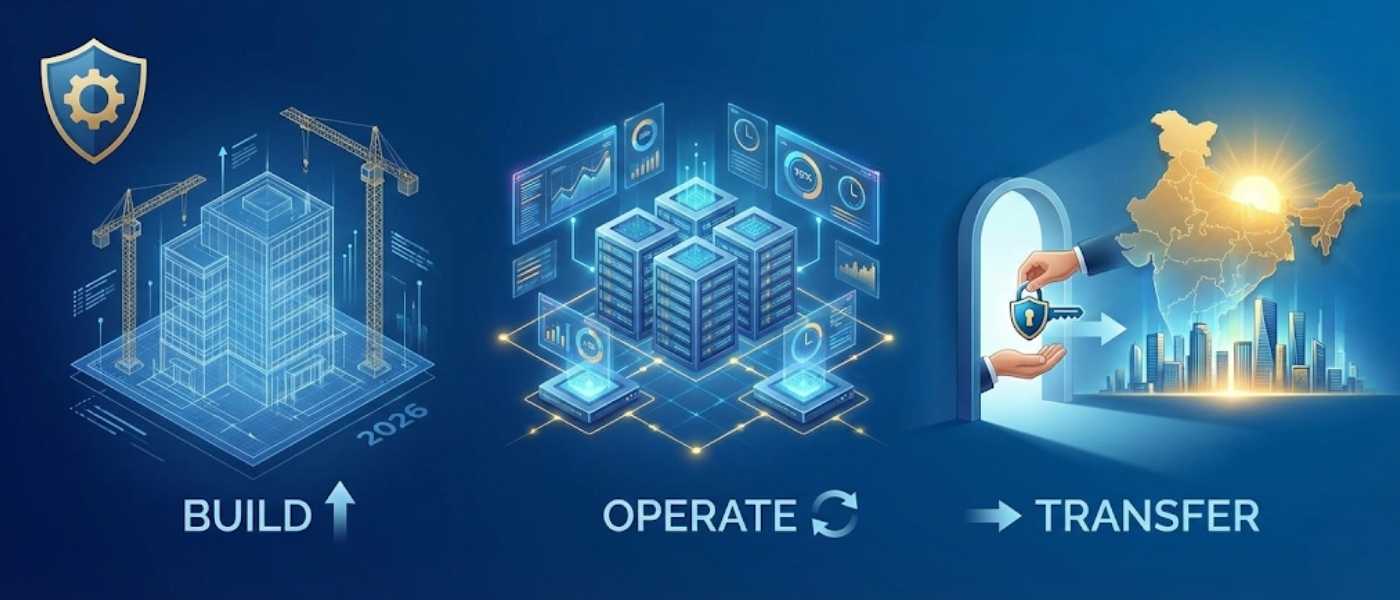
Why Build-Operate-Transfer Model Is the Safest Way to Enter India in 2026
Entering India Has Never Been More Attractive or More Complex
India in 2026 stands at the center of global enterprise expansion. With its deep talent pool, mature outsourcing ecosystem, strong digital infrastructure, and cost advantages, India has become the default destination for Global Capability Centers (GCCs), offshore delivery hubs, and innovation centers.
Yet, while opportunity is high, risk is equally real.
Global companies entering India face challenges such as:
- Regulatory and compliance complexity
- Talent acquisition and retention risks
- Cultural and operational misalignment
- High upfront investment in captive models
- Governance and IP protection concerns
- Execution risk during the first 12–24 months
This is precisely why the Build-Operate-Transfer (BOT) model has emerged as the safest, lowest-risk, and most strategically sound entry model for India in 2026.
BOT allows organizations to enter India without committing upfront to full ownership, while still building a fully captive, compliant, and scalable operation—at the right time and pace.
This article explains:
- Why traditional India entry models fail
- How BOT fundamentally de-risks expansion
- The BOT lifecycle in detail
- Risk, cost, and control comparisons
- When BOT is the right model (and when it isn’t)
- Why BOT is becoming the preferred GCC entry strategy in 2026
India Entry Models Explained: Where Most Companies Go Wrong
Before understanding why BOT is safest, it’s important to examine why other models struggle.
Captive (Wholly Owned Subsidiary)
In a captive model, a company sets up its own legal entity, hires employees directly, and manages operations independently.
Challenges:
- High upfront capital investment
- Long setup timelines (6–12 months)
- Legal, tax, labor, and compliance exposure from day one
- Talent acquisition without local employer branding
- High exit risk if strategy changes
Captives work but only when companies already have India experience.
Traditional Outsourcing / Vendor Model
Here, work is contracted to a third-party vendor.
Challenges:
- Limited control over talent and culture
- Vendor incentives misaligned with long-term capability building
- IP, security, and dependency risks
- Hard to convert into a captive later
Outsourcing optimizes cost but does not build long-term strategic capability.
Many companies later struggle when attempting to regain control after outsourcing, which is why the Build-Operate-Transfer model enables companies to gain control after outsourcing without operational disruption.
Joint Ventures or Acquisitions
Some firms attempt to accelerate India entry through partnerships or acquisitions.
Challenges:
- Integration risk
- Cultural misalignment
- Governance disputes
- Hidden liabilities
These models carry high strategic and financial risk, especially for first-time entrants.
What Is Build-Operate-Transfer (BOT)?
The Build-Operate-Transfer (BOT) model is a structured, phased approach to entering India that combines outsourcing safety with captive control.
BOT in Simple Terms:
- Build: A local partner sets up the India operation for you
- Operate: The partner runs and stabilizes the operation
- Transfer: Ownership is transferred to you—when you are ready
At the end of BOT, you own:
- The team
- The processes
- The infrastructure
- The IP
- The culture
Without having taken early-stage risk.
Why BOT Is the Safest Entry Model in 2026
BOT Eliminates Day-One Risk
In BOT, the service provider absorbs:
- Legal entity setup risk
- Compliance and labor law exposure
- Initial hiring and attrition risk
- Infrastructure and IT readiness
Your company enters India operationally, not legally, in the early phase.
This approach allows companies to enter India operationally first, while legal and compliance exposure remains insulated—making it one of the most effective ways to reduce risks and scale faster using BOT in India.
BOT Converts Fixed Risk Into Optionality
Traditional models force early commitment.
BOT offers strategic optionality:
- Proceed to transfer
- Extend the operate phase
- Scale up or down
- Exit without stranded assets
In uncertain global markets, optionality is safety.
BOT Enables “Test Before You Own”
BOT allows companies to:
- Validate India as a location
- Test operating models
- Evaluate talent quality
- Assess productivity and cultural fit
Only after proof of success do you commit to ownership.
This dramatically improves decision quality.
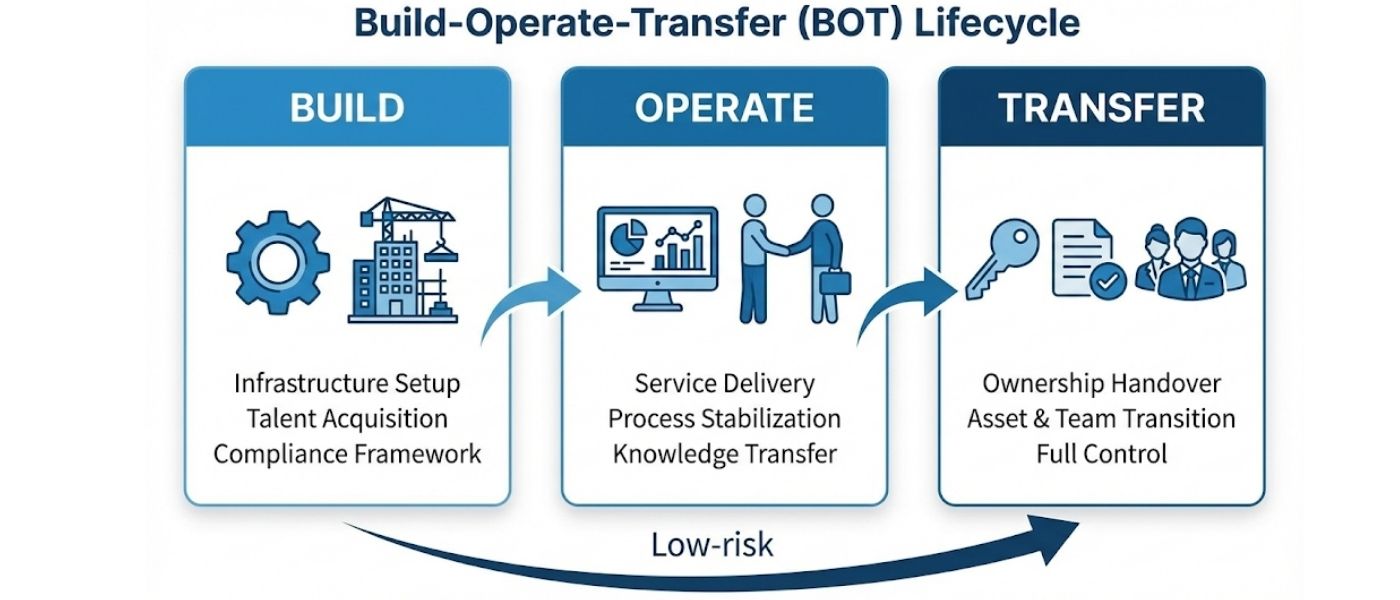
The BOT Lifecycle: A Step-by-Step Breakdown
Phase 1: Build
This phase focuses on foundation setup.
Activities include:
- Location selection (city, SEZ, non-SEZ)
- Office and infrastructure setup
- IT security and access controls
- Compliance frameworks
- Employer branding and hiring strategy
The partner leverages its local expertise to avoid common setup mistakes.
Outcome: A fully functional offshore operation without you forming an entity.
Phase 2: Operate
This is the most critical phase.
Key objectives:
- Stabilize delivery
- Achieve productivity benchmarks
- Embed your processes, tools, and culture
- Establish governance, KPIs, and reporting
- Reduce dependency on the partner
During this phase:
- Teams work exclusively for you
- Reporting lines mirror a captive model
- Knowledge transfer happens continuously
Outcome: A mature, captive-ready operation.
Phase 3: Transfer
Ownership is transferred to your legal entity.
Transfer includes:
- Employees moved to your payroll
- Contracts, assets, and IP transferred
- Licenses and compliances migrated
- Governance fully handed over
This phase is planned contractually from day one no ambiguity, no surprises.
BOT vs Captive vs Outsourcing
Risk Area | Captive | Outsourcing | BOT |
Legal risk | High | Low | Very low |
Capital investment | High | Low | Moderate |
Talent risk | High | Medium | Low |
Time to productivity | Slow | Fast | Fast |
Control | High | Low | High |
Exit flexibility | Low | Medium | High |
Long-term ownership | Yes | No | Yes |
BOT uniquely balances risk, control, and scalability.
Why BOT Is Ideal for GCC Setup in India
Global Capability Centers are no longer cost centers, they are:
- Innovation hubs
- Product engineering centers
- Analytics and AI labs
- Shared services powerhouses
BOT enables GCCs to be built correctly from day one.
BOT Aligns With GCC Objectives:
- Captive-level control
- Enterprise-grade governance
- Scalable talent strategy
- Long-term ownership
BOT aligns perfectly with GCC objectives by delivering enterprise-grade governance, scalable talent models, and long-term ownership. This is why many organizations now evaluate the benefits of Build-Operate-Transfer for entering the Indian market before committing to traditional captive setups.
Cost Economics: Why BOT Makes Financial Sense
BOT is not just safer, it’s smarter financially.
Cost Advantages:
- No sunk cost in failed pilots
- Lower setup and ramp-up expenses
- Predictable operating costs
- No premature capex commitment
Companies often save 20–30% in the first 24 months compared to captives while still ending up with full ownership.
Compliance and Governance: A Hidden Strength of BOT
India’s regulatory environment is robust but complex.
BOT partners bring:
- Labor law expertise
- Payroll and tax compliance
- Statutory reporting
- Data protection and IP safeguards
By the time of transfer, compliance is battle-tested, not theoretical.
Talent Acquisition and Retention Under BOT
India’s talent market is competitive.
BOT partners help by:
- Leveraging employer branding
- Faster hiring cycles
- Better compensation benchmarking
- Reduced early attrition
Employees join knowing they will transition into a global enterprise—boosting retention.
BOT vs “Lift and Shift” Failures
Many companies attempt to replicate onshore models offshore and fail.
BOT avoids this by:
- Localizing processes intelligently
- Adapting operating rhythms
- Embedding Indian leadership early
The result is sustainable performance, not fragile scale.
When BOT Is the Right Model (and When It Isn’t)
BOT Is Ideal If:
- You are entering India for the first time
- You plan a GCC or long-term offshore center
- You want ownership without early risk
- You need speed without compromise
BOT May Not Fit If:
- You need only short-term project work
- You want zero ownership long-term
- Your scale requirement is very small
What to Look for in a BOT Partner
Choosing the right BOT partner is critical.
Key Criteria:
- Proven BOT track record
- Strong compliance capabilities
- Transparent transfer framework
- Industry-specific experience
- Security and IP maturity
- Cultural alignment
A BOT partner is not a vendor; it is a temporary co-founder of your India operation.
BOT in 2026: Why Adoption Is Accelerating
Three trends are driving BOT adoption:
- Board-level risk scrutiny
- Demand for faster India entry
- Need for flexible global operating models
In 2026, BOT is no longer experimental—it is best practice.
The Long-Term Strategic Advantage of BOT
Companies that enter India via BOT:
- Build stronger GCCs
- Achieve faster ROI
- Avoid costly re-structuring
- Scale with confidence
Most importantly, they enter India once and enter right.
Conclusion
In 2026, entering India is a strategic necessity—but how you enter determines success or failure.
The Build-Operate-Transfer model:
- Removes early-stage risk
- Preserves long-term control
- Enables smarter investment decisions
- Aligns with modern GCC strategy
For global companies seeking risk-free, scalable, and future-ready India expansion, BOT is no longer an option—it is the safest path forward.
Recent Post
How to Set Up an Offshore QA Center of Excellence in India: A Practical Guide for Global Teams
Learn how to set up an offshore QA center of...
Managed IT Services for Small Businesses: Complete Guide (2026)
Discover what managed IT services for small businesses actually include,...

iValuePlus Services
iValuePlus is a one-stop solution to address all your needs to access, build and grow your business in the Indian market which is cost-effective & has a huge talent pool. Established in 2019 as a ‘Business Solution provider', our team has delivered successful growth projects in the international market.
Our services include setting up ODC (offshore development center), Staff Augmentation, Talent Acquisition, Digital Marketing, in the IT/ITES domain.