
Discover the best city to set up office in India...

Why Businesses Are Shifting to Managed IT Infrastructure Services in 2026
A Sydney-based product company was running a platform that supported tens of thousands of active users across multiple time zones. Their internal IT team of four was managing servers, network infrastructure, cloud environments, and security monitoring simultaneously, all while supporting 18 developers working on active sprint cycles. When a critical production incident occurred on a Saturday evening, the response took four hours. The business calculated that the downtime cost more in lost transactions and customer trust than six months of managed infrastructure services would have.
Within five months of engaging an offshore managed IT infrastructure partner, the company had 18 specialized professionals supporting their platform under an agile delivery model. Uptime reached 99 percent. Project delivery timelines improved by 40 percent. Operational costs dropped by 30 percent. Client satisfaction reached 95 percent.
This is the commercial reality driving the shift to managed IT infrastructure services for businesses in 2026. Not theory or trend reporting, but a specific, quantifiable improvement in operational performance and cost efficiency that internal IT models cannot replicate at the same investment level.
What are managed IT infrastructure services for businesses?
Managed IT infrastructure services for businesses refer to the outsourcing of IT environment management, monitoring, security, and optimization to a specialist provider. The provider takes operational ownership of servers, networks, cloud environments, security controls, backups, and disaster recovery, giving the business predictable costs, continuous oversight, and access to specialist expertise without maintaining the full scope of capability in-house.
Why IT Infrastructure Has Become a Strategic Business Decision
IT infrastructure has shifted from a back-office function to a direct determinant of business performance. In 2026, the reliability, security, and scalability of a company’s IT environment affect product delivery timelines, customer experience, regulatory compliance, and competitive positioning, making infrastructure management a board-level consideration rather than an IT department concern.
The Complexity Has Outpaced Internal Capacity
Most businesses today operate across a combination of on-premise servers; public cloud platforms such as AWS, Azure, and GCP, private cloud environments, SaaS applications; and remote access infrastructure for distributed teams. Managing these interconnected systems requires deep expertise across networking, cloud architecture, cybersecurity, virtualization, and compliance.
According to a Gartner forecast on IT spending, global IT infrastructure spending crossed $900 billion in 2024 and continues to grow at approximately 8 percent annually, driven by cloud adoption, AI infrastructure requirements, and cybersecurity investment. The technical complexity this represents is beyond the operational capacity of most internal IT teams, particularly at small and mid-market company scales, where the IT team is simultaneously responsible for everything from helpdesk tickets to infrastructure security.
The Cost of Getting It Wrong
A Gartner analysis found that IT downtime costs organizations an average of $5,600 per minute. For businesses running e-commerce platforms, financial services applications, or customer-facing SaaS products, this is not a hypothetical risk; it is an operational reality that managed IT infrastructure services are specifically designed to prevent.
What Managed IT Infrastructure Services for Businesses Actually Cover
Managed IT infrastructure services for businesses cover the full technology environment, servers, storage, networks, cloud platforms, security controls, monitoring, backup, and disaster recovery, under a defined service model with clear SLAs. In 2026, these services extend beyond basic maintenance to include proactive optimization, AI-driven monitoring, compliance management, and strategic infrastructure planning.
Core Service Domains
| Service Domain | What It Covers |
|---|---|
| Server and storage management | Physical and virtual server management, storage provisioning, capacity planning |
| Network infrastructure | LAN, WAN, SD-WAN, firewall management, connectivity monitoring |
| Cloud and hybrid management | AWS, Azure, GCP management, cost optimization, and hybrid integration |
| Security and compliance | Patch management, vulnerability scanning, security monitoring, compliance controls |
| Backup and disaster recovery | Automated backups, recovery testing, business continuity planning |
| 24/7 monitoring and support | Real-time infrastructure monitoring, incident response, helpdesk support |
| Infrastructure design and setup | Architecture planning, deployment, configuration management |
For businesses establishing new offices, expanding into India, or setting up offshore operations, the IT infrastructure services page covers the specific setup and management capabilities relevant to new and growing operations.

The Six Business Drivers Behind the 2026 Shift
The shift to managed IT infrastructure services for businesses in 2026 is driven by six converging factors: cost predictability, access to specialist expertise, improved uptime and reliability, stronger security posture, scalability for growth, and the need to redirect internal teams toward strategic priorities rather than infrastructure maintenance.
Driver 1: Cost Predictability and Optimisation
Maintaining in-house infrastructure requires capital expenditure on hardware, ongoing software licensing, staff salaries, training, and downtime recovery costs. These expenses are variable, unpredictable, and tend to spike at the worst moments, when a server fails, when a security incident requires emergency response, or when rapid scaling is needed to support business growth.
Managed IT infrastructure services convert these variable costs into a predictable monthly operational expenditure. The provider handles hardware refresh cycles, software updates, and capacity scaling as part of the engagement, removing the budget uncertainty that internal models carry.
Driver 2: Access to Specialist Expertise at Scale
A growing business cannot realistically employ specialists across all infrastructure domains internally. Cloud architecture, network engineering, cybersecurity, virtualization, and compliance management each require distinct, deep expertise. Managed infrastructure providers maintain teams of certified specialists across all these domains, giving businesses access to the full capability set without building and maintaining it internally.
Driver 3: Improved Uptime and Business Continuity
Proactive monitoring, automated alerting, and defined incident response protocols consistently deliver higher uptime than reactive in-house models. Managed infrastructure providers operate 24/7 monitoring infrastructure with defined response time SLAs, meaning incidents are identified and addressed before they become outages, rather than after they have already disrupted operations.
Driver 4: Stronger Security and Compliance Posture
Cybersecurity threats in 2026 are more sophisticated, more frequent, and more targeted than at any previous point. Infrastructure vulnerabilities, unpatched servers, misconfigured network controls, and inadequate endpoint protection remain the primary entry point for ransomware, data breaches, and supply chain attacks.
Managed IT infrastructure services embed security into the operational model, not as an afterthought. Patch management, vulnerability scanning, security monitoring, and compliance alignment are standard components of a professionally managed infrastructure engagement.
Driver 5: Scalability for Business Growth
Business growth, new offices, new markets, expanded headcount, or new product lines, creates infrastructure demands that internal teams struggle to meet quickly. Adding a new office location, onboarding a large cohort of employees, or migrating to a new cloud platform all require infrastructure capacity that managed providers can deploy significantly faster than internal teams building from scratch.
Driver 6: Internal Team Refocus
When internal IT teams spend their time managing infrastructure, they are not available for the strategic work that drives competitive differentiation, digital transformation initiatives, developer productivity improvements, data platform development, or AI capability building. Managed infrastructure removes the operational burden from internal teams and allows them to focus on the activities where their knowledge of the business creates unique value.
Managed IT Infrastructure vs In-House IT vs Traditional Outsourcing
Managed IT infrastructure services for businesses deliver better cost predictability, security coverage, and scalability than in-house IT, while providing stronger governance and knowledge retention than traditional ad-hoc outsourcing. The right model depends on company size, infrastructure complexity, and the strategic importance of IT control.
| Factor | Managed IT Infrastructure | In-House IT | Traditional Outsourcing |
|---|---|---|---|
| Monthly cost structure | Predictable, operational | Variable, capital-intensive | Variable, project-dependent |
| Security coverage | Continuous, proactive | Reactive, resource-limited | Inconsistent, vendor-dependent |
| Expertise depth | Multi-domain specialists | Limited by team size and budget | Varies by vendor |
| Uptime and monitoring | 24/7 with defined SLAs | Business hours, reactive | Varies by contract |
| Scalability | On-demand, managed by provider | Slow, requires hiring or capex | Scope-change driven |
| Compliance management | Built into service model | Internal responsibility | Often not included |
| Knowledge retention | High, provider-maintained | High, but lost when staff leave | Low, resets per engagement |
| Best suited for | Growing businesses, complex environments | Large enterprises with dedicated IT departments | One-off projects or specific tasks |
Real-World Case Study: Sydney-Based Product Company
The Challenge
A Sydney-based product company needed to scale technical capabilities rapidly to support an expanding platform across multiple technology stacks including PHP, Laravel, React.js, Vue.js, Angular.js, Docker, Kubernetes, and AWS. Their existing team could not provide the coverage or specialisation required to support the platform at the required availability level while continuing active development.
The business needed 18 specialised professionals operational within five months — a timeline that ruled out conventional recruiting in the Australian market.
The Solution
A dedicated offshore managed infrastructure and development team was established under an agile delivery model, providing 16/5 support coverage for the platform. The engagement covered ongoing enhancement and support, CI/CD pipeline management via Jenkins, database management across MySQL, PostgreSQL, and MongoDB, and cloud infrastructure operations on AWS including EC2, RDS, S3, and Lambda.
An agile development process was implemented to ensure iterative enhancements reached production on a structured schedule, with continuous improvement built into the sprint cadence.
The Outcomes
Within five months of engagement:
- 18 specialised professionals onboarded, covering the full technical stack
- 30 percent reduction in operational costs compared to the previous internal and ad-hoc vendor model
- 40 percent improvement in project delivery timelines through structured agile delivery
- 99 percent platform uptime maintained across the full engagement period
- 95 percent client satisfaction rate across stakeholder surveys
This case reflects what managed IT infrastructure engagement looks like in practice, not just server management and helpdesk tickets, but a comprehensive operational model that covers development support, infrastructure operations, and platform reliability under a single accountable engagement.
Key Components of a Managed IT Infrastructure Engagement
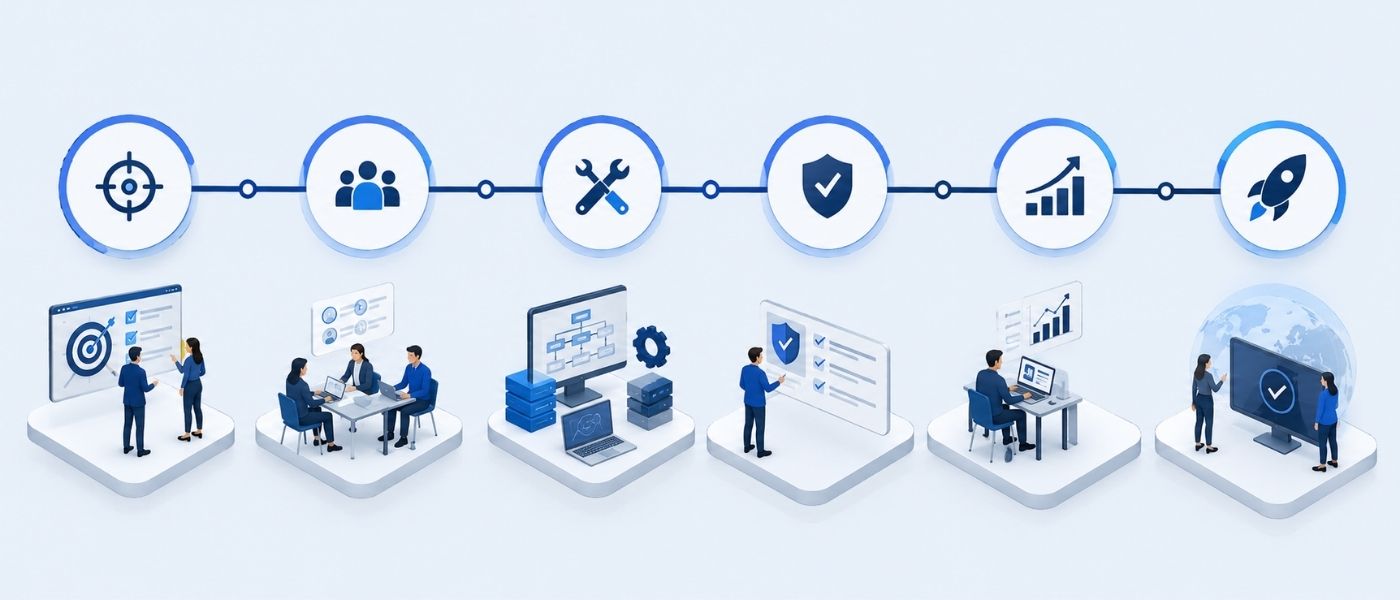
A well-structured managed IT infrastructure engagement covers six core components: infrastructure design and deployment, continuous monitoring and management, cloud and hybrid environment management, security and compliance, backup and disaster recovery, and ongoing optimization and support. Each component should be explicitly scoped in the service agreement, not assumed to be included.
Infrastructure Design and Setup
Professionally managed infrastructure engagements begin with an assessment of the current environment, followed by an architecture design that aligns with the business’s growth trajectory. This includes hardware and software deployment, network configuration, cloud environment setup, and documentation of the as-built environment.
Infrastructure designed for today’s headcount rather than projected 18-month headcount requires redesign within two years, an avoidable cost that good managed infrastructure providers flag at the design stage.
24/7 Monitoring and Incident Response
Real-time monitoring across all infrastructure components, servers, networks, cloud services, and security controls with automated alerting and defined incident response protocols is the operational core of managed infrastructure services. SLAs should define response times by incident severity: critical incidents (production down) typically requiring response within 15 to 30 minutes, major incidents within 1 to 2 hours, and standard issues within 4 to 8 hours.
For businesses with distributed or remote workforces that depend on consistent infrastructure performance, the IT support services page covers the specific support model components that keep distributed teams operational.
Cloud and Hybrid Environment Management
Most businesses in 2026 operate across a mix of on-premise and cloud infrastructure. Managing the interaction between these environments, data flows, security controls, cost optimisation, performance monitoring, requires continuous attention that internal teams rarely have capacity to provide consistently.
Cloud cost management alone is a significant value driver for many managed infrastructure engagements. Unoptimised cloud environments commonly carry 20 to 35 percent resource wastage from idle instances, oversized configurations, and unused storage. A managed infrastructure provider identifies and addresses this wastage as a standard component of the engagement.

Security and Compliance in Managed IT Infrastructure
Security is the most operationally critical component of managed IT infrastructure services for businesses in 2026. Managed infrastructure providers embed security into every layer of the environment, from network perimeter controls and endpoint protection through patch management, vulnerability scanning, and compliance reporting, rather than treating security as a separate workstream.
What Security-First Infrastructure Management Covers
- Patch management: Critical security patches deployed within defined windows, reducing the window of vulnerability that unmanaged environments carry
- Vulnerability scanning: Regular automated scanning across all infrastructure components with remediation prioritised by risk severity
- Security monitoring: Continuous monitoring for anomalous activity, unauthorised access attempts, and configuration drift
- Compliance controls: Implementation and maintenance of controls relevant to your regulatory environment, ISO 27001, SOC 2, GDPR, HIPAA, or industry-specific frameworks
For businesses with data protection obligations under GDPR, India’s DPDP Act 2023, or sector-specific regulations, compliance management embedded in the infrastructure service eliminates the risk of compliance gaps being discovered during audits rather than during operations.
How Managed IT Infrastructure Supports Digital Transformation
Digital transformation initiatives, AI adoption, data platform development, automation, and cloud migration, depend on a reliable, scalable infrastructure foundation. Managed IT infrastructure services provide the stable, secure, and scalable base that transformation programmes require to deliver their intended outcomes, rather than being delayed or compromised by infrastructure limitations.
AI and machine learning workloads require GPU-optimized cloud infrastructure, high-throughput data pipelines, and low-latency storage configurations that most internal IT teams have not previously managed. Managed infrastructure providers with AI workload experience can provision and manage this infrastructure faster than businesses building the capability from scratch.
For small and mid-sized businesses navigating the balance between infrastructure investment and digital transformation ambition, the managed IT services for small businesses guide provides a practical framework for scoping managed services at different stages of business growth.
How to Choose the Right Managed IT Infrastructure Partner
The right managed IT infrastructure partner for your business demonstrates full-stack infrastructure capability, holds verified security certifications, operates with transparent SLAs, provides named account management, and has demonstrable experience supporting businesses at your scale and in your industry. Provider selection based on cost alone consistently produces the most expensive long-term outcomes.
Evaluation Criteria Framework
| Criteria | What to Verify |
|---|---|
| Infrastructure scope | Can they manage your full environment — on-premise, cloud, hybrid — under one engagement? |
| Security certifications | ISO 27001, SOC 2 — verified through independent registries, not self-reported |
| SLA transparency | Response times by severity, uptime guarantees, and escalation paths documented |
| Account management | Named account manager, defined escalation structure, regular reporting cadence |
| References | Client references from businesses at comparable scale and industry |
| Compliance experience | Documented experience with your relevant regulatory frameworks |
| Scalability | Can they scale your infrastructure as you grow without requiring a new engagement? |
Questions That Reveal Provider Quality
- What is your process when a critical production incident occurs at 2 am on a Sunday?
- Can you walk us through how a current client’s infrastructure monitoring is set up and reported?
- What is the replacement process if a team member on our account changes and how is knowledge transferred?
- How do you manage security patching across environments where business-critical systems cannot afford downtime for updates?
Red Flags and Common Mistakes
The most common mistakes when selecting managed IT infrastructure providers are evaluating on price alone, accepting vague SLA language, failing to verify security certifications independently, and not defining transition and exit provisions before signing.
- Vague SLA language: “Best efforts” uptime commitments without defined response times or financial consequences for SLA breaches are not meaningful commitments
- No verified security certifications: ISO 27001 claims without certificate numbers that can be independently verified through the certification body’s registry should not be accepted
- Single point of contact risk: Providers without a team structure behind your named contact create continuity risk if that individual leaves
- No transition plan: An engagement without a documented transition process for exit is a provider protecting their own leverage, not the client’s interests
- Underspecified scope: Providers who quote without a detailed assessment of your current environment cannot give you a defensible scope or price
The Future of Managed IT Infrastructure Beyond 2026
Managed IT infrastructure services will evolve significantly between 2026 and 2030, with AI-driven autonomous monitoring replacing much of the manual incident detection work, infrastructure as code becoming the standard deployment model, and sustainability metrics entering SLA frameworks alongside traditional performance and availability measures.
The most significant near-term development is the integration of AI-driven operations (AIOps) into managed infrastructure monitoring. Platforms that use machine learning to correlate events, predict failures before they occur, and automate remediation responses are moving from enterprise-only tools to standard components of professional managed infrastructure engagements.
Businesses that invest in managed infrastructure relationships now, building the provider knowledge of their environment and the governance frameworks for managing it, will transition into these more advanced models significantly faster and with less disruption than those starting from scratch.
Conclusion
The shift to managed IT infrastructure services for businesses in 2026 is driven by the same logic that has driven outsourcing decisions in every maturing function: when the complexity and stakes of a discipline exceed what an internal team can reliably manage at competitive cost, specialist partners deliver better outcomes.
For most growing businesses, managed IT infrastructure is not a compromise on control. It is a practical response to the operational reality that modern IT environments require depth of expertise, continuity of coverage, and speed of response that internal teams cannot consistently deliver without significant ongoing investment.
iValuePlus provides end-to-end managed IT infrastructure services for businesses across on-premise, cloud, and hybrid environments. With ISO-certified quality and security standards, 24/7 monitoring capability, and a track record of delivery across technology, fintech, e-commerce, and product companies internationally, the team provides the infrastructure foundation that growing businesses require.
Get in touch to discuss your current infrastructure environment and receive a structured assessment of where managed services would deliver the most measurable impact for your business.
FAQs
What are managed IT infrastructure services for businesses?
Managed IT infrastructure services for businesses involve outsourcing the management, monitoring, security, and optimisation of IT environments to a specialist provider. The provider takes operational ownership of servers, networks, cloud platforms, security controls, and disaster recovery, giving the business continuous expert oversight at a predictable cost.
Why are businesses shifting to managed IT infrastructure services in 2026?
Businesses are shifting because modern IT environments combine on-premise, cloud, and hybrid infrastructure in ways that exceed most internal teams’ capacity to manage reliably. Cost predictability, access to specialist expertise, stronger security coverage, and faster scalability are the primary drivers of managed infrastructure adoption.
How much does managed IT infrastructure cost for a business?
Managed IT infrastructure costs vary by environment complexity and service scope. Small to mid-sized businesses typically invest $3,000 to $15,000 per month for comprehensive managed infrastructure covering monitoring, security, cloud management, and support. This is typically 40 to 60 percent less than maintaining equivalent in-house capability including staff, licensing, and capital expenditure.
What is the difference between managed IT infrastructure and traditional outsourcing?
Managed IT infrastructure provides continuous operational ownership with defined SLAs, proactive monitoring, and accumulated knowledge of the client environment. Traditional outsourcing is typically project or task-based with limited ongoing governance. Managed infrastructure improves over time as the provider deepens knowledge of the environment. Traditional outsourcing resets with each engagement.
How do managed IT infrastructure services improve security?
Managed infrastructure providers embed security into the operational model through continuous monitoring, automated patch management, regular vulnerability scanning, and compliance controls. This proactive approach significantly reduces the window of vulnerability compared to reactive in-house security management.
Can small businesses use managed IT infrastructure services?
Yes. Managed IT infrastructure services are particularly well-suited to small and mid-sized businesses that need enterprise-grade infrastructure capability without the cost of building it internally. Managed providers allow small businesses to access the same monitoring, security, and cloud management expertise that large enterprises maintain in-house.
How long does it take to onboard a managed IT infrastructure provider?
Onboarding a managed IT infrastructure provider typically takes 4 to 8 weeks, covering environment assessment, monitoring configuration, security baseline establishment, and SLA definition. Providers that skip a thorough assessment phase before onboarding are accepting significant risk on your behalf — and yours.
What SLAs should I expect from a managed IT infrastructure provider?
Expect uptime guarantees of 99 to 99.9 percent for critical systems, critical incident response within 15 to 30 minutes, major incident response within 1 to 2 hours, and standard issue resolution within 4 to 8 hours. SLAs should include financial consequences for missed commitments, not just best-efforts language.
Recent Post
How to Set Up an Offshore QA Center of Excellence in India: A Practical Guide for Global Teams
Learn how to set up an offshore QA center of...
Managed IT Services for Small Businesses: Complete Guide (2026)
Discover what managed IT services for small businesses actually include,...

iValuePlus Services
iValuePlus is a one-stop solution to address all your needs to access, build and grow your business in the Indian market which is cost-effective & has a huge talent pool. Established in 2019 as a ‘Business Solution provider', our team has delivered successful growth projects in the international market.
Our services include setting up ODC (offshore development center), Staff Augmentation, Talent Acquisition, Digital Marketing, in the IT/ITES domain.