
Discover the best city to set up office in India...

Why Companies Are Turning to IT Staff Augmentation Services in 2026
IT staff augmentation services involve embedding external IT professionals into your existing team on a flexible basis — while you retain full control over scope, architecture, and delivery. Companies adopt this model to access specialized talent faster, reduce fixed hiring costs, and scale engineering capacity without the delays of traditional recruitment.
Key Takeaways
- IT staff augmentation is now a core operating model — not a stopgap — used by companies to scale teams in weeks rather than months
- Time-to-hire for senior IT roles via traditional hiring exceeds 3–6 months; augmentation reduces this to days or weeks
- Companies convert fixed salary overhead into variable, project-aligned costs — reducing total cost of ownership by 40–60% in many engagements
- Unlike outsourcing, augmented staff work within your team, tools, and governance — you retain IP ownership and architectural authority
- India, Eastern Europe, and Southeast Asia have become primary offshore augmentation hubs, combining deep technical talent with significant cost advantages
- Governance, security certification (SOC 2, ISO 27001, GDPR), and performance frameworks determine whether an augmentation engagement succeeds or fails
What Are IT Staff Augmentation Services?
IT staff augmentation services involve integrating skilled external technology professionals into an existing in-house team on a temporary or long-term basis, while the client organization retains full control over project scope, task allocation, technical decisions, and delivery management. Unlike project outsourcing — where a vendor owns the outcome — augmented staff operate as an embedded extension of the internal team, following the same tools, workflows, and governance standards.
This distinction matters. Augmentation is not outsourcing with a different label. The client drives; the augmented professionals execute as part of the team. That structural difference in control and accountability is exactly why the model has become the default scaling mechanism for engineering-led organizations in 2026.
Why Traditional Hiring Can No Longer Keep Pace
The talent equation has shifted permanently. According to the U.S. Bureau of Labor Statistics, employment in computer and information technology occupations is projected to grow significantly faster than the average for all occupations — adding hundreds of thousands of roles over the coming decade. Demand is accelerating; supply is not keeping up.
In practice, this means:
- Time-to-hire for senior IT roles in the US, UK, and Western Europe routinely exceeds 3–6 months
- Total cost of employment for a mid-to-senior software engineer in the US — including salary, benefits, equity, payroll taxes, and onboarding — frequently exceeds $150,000–$200,000 annually
- Attrition risk in competitive tech markets means a significant portion of those hires leave within 18–24 months, restarting the cycle
In a business environment where speed is a direct competitive advantage — faster product launches, faster compliance responses, faster platform scaling — a 4-month hiring cycle is not a minor inconvenience. It is a material strategic liability.
IT staff augmentation services solve this at the structural level, not through workarounds.

How IT Staff Augmentation Compares to Other Talent Models
| Model | Client Control | Flexibility | Cost Structure | Best Use Case |
|---|---|---|---|---|
| In-house hiring | High | Low | Fixed, high | Core long-term leadership roles |
| Project outsourcing | Low | Medium | Fixed contract | Well-scoped, time-bound projects |
| Managed services | Medium | Medium | SLA-driven | Ongoing operations and support |
| IT staff augmentation | High | High | Variable | Scaling, specialisation, transformation |
The combination of high control and high flexibility is what makes staff augmentation structurally different — and why it has become the dominant model for organizations that need to move fast without surrendering ownership.
What Skills and Roles Drive Demand for IT Staff Augmentation in 2026?
Not all IT roles are equal in terms of shortage severity. The highest-demand areas where augmentation provides the most immediate value are:
- Cloud architecture and engineering — AWS, Azure, GCP specialists remain scarce and expensive in local markets
- Cybersecurity and DevSecOps — the global cybersecurity workforce gap is estimated at over 3.5 million unfilled roles (ISC² Cybersecurity Workforce Study)
- Data engineering and analytics — organisations building modern data stacks face acute shortages in dbt, Spark, Snowflake, and Databricks expertise
- AI and ML engineering — LLM integration, MLOps, and AI product development skills are in extreme demand relative to supply
- Full-stack and mobile development — React, Node, Flutter, and Swift talent pipelines remain consistently undersupplied
- ERP and enterprise platforms — SAP, Salesforce, and Oracle implementation specialists are perennially difficult to hire
For each of these, hiring full-time is either too slow, too expensive, or both — particularly when the need is project-specific or time-bound. Structured staff augmentation services in India provide pre-vetted, immediately deployable professionals across all of these specialisations.
Why IT Staff Augmentation Adoption Is Accelerating in 2026
Agile and Product-Led Delivery Demands It
Modern engineering organisations run on agile, DevOps, and product-led delivery models. These require teams that can scale for a sprint, adjust composition between releases, and integrate closely with product owners — not teams locked into annual headcount plans. Augmented IT professionals integrate directly into agile squads without the friction of outsourced delivery governance.
Economic Uncertainty Favours Variable Cost Models
According to Gartner’s IT research, CFOs are increasingly scrutinising fixed IT headcount commitments during periods of economic uncertainty. Staff augmentation converts fixed salary overhead into variable, project-aligned investment — giving finance leadership the flexibility to scale spend with business outcomes rather than against a fixed payroll baseline.
Global Talent Access Without Outsourcing Risk
Many enterprises want to tap global talent pools without surrendering architectural control or entering large, rigid outsourcing contracts. IT staff augmentation provides exactly this: distributed team capability with retained ownership. For US and UK companies evaluating this approach, remote staffing from India has emerged as one of the most cost-effective and talent-rich paths to global delivery capacity.
AI Is Reshaping Team Composition Requirements
AI integration projects — from LLM deployment to workflow automation — require specialist skills most existing in-house teams do not have. Rather than building those skills through lengthy training or permanent hiring, organisations are augmenting with AI/ML engineers for the duration of the initiative, then transitioning to a smaller, internal operational capability. This pattern is becoming standard across industries.
The Real Cost Advantage: What the Numbers Show
Cost reduction through IT staff augmentation is often cited, but rarely broken down honestly. Here is what it actually looks like:
US-based Senior Full-Stack Engineer (In-House)
- Base salary: $130,000–$160,000
- Employer payroll taxes and benefits: ~$30,000–$45,000
- Recruiting and onboarding: $15,000–$25,000 (one-time)
- Software licences, equipment, and overhead: $10,000–$15,000
- Total Year 1 cost: $185,000–$245,000
India-based Senior Full-Stack Engineer (Augmented)
- All-in monthly cost through a quality provider: $4,000–$7,000
- Total annual cost: $48,000–$84,000
The savings range of 40–65% is real — and it compounds across a team. A five-person augmented engineering squad that would cost $925,000–$1.2M in-house in the US can be resourced for $240,000–$420,000 through a well-managed offshore augmentation engagement, with no reduction in output quality when governed correctly.
For a detailed breakdown of what drives this value for US and UK companies specifically, the guide on benefits of partnering with an IT staff augmentation company in India covers the key variables.
Why India Is the Leading Destination for IT Staff Augmentation
India’s structural advantages in the global IT talent market are well-documented and durable:
Talent Scale India produces over 1.5 million engineering graduates annually — the largest pipeline of technical talent in the world. The country is home to a deep bench of professionals certified across AWS, Azure, Google Cloud, Salesforce, SAP, and every major development framework.
Cost-Quality Ratio Indian IT professionals offer globally competitive technical skills at 50–70% lower total cost than equivalent talent in the US, UK, or Australia. This is not low-cost arbitrage on junior talent — senior architects and principal engineers in India routinely hold dual certifications and international project experience.
English Proficiency and Communication India ranks consistently among the top countries globally in English proficiency for business — critical for effective integration into client teams and daily stand-ups, code reviews, and architecture discussions.
Time Zone Coverage IST (UTC+5:30) creates a natural overlap window with both US Eastern and European time zones, enabling real-time collaboration during business hours without requiring night shifts on either side.
Security and Compliance Infrastructure Leading Indian IT augmentation providers operate on ISO 27001-certified infrastructure with SOC 2 compliance, GDPR-aligned data handling, and NDA-backed IP protection frameworks — meeting the security requirements of regulated industries including fintech, healthcare, and enterprise SaaS.
Governance, Security, and Performance Management
Flexibility without governance is risk. The organisations that experience poor outcomes from IT staff augmentation are almost always those that treated it as a transactional staffing exercise rather than a managed delivery model.
What Governance Looks Like in Practice
- IP and NDA protection: All augmented staff should sign comprehensive IP assignment and confidentiality agreements before access is granted
- Role-based access control: System access should be scoped to project requirements — no blanket admin permissions
- Security compliance: SOC 2 Type II, ISO 27001, and GDPR alignment are baseline requirements for any provider handling production systems or sensitive data
- Performance tracking: Leading organisations measure augmented staff on the same KPIs as internal engineers — delivery velocity, code quality, sprint completion rates, and peer collaboration scores
- Communication architecture: Daily stand-ups, weekly syncs, and clear escalation paths eliminate the coordination failures that cause offshore engagement breakdowns
When these elements are in place, augmented teams perform at parity with — and often exceed — internal team benchmarks, particularly on specialised technical work.
Common Use Cases for IT Staff Augmentation in 2026
Organisations across sectors deploy IT staff augmentation for:
- Application development and modernisation (legacy migration, microservices refactoring)
- Cloud migration and optimisation (lift-and-shift, re-architecture, FinOps)
- Cybersecurity initiatives (penetration testing, zero-trust implementation, SOC buildout)
- AI and automation projects (LLM integration, RPA, intelligent document processing)
- ERP and CRM implementations (SAP S/4HANA, Salesforce, HubSpot)
- Data engineering and analytics (data lake buildout, BI dashboards, real-time pipelines)
- QA, automation testing, and performance engineering
- IT infrastructure and cloud support
The model is flexible enough to support both transformational initiatives and ongoing operational workloads — often simultaneously.
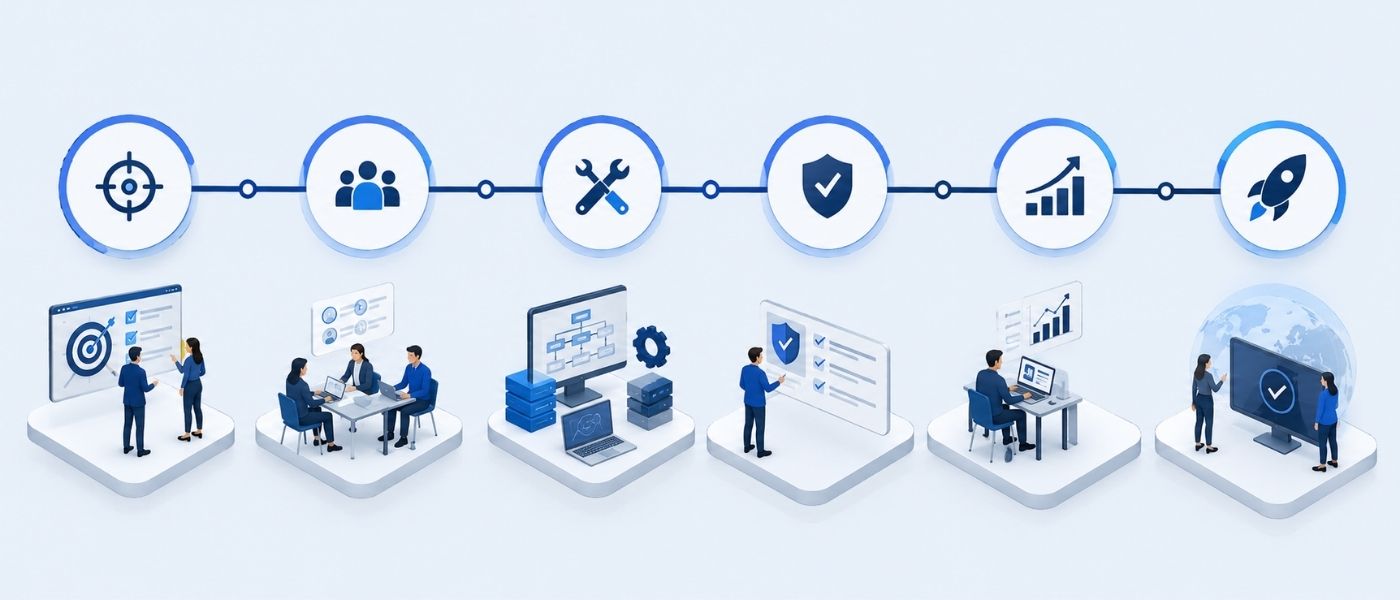
How to Implement IT Staff Augmentation Successfully
The practices that separate successful engagements from failed ones:
- Define roles with precision — vague job descriptions produce mismatched candidates. Write technical requirements as if hiring permanently.
- Integrate augmented staff into internal culture — team introductions, access to internal Slack or Teams, inclusion in planning meetings. Isolation is the primary cause of augmentation disengagement.
- Standardise tooling — augmented professionals should use the same Jira, GitHub, CI/CD pipelines, and documentation platforms as internal staff from day one.
- Establish communication cadence — daily stand-ups and weekly reviews are not optional overhead; they are the management infrastructure that makes distributed teams work.
- Implement security and governance controls before access is granted — not retrospectively.
- Measure performance continuously — weekly velocity tracking, code review participation, and sprint retrospectives should include augmented staff on equal terms.
FAQ
Q1: What is IT staff augmentation and how does it work?
IT staff augmentation involves integrating external technology professionals into your in-house team on a flexible basis. The client retains full control over scope, architecture, and delivery. The provider supplies pre-vetted talent that works within your existing tools, processes, and governance — functioning as a seamless team extension rather than a separate vendor.
Q2: How is IT staff augmentation different from outsourcing?
In outsourcing, the vendor owns the outcome and manages delivery independently. In staff augmentation, the client directs the work — augmented staff are an extension of the internal team. This means retained IP ownership, architectural authority, and daily control over priorities, which outsourcing does not provide.
Q3: How quickly can augmented IT staff be onboarded?
Quality providers can typically deploy pre-vetted professionals within one to three weeks, depending on seniority and specialisation. This compares to 3–6 months for traditional hiring cycles — a structural advantage that directly impacts project timelines and competitive speed.
Q4: What does IT staff augmentation cost?
Costs vary by role, seniority, and geography. India-based senior engineers typically cost $4,000–$7,000 per month all-in through a reputable provider — 50–65% less than equivalent US or UK in-house hiring when total employment costs are factored. Junior and mid-level roles are priced proportionally lower.
Q5: Is offshore IT staff augmentation secure
Reputable providers operate with ISO 27001 certification, SOC 2 Type II compliance, NDA-backed IP protection, and role-based access controls. Security risk is manageable with proper vetting and governance — the risk comes from poor provider selection, not the model itself.
Q6: What types of IT roles are best suited for staff augmentation?
Staff augmentation works best for specialised, project-specific, or time-bound roles — cloud engineers, data engineers, AI/ML specialists, cybersecurity professionals, full-stack developers, and ERP consultants. Permanent internal hiring is better suited to core leadership, product strategy, and roles requiring deep institutional knowledge.
Q7: How do you manage performance of augmented IT staff?
Treat augmented professionals identically to internal staff for performance measurement. Track delivery velocity, sprint completion, code quality, and collaboration metrics. Include them in retrospectives, code reviews, and planning sessions. Regular 1:1 check-ins between the engagement manager and team leads prevent issues from compounding.
Need specialized IT talent without the hiring risk?
iValuePlus provides end-to-end IT staff augmentation services—delivering pre-vetted engineers, developers, and technology specialists who integrate directly into your team within weeks. ISO-compliant, NDA-protected, and built for delivery. Get in touch today!
Recent Post
How to Set Up an Offshore QA Center of Excellence in India: A Practical Guide for Global Teams
Learn how to set up an offshore QA center of...
Managed IT Services for Small Businesses: Complete Guide (2026)
Discover what managed IT services for small businesses actually include,...

iValuePlus Services
iValuePlus is a one-stop solution to address all your needs to access, build and grow your business in the Indian market which is cost-effective & has a huge talent pool. Established in 2019 as a ‘Business Solution provider', our team has delivered successful growth projects in the international market.
Our services include setting up ODC (offshore development center), Staff Augmentation, Talent Acquisition, Digital Marketing, in the IT/ITES domain.