
Discover the best city to set up office in India...
Categories

How to Implement Finance & Accounting Outsourcing Services Without Risk | 2026 Guide
Why Finance and Accounting Outsourcing Is No Longer Optional
Finance and accounting (F&A) functions are the backbone of every organization. They ensure cash flow visibility, regulatory compliance, financial accuracy, and strategic decision-making. Yet, for many growing companies and global enterprises, managing these functions in-house has become increasingly complex, expensive, and risky.
Rising talent costs, compliance pressures, evolving accounting standards, multi-country tax regulations, and the demand for real-time financial insights are pushing organizations to rethink traditional operating models. This is where finance and accounting outsourcing services come into play.
However, while outsourcing promises cost savings, scalability, and access to specialized expertise, it also raises legitimate concerns:
- Will financial data remain secure?
- Will compliance standards be met across geographies?
- Will we lose control or visibility?
- Can an external partner truly understand our business?
This article answers those concerns. It provides a step-by-step, risk-mitigated framework for implementing finance and accounting outsourcing services—without compromising control, compliance, or strategic alignment.
Understanding Finance and Accounting Outsourcing Services
What Are Finance and Accounting Outsourcing Services?
Finance and accounting outsourcing services involve delegating part or all of an organization’s financial operations to a specialized external provider. These services range from transactional tasks to strategic finance functions.
Commonly Outsourced Finance & Accounting Functions
Transactional Services
- Accounts payable (AP)
- Accounts receivable (AR)
- General ledger (GL)
- Bank reconciliations
- Expense management
- Payroll processing
Payroll and accounting functions are often outsourced together to ensure regulatory alignment, as explained in this compliance-first payroll and accounting outsourcing strategy.
Compliance & Reporting
- Financial statements preparation
- Statutory and regulatory reporting
- Tax preparation and filings
- Audit support
- IFRS / GAAP compliance
Advanced & Strategic Services
- Financial planning and analysis (FP&A)
- Budgeting and forecasting
- Cash flow management
- Management reporting
- CFO advisory support
The Real Risks in Finance and Accounting Outsourcing
Outsourcing fails when companies treat it as a cost-cutting exercise rather than an operating model transformation.
Key Risks to Address Upfront
- Data Security & Confidentiality
Financial data is among the most sensitive business information. - Compliance & Regulatory Exposure
Errors in tax filings or reporting can result in penalties and reputational damage. - Loss of Control
Poor governance can lead to delays, inaccuracies, or misalignment. - Process Breakdowns
Undefined workflows cause inefficiencies and rework. - Vendor Dependency
Over-reliance without exit plans increases long-term risk. - Cultural & Communication Gaps
Misaligned expectations lead to friction and inefficiency.
A risk-free implementation addresses these issues by design, not as an afterthought.
Choosing the Right Finance and Accounting Outsourcing Model
There is no one-size-fits-all model. The right structure depends on your scale, geography, risk tolerance, and strategic goals.
- Transactional Outsourcing Model
- Best for startups and mid-sized firms
- Focus on AP, AR, payroll, reconciliations
- Low risk, quick implementation
- Managed Services Model
- Provider manages defined finance processes end-to-end
- SLA-driven performance
- Suitable for scaling businesses
- Dedicated Offshore Finance Team
- Full-time finance professionals aligned to your company
- High control and customization
- Ideal for global enterprises leveraging accounting services in India for overseas companies
- Hybrid / BOT (Build-Operate-Transfer) Model
- Provider builds and runs finance operations
- Gradual transfer to client ownership (optional)
- Lowest long-term risk for GCC-style finance operations
Risk Mitigation Tip:
Start with a hybrid or phased model to retain governance during transition.
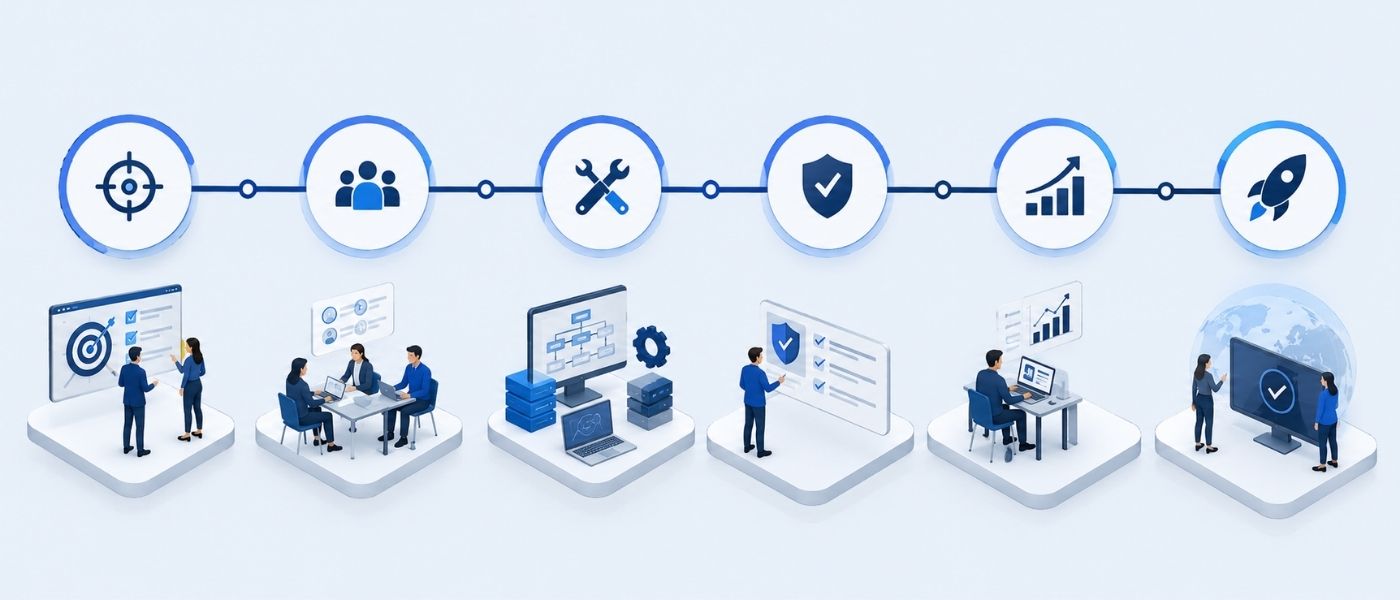
Step-by-Step Framework to Implement Without Risk
Step 1: Define Scope With Surgical Precision
Ambiguity is the biggest enemy of outsourcing success.
Best Practices
- Break functions into task-level components
- Define what stays in-house vs outsourced
- Identify decision-making vs execution tasks
Example
Instead of “outsourcing accounting,” define:
- Invoice processing
- Vendor reconciliations
- Month-end close activities
- Reporting timelines
Step 2: Conduct a Process & Controls Assessment
Before outsourcing, you must standardize internally.
Key Actions
- Document existing workflows
- Identify manual dependencies
- Remove bottlenecks and redundancies
- Define approval hierarchies
Outsourcing a broken process only amplifies inefficiencies.
Step 3: Select a Compliance-Ready Outsourcing Partner
Your outsourcing partner should function as a financial operations extension, not a vendor. Providers with proven strategic accounting outsourcing expertise consistently deliver better outcomes, as highlighted in this guide on strategic benefits of outsourcing accounting services.
Evaluation Criteria
- Experience with global accounting standards (IFRS, US GAAP, UK GAAP)
- Data security certifications (ISO 27001, SOC 2)
- Industry-specific finance expertise
- Regulatory knowledge across jurisdictions
- Robust transition methodology
Red Flag: Providers that promise savings but avoid governance discussions.
Step 4: Establish a Strong Governance & Control Framework
Risk-free outsourcing requires structured oversight.
Governance Components
- Defined SLAs and KPIs
- Escalation matrices
- Approval workflows
- Audit trails
- Monthly performance reviews
Control Mechanisms
- Maker-checker principles
- Segregation of duties
- Role-based system access
- Real-time dashboards
Step 5: Implement Secure Technology & Systems Integration
Technology is a risk mitigator—not a risk.
Key Elements
- Secure VPN and role-based access
- Integration with ERP systems (SAP, Oracle, NetSuite, QuickBooks)
- Automated workflows
- Cloud-based document management
- Data encryption protocols
Outsourcing should improve visibility, not reduce it.
Step 6: Phased Transition & Parallel Runs
Never “lift and shift” finance operations overnight.
Recommended Approach
- Knowledge transfer phase
- Parallel processing for 1–3 cycles
- Validation of outputs
- Gradual volume ramp-up
This ensures accuracy before full handover.

Compliance, Risk & Regulatory Safeguards
Financial Compliance Areas to Secure
- Statutory reporting
- Tax compliance
- Payroll laws
- Transfer pricing documentation
- Cross-border regulations
Best Practices for Zero Compliance Risk
- Retain compliance ownership internally
- Outsource execution, not accountability
- Regular internal and external audits
- Documented SOPs aligned with regulations
- Continuous regulatory updates
Managing Data Security & Confidentiality
Finance outsourcing must follow bank-grade security standards.
Essential Controls
- NDA and data protection clauses
- Secure access protocols
- Restricted device policies
- Continuous monitoring
- Disaster recovery planning
A credible provider treats data protection as a non-negotiable foundation.
Measuring Success Beyond Cost Savings
Cost reduction is only one dimension of value.
Key Performance Metrics
- Close cycle time
- Error rates
- Compliance adherence
- Forecast accuracy
- Cash flow visibility
- Cost-to-revenue ratio
Strategic Outcomes
- Faster decision-making
- Better financial insights
- Improved audit readiness
- Scalability without proportional cost increase
Common Mistakes That Increase Outsourcing Risk
Avoid these pitfalls:
- Choosing the cheapest provider
- Lack of internal ownership
- Poor documentation
- No exit strategy
- Over-outsourcing strategic finance roles
- Ignoring cultural alignment

Building a Long-Term, Low-Risk Finance Outsourcing Strategy
Finance and accounting outsourcing services should evolve with your business.
Future-Ready Approach
- Start transactional, move strategic
- Leverage analytics and automation
- Build shared ownership models
- Periodically reassess scope and KPIs
Align finance outsourcing with business growth plans
Why Finance and Accounting Outsourcing Works When Done Right
When implemented with structure, governance, and intent, finance and accounting outsourcing services deliver:
- Predictable cost structures
- Access to global finance talent
- Stronger compliance posture
- Improved financial visibility
- Scalable operations
- Reduced operational risk
Outsourcing is not about losing control—it’s about designing a better operating model.
Conclusion
The success or failure of finance and accounting outsourcing services is determined before the contract is signed—in how you design the model, choose the partner, and govern execution.
Organizations that approach outsourcing strategically gain a finance function that is:
- More resilient
- More compliant
- More scalable
- More insight-driven
When done right, finance and accounting outsourcing is not a risk—it is a competitive advantage.
Recent Post
How to Set Up an Offshore QA Center of Excellence in India: A Practical Guide for Global Teams
Learn how to set up an offshore QA center of...
Managed IT Services for Small Businesses: Complete Guide (2026)
Discover what managed IT services for small businesses actually include,...

iValuePlus Services
iValuePlus is a one-stop solution to address all your needs to access, build and grow your business in the Indian market which is cost-effective & has a huge talent pool. Established in 2019 as a ‘Business Solution provider', our team has delivered successful growth projects in the international market.
Our services include setting up ODC (offshore development center), Staff Augmentation, Talent Acquisition, Digital Marketing, in the IT/ITES domain.