
Discover the best city to set up office in India...
Categories


Offshore Development Services Explained: Models, Processes, and Best Practices
Offshore Development Is No Longer Just Outsourcing
Offshore development services have undergone a fundamental transformation over the past decade. What was once perceived as a cost-driven outsourcing tactic has evolved into a strategic operating model that supports innovation, scalability, resilience, and long-term growth.
In 2026, offshore development services are no longer limited to non-core tasks or maintenance work. Leading global companies rely on offshore teams to build mission-critical platforms, digital products, cloud-native systems, and data-driven solutions. The shift has been driven by persistent talent shortages, rising engineering costs in mature markets, and the need for continuous, high-velocity delivery.
This article provides a complete, practical explanation of offshore development services—covering delivery models, operational processes, governance structures, and best practices—so organizations can make informed decisions and avoid common pitfalls.
What Are Offshore Development Services?
Definition and Scope
Offshore development services involve engaging software engineers, QA professionals, DevOps specialists, data engineers, and related IT talent located in another country to support application development, product engineering, platform modernization, and digital transformation initiatives.
These services typically cover:
- Software and application development
- Cloud and DevOps engineering
- QA, testing, and automation
- Data engineering and analytics
- AI/ML and emerging technologies
- Maintenance, enhancement, and support
The defining principle is that offshore teams work as an extension of the client’s organization, aligned with its tools, standards, security policies, and delivery methodology—an approach central to modern offshore outsourcing services with end-to-end global delivery.
How Offshore Development Has Evolved
Early offshore models were:
- Vendor-led
- Transactional
- Output-focused
- Low governance
Modern offshore development services are:
- Client-governed
- Product- and outcome-driven
- Security- and compliance-first
- Deeply integrated with internal teams
This evolution is what enables offshore development to support core business systems, not just peripheral work.
Why Companies Use Offshore Development Services in 2026
Global Talent Shortage
Demand for advanced skills—cloud, cybersecurity, AI, data—continues to outpace supply in local markets. Offshore locations provide access to:
- Larger talent pools
- Specialized expertise
- Faster hiring cycles
Offshore development services remove geographic constraints from hiring.
Cost Optimization With Strategic Impact
Offshore delivery reduces:
- Salary and benefit costs
- Recruitment and attrition costs
- Time-to-productivity
More importantly, it allows organizations to reinvest savings into innovation and growth, rather than merely reducing spend.
Speed, Scalability, and Flexibility
Offshore development enables:
- Rapid team ramp-up and ramp-down
- Parallel workstreams
- Continuous delivery across time zones
This flexibility is critical in fast-changing markets.
Support for Long-Term Digital Transformation
Large initiatives—cloud migration, platform modernization, data transformation—require sustained engineering capacity. Offshore development services provide:
- Long-term scalability
- Stable teams
- Predictable cost structures
Offshore Development Service Models Explained
Choosing the right model is one of the most critical success factors.
Offshore Staff Augmentation
What it is:
Individual offshore engineers are embedded directly into the client’s teams.
Key characteristics:
- Client manages tasks and priorities
- High flexibility
- Fast onboarding
- Ideal for skill gaps or rapid scaling
Best for:
- Agile product teams
- Short- to medium-term needs
- Specialized roles
Dedicated Offshore Development Teams
What it is:
A dedicated offshore team works exclusively for one client on an ongoing basis.
Key characteristics:
- Stable team composition
- Deep product and domain knowledge
- Client retains delivery control
Best for:
- Long-term product development
- Platform engineering
- SaaS and enterprise systems
Managed Offshore Development Services
What it is:
The offshore provider takes responsibility for delivery outcomes, SLAs, and quality.
Key characteristics:
- Vendor-managed execution
- Outcome- or SLA-driven
- Reduced internal management effort
Best for:
- Well-defined scopes
- Support and maintenance
- Non-core platforms
Offshore Development Center (ODC)
What it is:
A dedicated, scalable offshore center that functions as an extension of the client’s organization.
Key characteristics:
- Long-term commitment
- High cultural and process alignment
- Often exclusive or semi-captive
Best for:
- Enterprises with sustained offshore demand
- Multi-product portfolios
- Strategic global delivery
Organizations exploring this model often follow a structured approach to how to set up an offshore development center in India.
Hybrid and BOT Models
Many organizations combine offshore development services with:
- Hybrid onshore–offshore models
- BOT (Build–Operate–Transfer) frameworks
- GCC (Global Capability Center) roadmaps
This allows phased maturity with lower upfront risk.
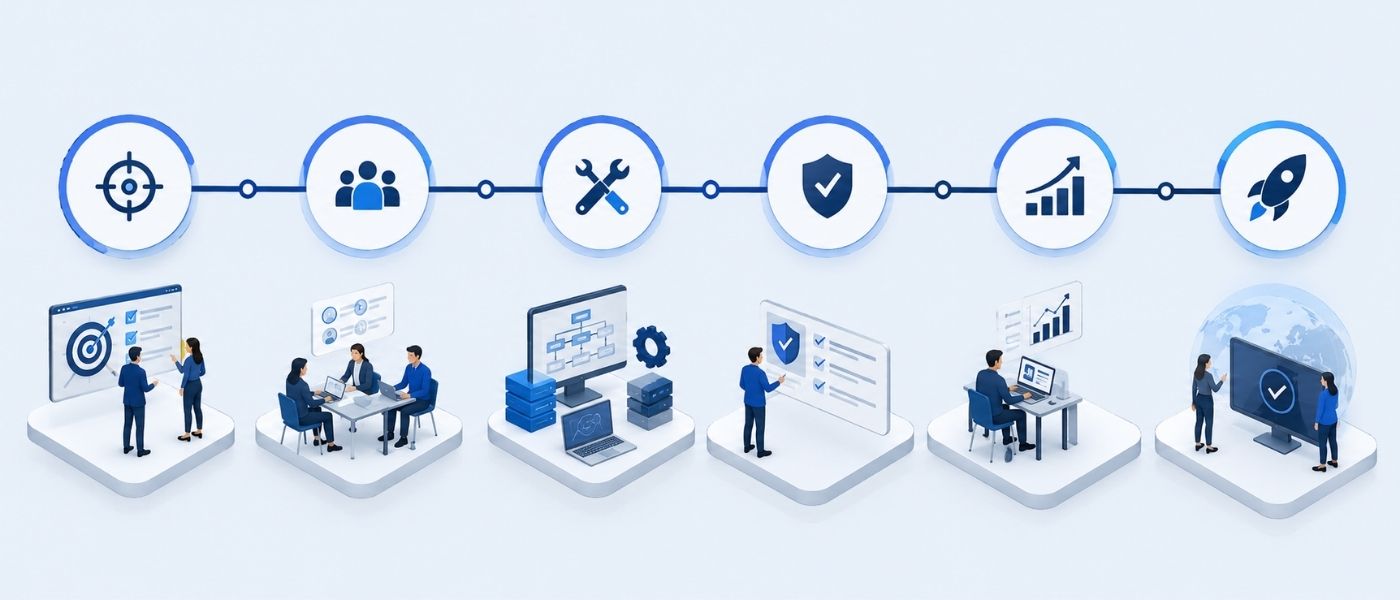
The Offshore Development Process: End-to-End
Discovery and Planning
Successful offshore engagements start with:
- Clear business objectives
- Defined scope and success metrics
- Technology and architecture alignment
- Risk and dependency assessment
This phase sets expectations and prevents downstream friction.
Team Formation and Onboarding
Key onboarding elements include:
- Role definitions and skill mapping
- Tool and environment access
- Security and compliance training
- Process and documentation walkthroughs
Strong onboarding accelerates productivity and alignment.
Delivery and Execution
Modern offshore teams operate using:
- Agile or hybrid methodologies
- CI/CD pipelines
- Automated testing and code quality checks
- Regular sprint ceremonies
Offshore teams should be indistinguishable from onshore teams in day-to-day execution.
Governance and Communication
Effective governance includes:
- Defined RACI models
- Regular status and performance reviews
- Clear escalation paths
- Stakeholder alignment forums
Governance ensures offshore development remains controlled, transparent, and predictable.
Continuous Improvement
Mature offshore development services emphasize:
- Retrospectives and feedback loops
- Process optimization
- Skill upskilling
- Automation and tooling improvements
Offshore delivery should improve over time, not stagnate.
Best Practices for Offshore Development Services
Treat Offshore Teams as an Extension, Not a Vendor
High-performing organizations:
- Include offshore teams in planning and retrospectives
- Share product context and roadmaps
- Build long-term relationships
This dramatically improves quality and ownership.
Prioritize Governance Over Micromanagement
Clear governance frameworks reduce the need for constant oversight. Focus on:
- Outcomes
- KPIs
- Accountability
Not task-level micromanagement.
Invest in Communication and Overlap
Best practices include:
- Defined overlap hours
- Regular video interactions
- Documentation-first culture
Practical methods for this are outlined in 5 tips for bridging time zone gaps with your offshore team.
Build Security and Compliance Into the Model
Modern offshore development services must include:
- Secure access controls
- IP protection clauses
- Compliance with ISO, SOC 2, GDPR
- Regular audits
Security should be proactive, not reactive.
Standardize Tools and Processes
Using shared:
- Repositories
- CI/CD pipelines
- Ticketing systems
- Monitoring tools
Ensures consistency and transparency across geographies.
Quality Assurance in Offshore Development
Quality is maintained through:
- Automated testing
- Code reviews
- Static analysis
- Performance and security testing
Offshore teams should follow the same quality gates as internal teams.
Addressing Common Offshore Development Challenges
Time Zone Differences
Mitigation strategies:
- Defined overlap windows
- Asynchronous communication
- Clear handoff processes
Time zones can become an advantage for 24/7 delivery.
Cultural Differences
Cultural alignment improves through:
- Cross-cultural training
- Stable team structures
- Shared values and goals
Long-term teams outperform rotating resources.
Knowledge Retention
Reduce dependency on individuals by:
- Documentation
- Knowledge bases
- Code ownership practices
- Cross-training
Offshore Development vs In-House vs GCC
Criteria | In-House | Offshore Development Services | GCC |
Speed to scale | Slow | Fast | Medium |
Cost efficiency | Low | High | Medium |
Setup effort | Low | Low | High |
Control | High | High | Very high |
Flexibility | Low | High | Medium |
Many companies start with offshore development services before evolving into GCCs.
Measuring Success in Offshore Development
Key metrics include:
- Velocity and throughput
- Defect rates
- Release frequency
- Cost per feature
- Team stability
- Stakeholder satisfaction
Metrics should focus on outcomes, not just hours worked.
The Future of Offshore Development Services
By 2026 and beyond, offshore development will increasingly feature:
- AI-assisted coding and testing
- Outcome-based pricing models
- Deeper integration with global operating models
- Stronger emphasis on compliance and governance
- Blurred lines between offshore, nearshore, and captive centers
Offshore development will become a default capability, not an alternative.
Conclusion
Offshore development services, when designed and governed correctly, enable organizations to:
- Scale faster
- Access global talent
- Reduce risk
- Improve cost efficiency
- Accelerate innovation
The difference between success and failure lies not in geography, but in models, processes, and best practices.
In 2026, offshore development is no longer about where work is done—it is about how global teams are orchestrated to deliver sustained business value.
Organizations that master offshore development services will build resilient, scalable, and future-ready technology organizations.
Recent Post
How to Set Up an Offshore QA Center of Excellence in India: A Practical Guide for Global Teams
Learn how to set up an offshore QA center of...
Managed IT Services for Small Businesses: Complete Guide (2026)
Discover what managed IT services for small businesses actually include,...

iValuePlus Services
iValuePlus is a one-stop solution to address all your needs to access, build and grow your business in the Indian market which is cost-effective & has a huge talent pool. Established in 2019 as a ‘Business Solution provider', our team has delivered successful growth projects in the international market.
Our services include setting up ODC (offshore development center), Staff Augmentation, Talent Acquisition, Digital Marketing, in the IT/ITES domain.