
Discover the best city to set up office in India...

DevOps Transformation in 2026: Scale With Speed, Security, and Cost Control
The landscape of software delivery has fundamentally shifted. Organizations are no longer asking whether DevOps matters, they’re asking how to master it at scale. In February 2026, the answer to that question looks very different than it did just two years ago, driven by AI-powered automation, strict financial governance, and an unwavering focus on security from day one.
This article explores the critical trends shaping DevOps strategy in 2026, backed by the latest industry data, and reveals what separates high-performing teams from those still struggling with fragmented toolchains and escalating cloud bills.
The DevOps Reality Check: Why 99% of Organizations Get It Right, But Most Still Struggle
The headline is encouraging: 99% of organizations that have implemented DevOps report positive effects on their operations. What’s even more compelling is that 83% of IT decision-makers now adopt DevOps explicitly to generate greater business value, not just technical efficiency.
But here’s the catch.
While the broad adoption is real, execution remains uneven. 61% of organizations report that DevOps has enhanced the quality of their deliverables, and 49% achieved shorter time to market after adoption but that leaves significant room for improvement. Many teams still operate with scattered, team-specific toolchains, inconsistent security practices, and opaque cloud spending.
The difference between winners and strugglers in 2026 comes down to one thing: operational structure. Teams that treat DevOps as a strategic platform for the entire organization—not a technical afterthought capture the real value.
What Organizations Are Actually Winning On
The data reveals three clear categories where mature DevOps teams pull ahead:
- Incident Response Speed: Organizations with strong DevOps practices can respond to published errors within hours. 39% of DevOps teams can fix a published error within a day, while others require weeks.
- Deployment Frequency: The gap between leaders and laggards is stark. While 9% of organizations release to production multiple times per day, 6% only do so multiple times per year.
- Cost Control: Organizations implementing structured cost optimization programs see measurable savings. Enterprises that implement structured cost optimization programs report an average 25–30% reduction in monthly cloud spend.
These aren’t small differences. They’re the difference between shipping competitive products and falling behind.

The 2026 DevOps Landscape: Seven Pillars Reshaping How Teams Work
Unlike previous years when DevOps was primarily focused on CI/CD automation, 2026 is characterized by integration across multiple disciplines. The strategic question organizations are asking is no longer “should we adopt DevOps?” but rather “which combination of practices fits our constraints, and how do we sequence the investment?”
1. Platform Engineering as the New Foundation
Platform engineering has moved from experimental to essential. By 2026, roughly 80% of software development organizations will rely on internal developer platforms (IDPs) to manage complexity and improve developer experience, moving away from scattered, team-specific toolchains.
What does this mean practically? Self-service portals, standardized “paved roads,” and golden paths that reduce manual ticket-driven work. Developers spend less time provisioning and more time building.
2. AI in CI/CD: From Recommendation to Action
The role of AI in DevOps has fundamentally changed. In 2025, teams relied on AI for recommendations. In 2026, AI is becoming an executor. In 2025, 76% of DevOps teams integrated AI into CI/CD, shifting from passive dashboards to predictive, automated responses in the delivery chain.
This translates to:
- Intelligent test selection (running only relevant tests)
- Predictive anomaly detection (flagging issues before users see them)
- Autonomous remediation (fixing known issues without human intervention)
3. GitOps and Declarative Infrastructure
GitOps adoption reached 64%, and 81% of adopters reported higher infrastructure reliability and faster rollback. This trend reflects a broader shift toward treating infrastructure as code, with Git as the single source of truth.
The operational benefit is tangible: infrastructure changes become auditable, reversible, and collaborative, just like code.
4. DevSecOps: Security Embedded, Not Bolted On
Security integration is accelerating. By 2025, 75% of DevOps initiatives include integrated security practices, up from just 40% in 2023. In 2026, this isn’t optional it’s the baseline expectation.
The shift is from reactive vulnerability patching to proactive threat modeling integrated into pipelines. AI will transform DevSecOps from reactive to predictive, spotting vulnerabilities before they become risks and automating compliance in real time, not after the fact.
5. Observability 2.0: From Dashboards to Actionable Insights
Traditional monitoring is dead. Observability is a major DevOps trend as organizations seek deeper visibility into increasingly complex and distributed systems. In 2026, this practice moves to the next level with observability 2.0, powered by AI and ML, where DevOps engineers can analyze massive streams of data, surface hidden patterns, and predict potential failures.
Real-time data analysis, automated root cause analysis, and predictive failure detection are now table stakes.
6. FinOps: Making Cloud Economics a Daily Practice
The explosion of cloud spending has forced a reckoning. Cloud cost management has evolved from an operational necessity to a strategic business discipline, with continuous cost optimization and dynamic resource allocation expected to save organizations up to USD 100 billion globally per year.
FinOps automation will become standard practice for 75% of enterprises by 2026. But it’s not just tooling it’s culture. Teams now see cost as a first-class metric, alongside reliability and performance.
7. AI and ML Operations (AIOps and MLOps)
As organizations accelerate AI adoption, specialized practices are emerging. By 2026, AIOps will be a standard component in 40% of DevOps teams, significantly reducing time spent on routine operations tasks and improving service quality.
MLOps, the operationalization of machine learning models, is equally critical. Managing model retraining, data quality, and production performance requires infrastructure and discipline distinct from traditional application deployment.

The Cost Reality: Why 94% of IT Leaders Struggle
94% of IT leaders worldwide struggle to manage and optimize cloud costs. This isn’t a technical problem, it’s a systemic one. Many organizations lack visibility into spending, lack cost allocation clarity, and lack governance mechanisms to prevent waste.
The problem is compounded by AI. GPU instances and AI inference workloads cost 5–10x standard compute. Organizations without disciplined cost practices can see bills skyrocket unexpectedly.
Here’s what separates efficient from inefficient organizations:
- Only 23% of organizations consider themselves “highly efficient” in cloud cost management (FinOps Foundation)
- Idle or underutilized resources account for 28–35% of total cloud waste
- Organizations with AI/ML workloads that track costs saw spending grow 46% year-over-year
The organizations getting ahead are implementing three things simultaneously:
- Real-time Cost Visibility: Dashboards that show team-level, service-level, and project-level costs updated hourly
- Automated Governance: Cost guardrails, budget alerts, and automated de-provisioning of idle resources
Engineering-Led Accountability: Making cost visible to engineers as they write code, not just in post-hoc finance reviews
The DevOps Skills Crisis: A Double-Edged Sword
Demand for DevOps expertise is at an all-time high. 65% of recruiters report a “surge in underqualified candidates” applying for specialized roles like DevOps engineers.
This creates both challenge and opportunity. Organizations with internal DevOps expertise and platform engineering practices can hire and onboard engineers faster. Those without face a talent crunch.
For many mid-market and enterprise organizations, the practical solution isn’t to hire 10 new engineers—it’s to partner with specialized external teams that bring certified expertise, proven frameworks, and 24/7 operational support.
Multi-Cloud and Hybrid: Complexity as the Norm
80% of organizations use multiple public or private clouds. Single-cloud strategies are rare. This complexity creates both architectural challenges and unique opportunities for cost optimization and resilience.
In 2026, successful DevOps practices must:
- Unify CI/CD pipelines across cloud providers
- Provide consistent security and compliance enforcement
- Deliver cost visibility across all clouds simultaneously
- Enable workload portability and migration strategies
This is no longer a “nice to have” capability—it’s the new baseline for enterprises.

Real-World DevOps Success: What Mature Organizations Actually Do
The gap between aspirational DevOps and reality is large. Here are the practices separating winners from the rest:
Practice 1: Dedicated Cross-Functional Platform Teams
Mature organizations don’t assign DevOps to existing IT teams. They create dedicated platform engineering teams—cloud architects, DevOps engineers, and security specialists working together to design and maintain infrastructure as a product.
Practice 2: Automated Compliance and Security
Instead of manual security reviews and compliance audits, mature teams embed security checks directly into CI/CD pipelines. Code scanning, infrastructure validation, and policy-as-code enforcement happen automatically, with developers seeing results in seconds, not weeks.
Practice 3: Continuous Financial Accountability
Cost isn’t reviewed once a month—it’s tracked continuously. Teams see cost impact in pull request reviews. Budget alerts fire before overages occur. This visibility prevents the “surprise bill” syndrome that plagues many organizations.
Practice 4: SRE-Driven Reliability
Service-level objectives (SLOs) aren’t marketing promises—they’re operational targets. Teams measure and improve based on real metrics. Blameless postmortems drive continuous improvement.
Practice 5: 24/7 Observability and Support
Production systems don’t sleep. Mature organizations maintain 24/7 monitoring and incident response, either through internal SRE teams or through managed services partnerships.
Building Your DevOps Transformation Roadmap
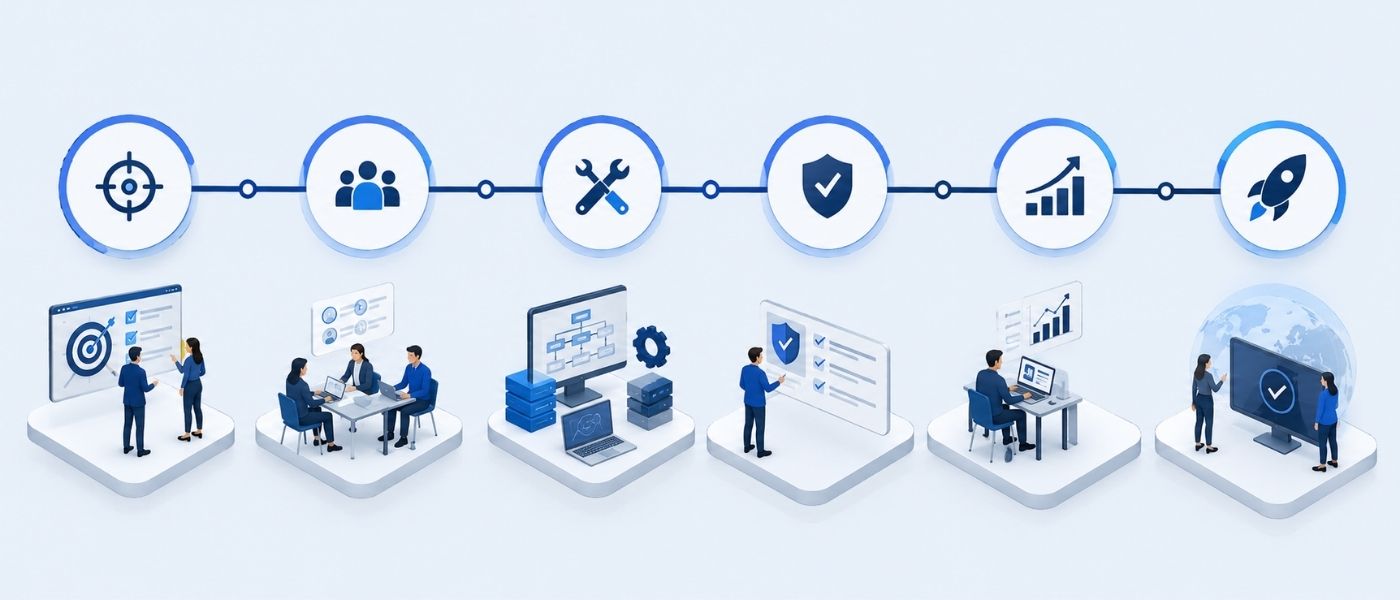
If your organization is still at the beginning of its DevOps journey, or if you’re struggling with the complexity of scaling DevOps across multiple teams and cloud environments, the roadmap typically follows this pattern:
Phase 1: Establish Visibility
- Assess current applications, infrastructure, and security posture
- Define business objectives and success metrics
- Identify skill gaps and resource needs
Phase 2: Build Foundations
- Design and deploy scalable cloud architecture using Infrastructure as Code
- Set up CI/CD automation and containerization
- Implement basic monitoring and alerting
Phase 3: Automate and Scale
- Deploy advanced observability and cost monitoring
- Implement DevSecOps and compliance automation
- Establish SRE practices and incident response protocols
Phase 4: Optimize and Evolve (Ongoing)
- Refine cost optimization strategies
- Integrate AI-driven automation
- Foster a true DevOps culture across teams
The Bottom Line: DevOps in 2026 Requires Strategic Partnership
The data is clear: organizations are investing heavily in DevOps because it works. But scaling DevOps across multiple cloud providers, managing complex workloads, maintaining security and compliance, and controlling runaway cloud costs—requires more than just tools and documentation.
It requires certified expertise, proven frameworks, and continuous oversight. It requires teams that understand both the technical depth of cloud infrastructure and the business context of your organization.
This is where the execution gap opens up for most organizations.
How iValuePlus Can Accelerate Your DevOps Transformation
At iValuePlus, we work with enterprises to design and deliver end-to-end DevOps transformations that connect directly to business outcomes: faster time-to-market, reduced operational risk, and measurable cloud cost savings.
Here’s what we bring:
Certified Expertise: Our team includes AWS DevOps Engineers, Azure Solutions Architects, Kubernetes-certified professionals, and Red Hat Certified Engineers. We don’t just implement tools, we architect solutions tailored to your business goals and constraints.
Proven Frameworks: Rather than building from scratch, we apply frameworks and best practices refined across dozens of enterprise transformations. Your roadmap isn’t theoretical; it’s grounded in real-world outcomes.
Multi-Cloud Flexibility: Whether you’re on AWS, Azure, GCP, or managing hybrid and multi-cloud environments, we bring vendor-neutral expertise that optimizes across all your platforms.
24/7 Operational Support: Through our IVPHUB managed services platform, we provide continuous monitoring, incident response, and optimization—so you focus on innovation while we manage the infrastructure.
End-to-End Service Coverage: From cloud strategy and architecture, to CI/CD pipeline design, containerization and Kubernetes orchestration, infrastructure as code, cloud migration, DevSecOps automation, cost optimization, and SRE enablement—we handle the complete spectrum.
Cost Optimization as Standard: Cloud bills shouldn’t be a surprise. We implement FinOps practices, cost governance automation, and continuous optimization that typically deliver 20–30% annual savings.
Engagement Models That Fit:
- Managed Services: 24/7 monitoring and SLA-backed support
- Project-Based Delivery: End-to-end DevOps enablement
- Dedicated Teams: Client-branded DevOps pods
- Build, Operate & Transfer: Full support including knowledge transfer
The organizations that are winning in 2026 aren’t the ones with the biggest DevOps teams, they’re the ones with the right structure, the right expertise, and the right partners.
If you’re ready to move from DevOps aspiration to DevOps excellence, we’re here to help you navigate the complexity and accelerate your transformation.
Ready to get started?
Get in touch with us to learn how our tailored outsourcing solutions can support your business objectives and drive long-term.
Recent Post
How to Set Up an Offshore QA Center of Excellence in India: A Practical Guide for Global Teams
Learn how to set up an offshore QA center of...
Managed IT Services for Small Businesses: Complete Guide (2026)
Discover what managed IT services for small businesses actually include,...

iValuePlus Services
iValuePlus is a one-stop solution to address all your needs to access, build and grow your business in the Indian market which is cost-effective & has a huge talent pool. Established in 2019 as a ‘Business Solution provider', our team has delivered successful growth projects in the international market.
Our services include setting up ODC (offshore development center), Staff Augmentation, Talent Acquisition, Digital Marketing, in the IT/ITES domain.