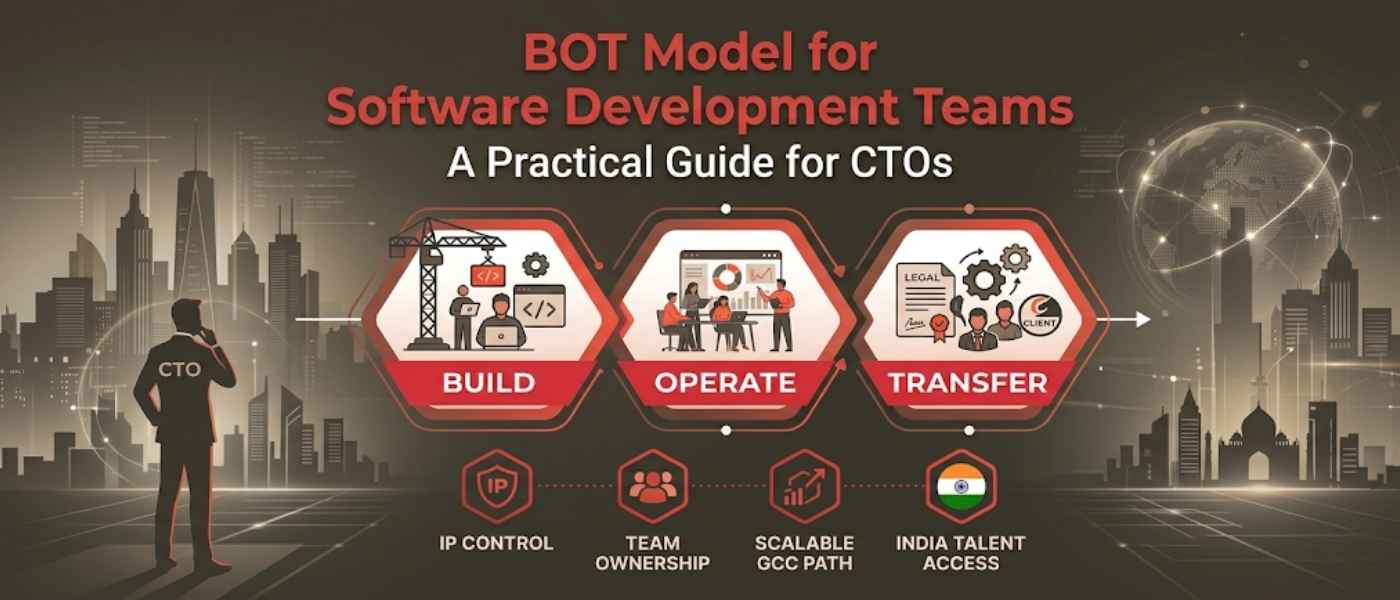

Learn how the BOT Model for Software Development Teams helps...

How to Scale Your Engineering Team with an Offshore Development Centre
Scaling your engineering team with an offshore development centre means establishing a dedicated, long-term remote engineering unit in a talent-rich country. Unlike ad hoc freelancers or short-term contractors, an ODC operates as a fully integrated extension of your in-house team — with dedicated developers, aligned processes, and shared product ownership — allowing engineering leaders to expand capacity fast without the cost and time-to-hire constraints of local recruitment.
Key Takeaways
• An Offshore Development Centre (ODC) is a long-term, dedicated engineering unit — not a freelance pool.
• ODCs reduce time-to-hire from 3–6 months (local) to 4–8 weeks for the first cohort.
• Cost savings of 50–70% vs. equivalent US/UK engineers are realistic — but total value matters more than rate arbitrage.
• The biggest scaling failures happen in onboarding and cultural integration, not technical capability.
• Successful ODC scaling requires clear ownership models, shared tooling, and deliberate communication rituals.
• ODC vs. staff augmentation: augmentation suits sprint bursts; ODC suits long-term product ownership and team continuity.
• Engineering leaders should treat ODC setup as a product launch — not a procurement exercise.
The Engineering Capacity Crisis No One Talks About Honestly
Real Scenario
A Series B startup CTO has seven open engineering roles. The recruiter says 3–4 months to fill each. The product roadmap cannot wait. Two senior engineers just quit for larger companies. The board wants a platform redesign shipped in Q2. Sound familiar?
The structural problem is not unique to startups. Mid-market companies scaling from 50 to 200 engineers face it too. Even enterprise IT departments hit it when spinning up new product lines. Local engineering talent is scarce, expensive, and slow to recruit — particularly in markets like the US, UK, Germany, and Australia where demand for senior developers consistently outpaces supply.
According to the U.S. Bureau of Labor Statistics, software developer employment is projected to grow 25% through 2032, far outpacing average occupational growth. Meanwhile, Stack Overflow’s Developer Survey consistently shows that developers with 5+ years of experience are the most in-demand and the hardest to retain. Time-to-hire for senior engineers in competitive markets now averages 45–90 days, and that is before factoring in onboarding ramp-up.
The result is a compound problem: teams cannot ship fast enough to meet product velocity expectations, and they cannot hire fast enough to close the gap. This is precisely the inflection point where engineering leaders begin evaluating the offshore development centre model seriously — not as a cost-cutting measure, but as a structural solution to a structural problem.
This article is written for those leaders: founders, CTOs, VPs of Engineering, and product managers who are past the ‘is offshore even viable?’ question and want a clear, honest, execution-focused guide to making it work.
What Is an Offshore Development Centre?
An Offshore Development Centre (ODC) is a dedicated, long-term software engineering unit established in a foreign country, operating as a functional extension of a company’s core engineering team. Unlike outsourced project vendors or freelance contractors, an ODC is staffed with full-time developers who work exclusively for one client, follow that client’s engineering processes, and are integrated into their sprint cycles, codebase, and product roadmap.
What an ODC Is NOT
- It is not a freelance platform (Upwork, Toptal) where you hire individuals per project
- It is not a project outsourcing arrangement where a vendor delivers a defined scope
- It is not a body-shopping exercise where you pay for warm seats without skill guarantees
- It is not a temporary arrangement — ODCs are designed for 12+ month engagements with team continuity
The Three Operating Models
Not all ODCs are structured the same way. Understanding the operating model options is critical to choosing the right fit:
- Fully Managed ODC
The offshore partner manages recruitment, HR, facilities, and team leadership. You retain product and technical direction. Best for companies without prior offshore experience or those scaling quickly without an established management bandwidth.
- Build-Operate-Transfer (BOT)
The partner builds and operates for an agreed period (typically 12–24 months), then transfers ownership — legally and operationally — to you. Best for companies planning to eventually own the offshore entity outright.
- Captive Centre
You establish and directly own the offshore entity from day one — your own legal entity, office, and payroll in the destination country. Highest control, highest setup cost, and requires significant HR and legal infrastructure. Best for enterprises with 50+ offshore headcount targets.
For most engineering leaders scaling from 5 to 50 offshore engineers, the fully managed ODC is the practical starting point. The BOT model becomes relevant when offshore headcount exceeds 30–40 and you want to reduce dependency on the partner.
ODC vs. Staff Augmentation vs. In-House: Choosing the Right Model
This is the most consequential strategic decision, and most leaders get it wrong by defaulting to whichever model they are most familiar with rather than the one that matches their actual situation.
Dimension | In-House Team | Staff Augmentation | Offshore Development Centre |
Cost per Engineer/yr | $120K–$200K (US) | $60K–$100K blended | $25K–$60K (India/EE) |
Time to Hire | 3–6 months | 2–6 weeks | 4–8 weeks (first build) |
IP & Code Control | Full | Full | Full (if structured) |
Team Continuity | High | Low–Medium | High |
Ramp-up Speed | Slow | Fast | Medium (first time) |
Cultural Alignment | Native | Variable | Requires investment |
Scalability | Limited by local talent | Short-term flexible | Long-term scalable |
Operational Overhead | High (HR, benefits) | Medium | Low–Medium (via partner) |
Knowledge Retention | High | Low (contractor churn) | High |
Best For | Core product ownership | Sprint bursts, skill gaps | Long-term team growth |
The Decision Framework
Use the following questions to guide model selection:
- Do you need engineers for more than 6 months with continuous delivery? → ODC
- Do you need to fill a specific skill gap for a 3-month sprint? → Staff Augmentation
- Is this team going to own a product area long-term? → ODC or In-House
- Is budget flexibility more important than continuity? → Augmentation
- Do you plan to scale beyond 20 engineers offshore? → ODC (augmentation doesn’t scale cleanly)
Staff augmentation is faster to start and easier to exit. ODCs require more upfront investment in setup and integration but deliver significantly better ROI at scale. Engineering leaders who treat offshore purely as a cost lever usually choose augmentation and then wonder why quality and continuity suffer.
When Is the Right Time to Scale with an Offshore Development Centre?
There is no universal answer, but there are clear signals that indicate readiness — and clear warning signs that indicate premature scaling.
Strong Signals You Are Ready
- Your engineering backlog has grown consistently for 2+ quarters despite hiring
- Time-to-hire for engineers in your local market exceeds 60 days
- Your product roadmap has well-defined sub-systems or modules that can be team-owned
- You have documented engineering processes: sprint rituals, code review standards, CI/CD pipelines
- Leadership has alignment that offshore is a strategic capability, not a short-term fix
- You have at least one senior engineer willing to act as the integration bridge (tech lead or engineering manager)
Warning Signs You Are Not Ready
- Your codebase has no documentation and relies entirely on institutional knowledge
- Your product requirements change weekly without structure (ODC teams need reasonable stability to operate)
- You expect immediate productivity from day one — ODC onboarding realistically takes 4–8 weeks
- Leadership sees offshore as purely a cost measure and is unwilling to invest in integration
- You are scaling with no in-house engineering leadership to manage the distributed team
ODCs amplify what already exists in your engineering culture. If your in-house processes are strong, an ODC will scale them. If they are fragmented, the ODC will surface those problems faster. Use the ODC readiness assessment as a forcing function to improve internal process before scaling offshore.
How to Scale Your Engineering Team with an ODC: The 5-Phase Execution Framework
Phase | Timeframe | Key Activities | Outcome |
1. Design | Weeks 1–2 | Role mapping, partner selection, legal setup | ODC blueprint ready |
2. Hire & Onboard | Weeks 3–8 | Talent sourcing, interviews, onboarding sprint | Team operational |
3. Integrate | Months 2–3 | Tooling, rituals, initial sprints | Velocity baseline set |
4. Scale | Months 3–6 | Add engineers, expand scope | ODC owns sub-products |
5. Optimise | Month 6+ | KPI reviews, promotions, autonomy grants | Self-sustaining unit |
Phase 1: ODC Design (Weeks 1–2)
Before hiring a single engineer, the architecture of the ODC must be defined. This means:
Role and Team Topology
Map the roles you need, not just the headcount. A common mistake is requesting ’10 developers’ without specifying full-stack vs. backend vs. frontend split, seniority mix, or whether you need QA, DevOps, and product design embedded. A functional ODC team for a product module typically looks like: 1 tech lead, 4 engineers (2 senior, 2 mid), 1 QA engineer. This is a delivery-capable unit. Scale this module, not individual contributors.
Legal and IP Structure
Regardless of ODC model (managed, BOT, captive), establish clear contractual IP ownership before work begins. This means: all code is work-for-hire belonging to you, NDA covering both the partner firm and individual engineers, source code escrow or direct repository access, and data processing agreements aligned with your compliance requirements (GDPR, HIPAA, SOC 2 as relevant).
Partner Selection Criteria
Evaluate ODC partners on these non-negotiable dimensions:
- Technical bench depth in your stack — do they have proven delivery in your specific technology?
- Retention rate of offshore engineers — ask for average tenure; anything below 18 months is a red flag
- Communication infrastructure — do they have dedicated account managers and escalation paths?
- Reference clients in your product category — B2B SaaS references mean something different to B2C
- Transparency in recruitment — can you interview and approve every hire? You should insist on this
Phase 2: Hire and Onboard (Weeks 3–8)
The single biggest determinant of ODC success is onboarding quality. Most failed ODC relationships can be traced to insufficient investment here.
The Onboarding Sprint
Treat the first two weeks as a paid onboarding sprint — not a delivery sprint. The offshore team should spend this time:
- Reading and commenting on your codebase — pull request reviews of existing code
- Completing your developer environment setup and getting verified by an in-house engineer
- Walking through your product roadmap with the product manager via recorded sessions
- Shadowing in-house sprint ceremonies for at least one full sprint cycle
- Completing a ‘hello world’ task — a small, real feature that touches your stack end-to-end
The Integration Bridge
Assign one in-house senior engineer as the integration lead for the first 90 days. This person is accountable for technical onboarding, code review, and escalation resolution. Without this role, offshore onboarding drifts and quality suffers. Budget 20–30% of this engineer’s time for the first quarter.
Documentation as Onboarding Infrastructure
If your codebase and product context are not documented, the ODC will lose 2–4 weeks trying to reverse-engineer context that should be written down. Before the offshore team starts, document: system architecture and key design decisions, module ownership map, coding standards and conventions, CI/CD pipeline and deployment process, and the definition of done for your sprint.
Phase 3: Integration (Months 2–3)
Integration is where ODC scaling either coheres or fragments. The primary risk in this phase is that the offshore team develops a parallel culture—shipping code but not genuinely collaborating. Preventing this requires deliberate structural interventions.
Communication Rituals That Work Across Time Zones
For teams spanning Indian Standard Time (IST) and US/UK time zones, a 3.5–4 hour daily overlap exists. Use it deliberately:
- Daily async standup via Slack or Loom — written by offshore team each morning, reviewed by in-house lead
- Weekly synchronous sprint planning (video call during overlap window)
- Bi-weekly retrospectives including both teams — make offshore engineers active contributors, not observers
- Monthly 1:1s between in-house engineering manager and each offshore tech lead
Shared Tooling Standards
Distributed teams fracture when tooling is inconsistent. Enforce a single source of truth:
- Version control: GitHub or GitLab with enforced branch protection and required reviews
- Project tracking: Jira or Linear — one board, not separate offshore and onshore boards
- Documentation: Confluence or Notion — shared, not siloed
- Communication: Slack with defined channel structure (avoid email for technical discussion)
- Video: Google Meet or Zoom with recording enabled for async review
Phase 4: Scale (Months 3–6)
Once the initial team is delivering reliably — measured by sprint velocity, code review quality, and defect rate — scaling becomes additive rather than structural. The key principle: scale in team modules, not individual headcount.
Add engineers in functional units: a backend engineer, QA engineer, and tech lead as a cohesive group. Avoid adding individuals in isolation — they take longer to onboard and create communication bottlenecks. By month 4–5, the offshore team should be capable of owning a complete product module: defining acceptance criteria, self-reviewing within the offshore team, and proposing architectural decisions.
You know your ODC integration is working when offshore engineers start raising issues proactively—flagging architectural risks, suggesting refactors, and questioning scope. Passive execution is a sign of insufficient integration. Proactive technical contribution is the goal
Phase 5: Optimise (Month 6+)
The mature ODC phase is about transition from extension team to autonomous product unit. Engineering leaders who reach this stage unlock genuine organisational scalability — the ability to spin up new product capabilities without proportionally increasing local headcount.
In this phase, focus on: establishing career progression for offshore engineers (promotions, role expansion, leadership opportunities), formalising knowledge transfer so that offshore engineers can onboard new in-house hires as effectively as in-house engineers can, and creating a health dashboard tracking ODC metrics.

The Real Challenges of Offshore Team Scaling — And How to Solve Them
Honesty is a trust signal. Engineering leaders evaluating ODCs deserve a clear-eyed view of where things go wrong, not just vendor-optimistic narratives.
Challenge 1: Communication Gaps and Misunderstood Requirements
The most common failure mode. Offshore engineers implement what was specified, not what was meant. The fix is not more meetings — it is structured requirement writing. Every story must include: business context (‘why this matters’), acceptance criteria (testable, not aspirational), edge cases explicitly called out, and a definition of done that includes QA sign-off.
Invest in a Behaviour-Driven Development (BDD) approach for critical features. Gherkin-format acceptance criteria (Given/When/Then) dramatically reduce misinterpretation across cultures and time zones.
Challenge 2: Quality Assurance in Distributed Teams
Code quality degrades when review processes are asynchronous and reviewers feel detached from the codebase. Solutions that work:
- Mandatory code review from both an offshore and in-house engineer for all production-bound changes
- Automated quality gates in CI/CD: linting, test coverage thresholds (minimum 70% for new code), and security scanning
- Monthly architecture reviews where offshore tech leads present their design decisions to the full engineering team
- Bug retrospectives — when defects reach production, a blameless post-mortem involving both teams
Challenge 3: Time Zone Management
The India-US overlap window is real but limited (approximately 3.5 hours with Eastern Time). Use it for high-bandwidth collaboration (planning, architecture discussions, escalations). Use async for everything else. The failure pattern is trying to run synchronous workflows across a 10-hour gap — it exhausts both teams and creates bottlenecks.
Build async-first engineering culture: decisions documented in writing before meetings, meeting recordings available within 2 hours, and a clear escalation protocol for blocking issues that cannot wait for the overlap window.
Challenge 4: Offshore Team Attrition
India’s IT sector has historically high attrition (15–25% annually across the industry). The good news: ODCs with structured career development, competitive compensation (above market band), and genuine product ownership consistently outperform this benchmark. The key levers:
- Visible career progression within the ODC — tech lead, senior tech lead, principal engineer paths
- Regular skip-level conversations between your VP Engineering and offshore team members
- Annual on-site visits (or supported travel) for offshore engineers to your headquarters — relationship investment pays retention dividends
- Competitive compensation indexed to local market bands, reviewed annually
Challenge 5: Knowledge Silos and Bus Factor
When a small offshore team owns complex systems, knowledge concentration becomes a risk. Enforce pair programming for all new module development, maintain living architecture documentation in Confluence or Notion, require knowledge transfer sessions (recorded) before any team member rotation, and implement cross-training between offshore and in-house for critical systems.
Engineering Productivity Metrics to Track in a Distributed Team
You cannot manage what you do not measure. For distributed engineering teams, standard velocity metrics are insufficient. Measure these:
Delivery Metrics
- Sprint velocity (story points delivered vs. committed) — target 85%+ consistency
- Cycle time (idea to deployed) — track per team and compare across in-house and offshore
- Lead time for changes — how long from commit to production
- Change failure rate — percentage of deployments causing production incidents
Quality Metrics
- Defect escape rate (bugs found post-sprint as % of delivered stories)
- Code review turnaround time — target under 24 hours for first review
- Test coverage trend — monitoring for regression, not just absolute number
Collaboration Metrics
- Cross-team PR reviews (offshore reviewing in-house code and vice versa)
- Response time to blocking issues raised by offshore team
Documentation coverage for modules owned by offshore engineers
Share all metrics transparently with the offshore team. Dashboards visible only to management create distrust. Offshore engineers who can see their own performance data — and understand how it connects to product outcomes — are more engaged and self-correcting.
What to Look for in an ODC Partner
Choosing the wrong ODC partner is expensive in both money and time. Most leaders make the mistake of evaluating on price first. Here is a weighted evaluation framework:
Non-Negotiable Criteria (Threshold, Not Differentiators)
- Transparent recruitment: you interview and approve every engineer before they join
- IP and data security: SOC 2 Type II, ISO 27001, or equivalent certification
- Dedicated account management: a named person accountable for your relationship (not shared support queues)
- Retention guarantees: contractual replacement SLA if a key engineer leaves within the first 6 months
Differentiating Criteria (Where Partners Separate)
- Domain expertise in your product category — ODC partners who have built similar products understand engineering trade-offs better
- Talent depth in your specific stack — ask for CVs of bench candidates, not just currently placed engineers
- Infrastructure and tooling maturity — do they have collaboration tools, security protocols, and physical office infrastructure in place?
- Cultural investment — do they run English proficiency programmes, Western work culture training, and cross-cultural communication workshops?
For engineering leaders evaluating ODC partners in India, iValuePlus offers a structured offshore team setup model with transparent recruitment, dedicated account management, and proven delivery across product engineering domains. Their offshore development centre model is designed for long-term team integration rather than short-term project delivery.
Step-by-Step: How to Scale Engineering Team with an ODC
Step 1: Design your ODC: Define team topology (roles, seniority mix), select operating model (managed/BOT/captive), and establish IP and legal structure.
Step 2: Select a partner: Evaluate ODC partners on stack expertise, engineer retention rates, recruitment transparency, and security certifications.
Step 3: Hire and onboard: Run a dedicated onboarding sprint (2 weeks), assign an in-house integration lead, and document your codebase and processes.
Step 4: Integrate: Establish shared tooling, define communication rituals for time zone overlap, and embed offshore engineers into sprint ceremonies.
Step 5: Scale in modules: Add engineers in functional team units (not individuals), grant progressive product ownership, and track delivery and quality metrics.
Step 6: Optimise: Build career progression, run regular 1:1s across geographies, and formalise knowledge transfer protocols.
Benefits of Scaling with an ODC
• Access global engineering talent pools without geographic hiring constraints
• Reduce cost per engineer by 50–70% vs. US/UK equivalents.
• Scale headcount in 4–8 weeks vs. 3–6 months for local hiring
• Maintain team continuity and knowledge retention
• Enable 24-hour development cycles with follow-the-sun team structures
• Build a long-term engineering capability that compounds in value as the team matures
• Reduce HR and recruiting overhead through a managed ODC partner
FAQ
Q: How quickly can I scale my engineering team with an offshore development centre?
The first hire cohort typically takes 4–8 weeks from partner selection to team operational. This includes sourcing, interviewing, onboarding, and environment setup. Subsequent scaling (adding engineers to an established ODC) can happen faster — 2–4 weeks per additional engineer batch. For context, local senior engineering hiring in the US typically takes 45–90 days per individual.
Q: How do I maintain code quality with an offshore engineering team?
Quality in distributed teams is a process problem, not a geography problem. Enforce mandatory code review from both offshore and in-house engineers for production changes, implement automated quality gates (linting, test coverage, security scanning) in your CI/CD pipeline, run monthly architecture reviews where offshore tech leads present their design decisions, and track defect escape rates per team. Transparency in metrics is essential — share dashboards with the offshore team, not just management.
Q: What is the difference between staff augmentation and an offshore development centre?
Staff augmentation places individual contractors within your existing team for defined periods — typically weeks to months. It is faster to start and easier to exit, but contractors have lower continuity, lower knowledge retention, and limited scalability. An ODC is a long-term, dedicated team with full-time engineers who work exclusively for you, follow your processes, and build compound knowledge of your product over time. ODCs deliver better ROI at scale; augmentation is better for targeted, short-term skill gaps.
Q: How do I handle time zone differences with an offshore development team in India?
The India-US East Coast overlap is approximately 3.5 hours (IST is UTC+5:30). Use this overlap window for high-bandwidth synchronous work: sprint planning, architecture discussions, and escalation resolution. Build an async-first engineering culture for everything else: documented decisions before meetings, recorded sessions for review, written daily standups, and a clear protocol for blocking issues. Avoid forcing synchronous workflows across a 10-hour gap — it creates burnout on both sides.
Q: What does it cost to set up an offshore development centre in India?
Fully-loaded costs for an ODC engineer in India (salary, partner margin, infrastructure, benefits) typically range from $25,000 to $60,000 per engineer per year depending on seniority and location (Tier 1 cities like Bengaluru and Hyderabad command a premium vs. Tier 2 cities like Pune or Ahmedabad). Add a one-time setup cost of $5,000–$20,000 with a managed ODC partner for legal, compliance, and recruitment. Compare this to $120,000–$200,000 fully loaded for a US senior engineer. The cost delta is real, but optimise for quality and delivery capability, not just rate.
Q: How do I protect my intellectual property with an offshore development team?
IP protection in an ODC engagement requires contractual, technical, and process-level controls. Contractually: ensure all work is classified as work-for-hire owned by you, with NDAs signed by both the partner firm and individual engineers. Technically: use cloud-hosted source code repositories with role-based access controls, restrict code access to what each engineer needs, and enable audit logging. Process-level: implement code review before any engineer’s access changes, and run periodic access reviews. Choose partners with SOC 2 Type II or ISO 27001 certification.
Q: How many engineers should I start with when building an offshore development team?
Start smaller than feels comfortable — 3 to 5 engineers is the optimal first cohort for most companies. This is large enough to be a self-functioning delivery unit but small enough to onboard effectively without overwhelming your in-house integration capacity. The most common mistake is starting with 10+ engineers before your onboarding process is proven. Scale from a working foundation, not a theoretical maximum.
Q: Can an offshore development centre take full ownership of a product or module?
Yes — and this is the goal of a mature ODC, not the starting point. By month 4–6, offshore teams with strong integration can and should own complete product modules: defining acceptance criteria, self-reviewing within the offshore team, proposing architecture changes, and driving sprint ceremonies for their scope. This requires deliberate knowledge transfer, documentation investment, and progressive ownership grants. It does not happen automatically — it is engineered through your team integration practices.
Ready to Design Your ODC?
If your engineering backlog is growing faster than your team, and local hiring timelines are holding back your roadmap, it may be time to evaluate an offshore development centre. iValuePlus helps engineering leaders design, staff, and integrate dedicated offshore teams — with transparent recruitment, managed infrastructure, and long-term team continuity. Start with a no-obligation conversation about your team structure and growth goals. Get in touch today!
Recent Post
Offshore Development Team for Startups: Benefits, Risks & Costs
Should your startup hire an offshore development team? Explore real...
Staff Augmentation for Startups: Can You Hire 2–3 Developers Without Setting Up an Office?
Hire 2–3 offshore developers from India without setting up an...

iValuePlus Services
iValuePlus is a one-stop solution to address all your needs to access, build and grow your business in the Indian market which is cost-effective & has a huge talent pool. Established in 2019 as a ‘Business Solution provider', our team has delivered successful growth projects in the international market.
Our services include setting up ODC (offshore development center), Staff Augmentation, Talent Acquisition, Digital Marketing, in the IT/ITES domain.