
How Companies Launch India Operations Faster with BOT Model India...
Categories
Tags
- BOT model for India operations
- build operate transfer company India
- build operate transfer services
- dedicated development center India
- Dedicated offshore team India
- GCC setup through BOT model
- global capability center setup India
- hiring offshore teams in India
- India expansion for global companies
- India expansion strategy
- India expansion without legal entity
- India market entry strategy
- India offshore team setup
- managed offshore operations India
- offshore delivery center india
- offshore development center India
- offshore expansion India
- offshore infrastructure setup India
- operational setup for India expansion
- scalable offshore operations India

How Companies Launch India Operations Faster with BOT Model
India continues to attract global companies looking to scale engineering, operations, customer support, finance, and product delivery capabilities. Yet while the opportunity appears massive, execution is rarely simple. The build operate transfer model for India expansion has emerged as one of the most practical approaches for companies that want speed, operational control, scalability, and long term ownership without slowing growth momentum.
On paper, India expansion often looks straightforward. In reality, companies encounter hiring delays, infrastructure bottlenecks, compliance uncertainty, fragmented vendor coordination, and leadership bandwidth constraints much earlier than expected.
This is where many global companies begin facing delays.
A CTO may approve offshore scaling plans expecting operational readiness within 60 days, only to discover that recruitment cycles, office infrastructure, local governance, onboarding frameworks, payroll compliance, and delivery management collectively stretch timelines far beyond initial expectations.
The BOT model changes this dynamic.
Instead of forcing organizations to build India operations from scratch, the model enables businesses to launch dedicated offshore operations quickly through an experienced local partner while preserving future ownership and strategic control.
For companies evaluating offshore expansion in India, GCC setup strategies, or dedicated offshore team models, BOT has become less about outsourcing and more about operational acceleration with long term scalability.
Why Traditional India Expansion Often Becomes Slow
Many organizations underestimate the operational complexity involved in establishing offshore operations in India.
The challenge is rarely about market potential. It is about execution coordination.
Traditional India expansion usually requires companies to simultaneously manage:
- Legal entity registration
- Infrastructure procurement
- Hiring operations
- Payroll compliance
- Vendor onboarding
- Local HR processes
- Security and IT governance
- Leadership alignment
- Delivery continuity planning
Most organizations recognize scalability gaps only after delivery timelines begin slipping.
For example, a SaaS company attempting to build an offshore engineering team may initially focus only on hiring developers. Within weeks, they discover additional dependencies:
- Device provisioning
- Cloud access governance
- Workspace readiness
- Employment contracts
- Shift management
- Information security compliance
- Talent retention frameworks
- Reporting structures
Each dependency creates additional coordination layers.
According to McKinsey & Company, operational execution and organizational agility increasingly determine the success of global scaling initiatives, especially in distributed delivery environments.
Similarly, Deloitte has consistently highlighted India’s growing role in Global Capability Center expansion due to its engineering talent ecosystem and scalable workforce infrastructure.
The problem is not whether India offers talent.
The problem is how quickly companies can operationalize that talent into productive offshore delivery systems.
Operational Challenges Companies Face During India Expansion
- Hiring Delays
Hiring remains one of the largest execution bottlenecks.
Global companies entering India often face:
- Competitive talent markets
- Long notice periods
- Poor recruitment filtering
- Inconsistent technical assessments
- Delayed onboarding cycles
Without established recruitment infrastructure, companies lose momentum rapidly.
A business planning to onboard 25 engineers in 90 days may end up taking six months if hiring systems are not already operational.
- Infrastructure Readiness
Infrastructure setup delays frequently disrupt launch plans.
This includes:
- Secure office environments
- Device management
- VPN architecture
- Cloud infrastructure alignment
- Network security
- Compliance frameworks
- Collaboration systems
Infrastructure becomes even more complex when organizations operate across hybrid and remote workforce models.
- Compliance Complexity
India expansion involves multiple regulatory and operational compliance requirements, including:
- Payroll processing
- Employment law adherence
- Tax structures
- Data governance
- Statutory documentation
- Vendor contracts
Companies unfamiliar with local operational frameworks often experience avoidable delays.
- Leadership Bandwidth Constraints
Senior leadership teams frequently underestimate the management overhead involved in offshore expansion.
Instead of focusing on growth, executives become consumed by operational firefighting.
- Delivery Continuity Risks
Poor offshore setup impacts:
- Delivery timelines
- Product releases
- Customer support quality
- Engineering productivity
- Team retention
This becomes especially dangerous for high growth startups and scaling SaaS businesses.
Why Businesses Use Build Operate Transfer Model for India Expansion
The build operate transfer India approach solves operational acceleration challenges without forcing companies into long term outsourcing dependency.
Under the BOT structure:
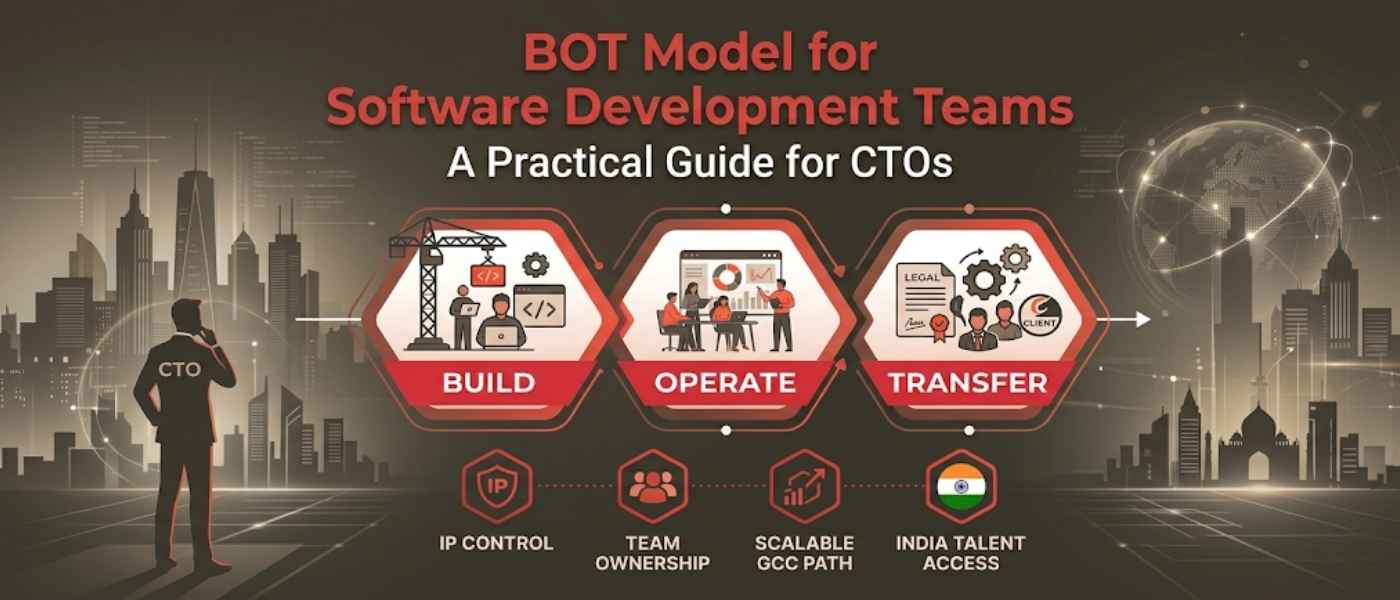
Build Phase
The offshore partner establishes operational foundations.
This includes:
- Hiring infrastructure
- Workspace setup
- HR operations
- IT infrastructure
- Compliance systems
- Governance frameworks
Operate Phase
The partner manages day to day operational execution while the client retains strategic direction.
The company gains:
- Dedicated offshore teams
- Delivery continuity
- Faster scaling
- Operational stability
- Workforce management
Transfer Phase
Ownership transitions fully to the client once operations mature.
This creates long term control without early stage operational friction.
Unlike traditional outsourcing, the team operates as an extension of the client’s business rather than a shared vendor resource pool.
This distinction matters significantly for companies prioritizing:
- IP protection
- Product ownership
- Engineering culture
- Long term operational maturity
- GCC scalability
For a deeper understanding of how organizations structure GCC expansion through BOT frameworks, read:
BOT to Build GCCs in India
How the BOT Model Accelerates India Operations
Faster Hiring Execution
Established BOT providers already maintain:
- Recruitment pipelines
- Talent acquisition systems
- Technical screening processes
- HR onboarding workflows
This dramatically reduces hiring timelines.
Instead of building recruitment infrastructure from scratch, companies access operationally ready hiring ecosystems.
Immediate Infrastructure Access
BOT providers already possess:
- Office infrastructure
- IT systems
- Managed infrastructure frameworks
- Security protocols
- Cloud enablement capabilities
This accelerates offshore operational readiness significantly.
Reduced Operational Fragmentation
Traditional expansion requires coordinating multiple vendors simultaneously.
BOT consolidates:
- Hiring
- Compliance
- Infrastructure
- Workforce operations
- Delivery governance
This simplifies execution.
Lower Expansion Risk
Companies avoid heavy upfront investments before validating operational success.
This is particularly valuable for:
- Scaling startups
- SaaS firms
- Enterprises testing offshore delivery models
- Companies launching GCC operations
Built-In Scalability
Once operational systems stabilize, scaling becomes faster and more predictable.
The company moves from setup mode into optimization mode much earlier.
Step-by-Step Breakdown of BOT Implementation
Phase 1: Strategic Planning
Companies define:
- Expansion objectives
- Team structures
- Delivery functions
- Budget frameworks
- Operational KPIs
- Governance expectations
This stage determines long term offshore alignment.
Phase 2: Hiring and Workforce Setup
The BOT provider begins:
- Talent sourcing
- Interview coordination
- Offer management
- Onboarding
- Workforce planning
At this stage, companies often start seeing productivity improvements within weeks instead of months.
Phase 3: Infrastructure and Operations Setup
Operational readiness includes:
- Office infrastructure
- Device provisioning
- Cloud systems
- Security implementation
- Payroll systems
- Collaboration environments
Phase 4: Operational Management
The offshore operation begins functioning as a dedicated extension of the client organization.
This includes:
- Daily delivery management
- Workforce governance
- Performance reporting
- Operational optimization
- Scalability planning
Phase 5: Ownership Transfer
Once the offshore operation matures, ownership transitions fully to the client.
This includes:
- Team transition
- Infrastructure transfer
- Governance handover
- Operational continuity planning
Companies retain the advantages of a mature offshore operation without enduring early stage setup friction.
To understand how BOT differs from other operational structures, explore:
BOT vs BOTT vs BOOT Key Differences
BOT vs Traditional Outsourcing vs Captive GCC Comparison Table
Factor | BOT Model | Traditional Outsourcing | Captive GCC Setup |
Setup Speed | Fast operational launch | Moderate | Slow |
Infrastructure Ownership | Transfers to client | Vendor-owned | Fully client-owned |
Operational Control | High | Limited | High |
Hiring Flexibility | Strong | Vendor-dependent | Strong |
Team Alignment | Dedicated teams | Shared resources common | Fully aligned |
Scalability | Highly scalable | Vendor constrained | Depends on internal capacity |
Compliance Management | Managed initially | Vendor managed | Internal responsibility |
Transition Ownership | Client gains ownership | Vendor retains ownership | Already owned |
Long Term Cost Efficiency | Strong | Moderate | High after maturity |
Delivery Stability | High | Variable | High |
IP Protection | Stronger control | Shared vendor risk | Full control |
Workforce Continuity | Strong | Can fluctuate | Strong |
Infrastructure Setup | Accelerated | Vendor controlled | Slow setup cycle |
Governance Visibility | High transparency | Limited visibility | Full visibility |
Expansion Risk | Lower | Moderate | High upfront risk |
How BOT Helps Companies Build Dedicated Offshore Teams Faster
Dedicated offshore teams require more than recruitment.
They require operational cohesion.
The BOT model helps companies establish:
- Engineering pods
- Product delivery teams
- Customer support operations
- Finance and payroll teams
- QA and DevOps functions
- IT infrastructure teams
The key advantage is operational synchronization.
Rather than hiring isolated individuals, businesses build integrated offshore delivery ecosystems.
This becomes increasingly important for:
- Agile development environments
- Product engineering companies
- SaaS scaling organizations
- Global capability center expansion
According to Gartner, distributed delivery ecosystems increasingly rely on operational flexibility and scalable workforce structures to maintain resilience.
BOT models directly support this operational requirement.
Infrastructure, Hiring, and Compliance Advantages of BOT
Infrastructure Advantages
Companies gain access to:
- Managed office environments
- Cloud infrastructure support
- Secure network architecture
- Remote workforce enablement
- IT governance systems
Hiring Advantages
BOT providers typically maintain:
- Existing talent pipelines
- Specialized recruiters
- Technical screening systems
- Faster onboarding capabilities
Compliance Advantages
Compliance management becomes significantly easier because operational frameworks already exist.
This includes:
- Payroll processing
- HR compliance
- Vendor contracts
- Employment documentation
- Local operational governance
For organizations entering India for the first time, this operational maturity dramatically reduces risk exposure.
For more insights into operational execution through BOT structures, visit:
Build Operate Transfer in India Simplifying Your Entry into the Indian Market
Common Mistakes Companies Make During India Expansion
Treating Expansion as Only a Hiring Initiative
India expansion is operational transformation, not just recruitment.
Companies that focus only on hiring often struggle with delivery maturity later.
Underestimating Infrastructure Dependencies
Operational readiness depends heavily on infrastructure coordination.
Delays here can impact productivity immediately.
Scaling Too Quickly Without Governance
Rapid scaling without governance structures creates:
- Delivery inconsistency
- Team misalignment
- Quality issues
- Leadership overload
Choosing Cost Over Operational Fit
Low cost vendors often create long term operational instability.
The cheapest option rarely becomes the most scalable one.
Ignoring Transition Planning
Many organizations fail to define how ownership transitions will occur later.
Strong BOT models prioritize transfer readiness from the beginning.

Insights on Scaling Offshore Operations in India
The most successful offshore operations prioritize operational maturity over short term scaling speed.
This includes:
- Leadership alignment
- Delivery governance
- Workforce retention
- Infrastructure resilience
- Security standardization
- Process maturity
According to IBM and Microsoft, cloud enabled distributed operations continue reshaping global workforce strategies.
India’s ecosystem is particularly attractive because it combines:
- Engineering talent
- Operational scalability
- Mature IT infrastructure
- GCC ecosystem growth
- Strong startup culture
Companies that scale effectively usually adopt phased operational expansion rather than uncontrolled hiring acceleration.
When Companies Should Consider BOT for India Operations
BOT models are especially valuable when companies need:
- Faster India expansion
- Dedicated offshore operations
- Long term ownership
- GCC setup support
- Scalable engineering teams
- Lower operational risk
- Flexible workforce scaling
- Reduced setup complexity
Typical use cases include:
SaaS Companies
Rapid product scaling often requires offshore engineering acceleration.
Enterprises Launching GCCs
BOT reduces operational friction during early GCC setup stages.
Startups Expanding Globally
Startups gain scalability without heavy operational overhead.
Companies Testing India Expansion
BOT reduces commitment risk before establishing full captive operations.
Future Trends in Offshore Expansion and GCC Growth
AI-Driven Offshore Operations
AI enabled workforce management is improving:
- Recruitment efficiency
- Productivity monitoring
- Operational analytics
- Workforce planning
Distributed Global Teams
Remote and hybrid operational models continue reshaping offshore delivery structures.
GCC Growth in India
India remains one of the fastest growing GCC ecosystems globally.
According to Statista and LinkedIn workforce insights, India’s digital talent ecosystem continues expanding rapidly across engineering, analytics, AI, and operational domains.
Automation-Led Delivery Models
Organizations increasingly integrate automation into offshore operations to improve scalability and delivery consistency.
Remote Infrastructure Management
Cloud infrastructure maturity has significantly accelerated offshore operational flexibility.
Quick Decision Summary
If Your Business Needs | BOT Model Fit |
Faster India market entry | Excellent |
Dedicated offshore teams | Excellent |
Long term ownership | Excellent |
Low operational complexity | Strong |
Quick scalability | Strong |
Full operational control later | Excellent |
Minimal setup delays | Strong |
Lower expansion risk | Strong |
FAQ
What is the build operate transfer model for India expansion?
The build operate transfer model for India expansion allows companies to establish offshore operations through a local operational partner who builds, manages, and later transfers the operation to the client organization.
How fast can companies launch offshore teams through a BOT model?
Many companies can begin operational hiring within weeks depending on team size, infrastructure complexity, and governance requirements. BOT structures accelerate execution because operational systems already exist.
How is BOT different from traditional outsourcing?
Traditional outsourcing keeps operational ownership with the vendor. BOT models eventually transfer operational ownership, infrastructure, and teams to the client organization.
Is BOT suitable for GCC setup in India?
Yes. BOT is increasingly used for GCC setup because it reduces early stage operational friction while preserving long term ownership and strategic control.
Can companies scale dedicated offshore teams through BOT?
Yes. BOT models are specifically designed for scalable offshore operations, allowing businesses to expand engineering, support, finance, or operational teams efficiently.
Does BOT reduce compliance complexity during India expansion?
Yes. BOT providers typically manage local compliance frameworks including payroll, employment documentation, infrastructure governance, and operational setup during early phases.
What industries commonly use BOT models in India?
Common industries include SaaS, fintech, healthcare technology, logistics, product engineering, IT services, AI development, and enterprise software.
When should a company avoid traditional captive setup and choose BOT instead?
Companies seeking faster execution, reduced operational complexity, lower expansion risk, and scalable workforce expansion often benefit more from BOT than building a captive GCC independently from day one.
Conclusion
India expansion continues to evolve from a simple cost optimization strategy into a long term operational scalability initiative. Companies today require faster execution, stronger governance, scalable workforce models, and greater operational resilience.
The build operate transfer model for India expansion addresses these realities directly.
Instead of forcing businesses to navigate infrastructure setup, hiring delays, compliance management, and operational coordination independently, BOT enables organizations to launch mature offshore operations with significantly lower friction.
For global companies building GCCs, dedicated offshore teams, or scalable delivery ecosystems, the model offers a balanced combination of speed, operational control, flexibility, and future ownership.
The companies scaling successfully in India are rarely the ones moving fastest blindly.
They are the ones building operationally sustainable expansion frameworks from the beginning.
Explore how structured BOT execution can support your India expansion roadmap through our Build Operate Transfer Services.
Recent Post
Why Companies Start with an ODC Before Building a GCC
Why Global Companies Start with an ODC Before Building a...
Infrastructure Setup for GCCs in India: What Global Companies Need
Infrastructure Setup for GCCs in India: What Global Companies Need...

iValuePlus Services
iValuePlus is a one-stop solution to address all your needs to access, build and grow your business in the Indian market which is cost-effective & has a huge talent pool. Established in 2019 as a ‘Business Solution provider', our team has delivered successful growth projects in the international market.
Our services include setting up ODC (offshore development center), Staff Augmentation, Talent Acquisition, Digital Marketing, in the IT/ITES domain.