
Discover the best city to set up office in India...

A Complete Comparison of BOT, BOTT, and BOOT Delivery Models
In today’s global business landscape, organizations increasingly need to establish operations across multiple geographies while managing costs and maintaining quality. Three service delivery models have emerged as the primary frameworks for this expansion: Build-Operate-Transfer (BOT), Build-Operate-Transform-Transfer (BOTT), and Build-Own-Operate-Transfer (BOOT). While these acronyms may look similar, they represent fundamentally different approaches to outsourcing, global expansion, and service delivery.
This comprehensive guide breaks down each model, explores their key differences, and helps you determine which approach best fits your organization’s needs.
What is Build-Operate-Transfer (BOT)?
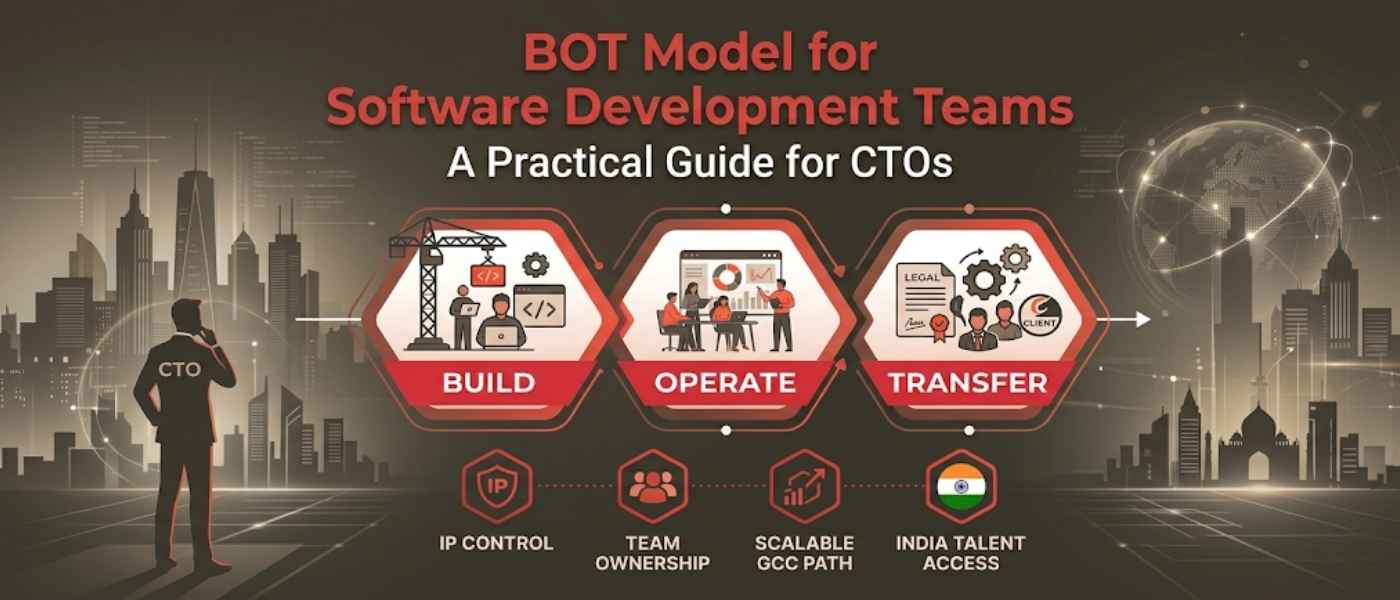
BOT is a contractual relationship where a service provider sets up, optimizes, and operates an IT or business process service delivery operation with the intent of eventually transferring it to the client organization as a captive center.
According to Gartner, the official definition is: “A contractual relationship in which an organization hires a service provider to set up, optimize and run an IT or business process service delivery operation with the contractually stipulated intent of transferring the operation to the organization as a captive center.”
BOT Key Characteristics
- Client Ownership: Client owns the team and operations from legal transfer
- Cost Savings: 40-60% savings compared to traditional in-house hiring
- Full Control: Client has complete control after transfer
- IP Rights: Client owns all intellectual property
- Timeline: 18-36 months (IT projects)
- Best For: Market entry, scaling operations, building offshore teams
What is Build-Own-Operate-Transfer (BOOT)?
BOOT is similar to BOT but with one critical difference: the service provider retains ownership of the facility or organization during the operating phase before transferring it at the end of the contract.
BOOT vs BOT: The Critical Difference
The fundamental distinction lies in the ownership timing:
- BOT: Client maintains ownership rights from the beginning; provider operates under client’s authority
- BOOT: Provider maintains ownership during the operating phase; client gains ownership only at the end
BOOT vs BOT: The Critical Difference
BOOT is primarily used in:
- Large infrastructure projects: Toll roads, airports, power plants, water treatment facilities
- Public-Private Partnerships (PPP): Government projects requiring private sector financing
- Long-term concessions: Projects lasting 10-25+ years
- Revenue-generating assets: Where providers recover investment through user fees or government payments
BOOT Financial Model
In BOOT projects, the service provider finances the entire development and recovers its investment through:
- User fees (e.g., toll roads, water charges)
- Government payments or subsidies
- Operational revenue during the concession period
- Return on investment calculated over 15-25 years
Geographic Prevalence
BOOT is more common in:
- Australia, Canada, New Zealand
- Emerging markets with infrastructure needs
- Public-private partnership frameworks
What is Build-Operate-Transform-Transfer (BOTT)?
BOTT extends the BOT model by adding a critical fourth stage: Transformation. Before transferring ownership to the client, the service provider modernizes, optimizes, and transforms the operation to meet current technology standards and business requirements.
The Four Phases of BOTT
Phase 1: Build Same as BOT—infrastructure and team are established.
Phase 2: Operate The service provider manages operations while simultaneously planning transformation initiatives.
Phase 3: Transform This is the unique BOTT stage where:
- Legacy systems are modernized
- New technologies are implemented
- Processes are reengineered
- Operating models are transformed (digital transformation, cloud migration, process optimization)
- Team is trained on new capabilities
- System is stabilized in its new form
Phase 4: Transfer The client receives a fully transformed, optimized operation ready for long-term success.
BOTT Key Characteristics
- Transformation Focus: Includes modernization before transfer
- Higher Quality: System is optimized before handover
- Extended Timeline: 24-42 months (longer than BOT due to transformation phase)
- Higher Cost: Includes transformation services and extended timeline
- Better Long-term Outcomes: Reduced post-transfer issues
- Best For: Legacy system modernization, digital transformation, quality-critical operations
Side-by-Side Comparison: BOT vs BOTT vs BOOT
Aspect | BOT | BOTT | BOOT |
Phases | 3 (Build, Operate, Transfer) | 4 (Build, Operate, Transform, Transfer) | 3 (Build, Own, Operate, Transfer) |
Ownership During Operation | Client owns | Client owns | Provider owns |
Timeline (IT) | 18-36 months | 24-42 months | 10-25+ years (Infrastructure) |
Primary Use | IT outsourcing, talent, GCC | Digital transformation | Infrastructure, PPP |
Cost Structure | Monthly fee + salary | Monthly fee + transformation | Revenue-based + government fees |
Risk to Client | Low | Low | Medium (provider retains ownership longer) |
Transformation Included | No | Yes | Not primary focus |
Transfer Complexity | Simple | More complex (post-transformation) | Complex (provider has been owner) |
Geographic Use | Global (US, LATAM, EE, Asia) | Growing globally | Australia, Canada, NZ, PPP |
Control During Operate | Client control | Client control | Limited (provider is owner) |
IP Ownership | Client from start | Client from start | Provider → Client at transfer |
Why Choose Each Model?
Choose BOT When:
- You need to establish an offshore or nearshore development team quickly
- You want to enter new markets with minimal infrastructure risk
- You require eventual full ownership and control
- Cost savings (40-60% vs. traditional hiring) are critical
- You need talent from specific regions (India, LATAM, Eastern Europe, Southeast Asia)
- Timeline is important (18-36 months)
- You’re building a Global Capability Center (GCC)
Real Example: A US tech company establishing a development center in Mexico or Eastern Europe to serve LATAM or European markets.
Choose BOTT When:
- You’re modernizing legacy systems that require transformation
- Quality and optimization before transfer are non-negotiable
- You need the provider to implement digital transformation, cloud migration, or process reengineering
- Long-term operational sustainability is critical
- You can accommodate a longer timeline (24-42 months)
- Budget allows for transformation services
- You want reduced post-transfer issues and stronger outcomes
Real Example: A financial services company transferring mortgage servicing operations to an offshore center while modernizing systems from mainframe to cloud architecture.
Choose BOOT When:
- You’re funding large-scale infrastructure projects (airports, roads, utilities)
- Government or public-private partnership structures are involved
- The provider needs to recoup significant upfront investment through operational revenue
- Long-term concession periods (10-25+ years) are acceptable
- Revenue-generating assets are being developed
- You’re in a geography with established PPP frameworks (Australia, Canada, NZ)
Real Example: A government contracting with a private company to build, operate, and eventually transfer a toll road or water treatment facility.
Current Market Adoption
Key Statistics (2025):
- 50% of global companies are already using BOT or BOTT models for global in-house centers
- Over 70% are seriously considering these models
- The IT outsourcing market is projected to reach $812.7 billion by 2029
- Growth rate: 7-8% CAGR through 2030
Why the Surge?
The resurgence of BOT/BOTT models (often called “Wave 2” of BOT) is driven by a critical need: access to technical talent. Unlike Wave 1 (1990s-2010s) which focused on cost reduction and market entry, Wave 2 focuses on:
- Securing AI, cloud, cyber, and analytics talent at scale
- Retaining knowledge and capabilities in-house
- Gaining control over strategic technology functions
- Building sustainable remote work capabilities post-COVID
Critical Success Factors
Regardless of which model you choose, success depends on:
- Partner Selection
- Choose a vendor with financial strength and experience
- Evaluate cultural fit and communication style
- Verify local market expertise and regulatory knowledge
- Clear Contracting
- Define phases, timelines, and KPIs explicitly
- Specify transfer terms, IP ownership, and ownership timeline
- Include performance benchmarks and remedies
- Knowledge Transfer
- Ensure comprehensive documentation of processes
- Plan training and development programs
- Create transition plans with overlap periods
- Team Retention
- Build loyalty through career development opportunities
- Maintain competitive compensation during and after transfer
- Foster cultural integration from day one
- Regular Communication
- Establish communication protocols spanning time zones
- Regular steering committee meetings
- Transparent reporting and escalation procedures
- Smooth Handover
- Plan transfer phase carefully (4-6 months before)
- Schedule comprehensive training and knowledge transfer
- Ensure minimal operational disruption during transition
Common Challenges and Solutions
Challenge: Offer Rejections and Recruitment Delays
Solution: Partner with experienced recruiters with established pipelines in target markets.
Challenge: Vendor Interference During Operate Phase
Solution: Define clear governance and escalation procedures in contracts; establish regular alignment meetings.
Challenge: Transfer Delays and Hidden Costs
Solution: Build detailed transition plans 6 months before transfer; clearly define transfer responsibilities and costs upfront.
Challenge: Cultural Integration Issues
Solution: Emphasize cultural fit during hiring; assign mentors from client’s team; provide cultural training.
Challenge: IP and Data Security Concerns
Solution: Establish clear IP ownership clauses; implement data security protocols; conduct regular audits.

iValuePlus: Your Build-Operate-Transfer (BOT) Partner
At iValuePlus, we specialize in helping enterprises establish and scale operations globally through Build-Operate-Transfer engagements. With 25+ years of global outsourcing experience and proven expertise across IT, QA services, finance operations, and human resources, we deliver world-class BOT solutions for organizations across healthcare, fintech, telecom, and energy sectors.
Our BOT Services
BOT for Global Capability Centers (GCC) We handle the complete BOT lifecycle for establishing offshore and nearshore operations:
- Market assessment and location selection (India, LATAM, Eastern Europe)
- Strategic talent recruitment and team assembly
- Legal setup, compliance, and regulatory approvals
- Infrastructure establishment and workspace setup
- 24/7 operational management and team leadership
- Continuous process optimization during operate phase
- Seamless ownership transfer with minimal disruption
Our proven BOT framework typically delivers 40-60% cost savings compared to traditional in-house hiring while maintaining exceptional quality standards and preserving your strategic control.
Conclusion
BOT, BOTT, and BOOT are distinct models serving different organizational needs:
- BOT is ideal for companies seeking to establish control over offshore teams and operations quickly
- BOTT adds transformation for organizations modernizing systems and requiring optimized handovers
- BOOT serves infrastructure and public-private partnership contexts where long-term ownership retention is necessary
The choice depends on your timeline, budget, transformation needs, and long-term strategic goals. With 50% of global companies already adopting BOT/BOTT models and over 70% considering them, now is the time to evaluate whether one of these approaches fits your organizational expansion strategy.
The key to success is selecting the right partner, defining clear expectations, and maintaining strong communication throughout all phases—from build through transfer and beyond.
Recent Post
How to Set Up an Offshore QA Center of Excellence in India: A Practical Guide for Global Teams
Learn how to set up an offshore QA center of...
Managed IT Services for Small Businesses: Complete Guide (2026)
Discover what managed IT services for small businesses actually include,...

iValuePlus Services
iValuePlus is a one-stop solution to address all your needs to access, build and grow your business in the Indian market which is cost-effective & has a huge talent pool. Established in 2019 as a ‘Business Solution provider', our team has delivered successful growth projects in the international market.
Our services include setting up ODC (offshore development center), Staff Augmentation, Talent Acquisition, Digital Marketing, in the IT/ITES domain.