
Discover the best city to set up office in India...

Dedicated Offshore Development Center: A Long-Term Growth Model for Global Businesses
Most companies that set up an offshore development center do so for the wrong reason. They’re trying to cut costs. That works—for about 12 months. The ones that build lasting competitive advantage treat the ODC differently from the start: as permanent infrastructure, not an outsourced headcount arrangement.
The distinction sounds subtle. The operational and strategic consequences are not. A cost-driven ODC gets you cheaper developers. A strategy-driven ODC gets you a global team that ships products faster, retains institutional knowledge, and gives your business 24-hour development capacity across time zones.
This guide is written for CXOs, engineering leaders, and operations heads who are either evaluating their first offshore center or trying to unlock more value from an existing one. It covers why the model is structurally compelling in 2025, how to build it correctly, what the failure modes actually are, and what a mature, high-performing ODC looks like in practice.
Why the Dedicated ODC Model Is More Relevant in 2025 Than Ever
The Talent Math Doesn’t Work Anymore in Western Markets
The World Economic Forum’s projection of an 85-million-person technology talent shortfall by 2030 is not a distant problem—it’s already visible in hiring timelines, salary inflation, and retention data across the US, UK, Germany, and Australia.
Average time-to-hire for a senior software engineer in the US now exceeds 45 days. In competitive markets like San Francisco and New York, fully-loaded annual costs for a mid-level developer routinely exceed $200,000. Companies that rely exclusively on local hiring are structurally disadvantaged against competitors who’ve built global talent strategies.
India produces over 1.5 million engineering graduates annually. Its top-tier talent pool—IIT, NIT, BITS Pilani graduates, plus a mature private engineering ecosystem—now spans AI/ML, cloud-native development, cybersecurity, blockchain, and data engineering. The depth of specialization available in Bengaluru or Hyderabad now matches, and in some areas exceeds, what’s available in Tier-2 US cities.
Cost Advantage Is Real, But It’s Not the Point
India ODC operating costs are 50–70% lower than equivalent teams in the US or UK. That’s a meaningful number—but experienced operators will tell you that companies who build an ODC purely for cost arbitrage rarely unlock the model’s full potential.
The real competitive advantage is this: an ODC gives you a team that can extend your development day by 9–12 hours, retain domain knowledge across product cycles, and scale headcount in weeks rather than quarters. Microsoft, Google, Amazon, and Oracle have all made this calculation—their India centers are not cost centers. They’re R&D hubs that contribute core product development and IP.
Post-2023 Macroeconomic Conditions Favor the Model
Following the tech industry’s 2022–2023 contraction, several dynamics have made ODCs structurally more attractive: senior engineering talent in India is more accessible than it was during the 2021 hiring boom; hybrid and remote-first working norms have removed the cultural resistance to distributed teams; and enterprise AI tools have dramatically reduced the communication overhead that historically made offshore integration difficult.
Dedicated Offshore Development Center vs. Traditional IT Outsourcing: The Critical Difference
| Dimension | Traditional Outsourcing | Dedicated ODC |
|---|---|---|
| Engagement Type | Project-based, temporary | Permanent strategic infrastructure |
| Who Controls Strategy | Vendor drives execution | Company owns all strategic direction |
| Knowledge Retention | Lost when project ends | Institutionalized, compounds over time |
| Team Alignment | Vendor serves multiple clients | Exclusively aligned to one company |
| Scalability | Constrained by contract scope | Expands on company timeline |
| IP and Data Risk | Higher — shared vendor environments | Controlled — dedicated infrastructure |
| Long-Term Cost Trajectory | Rises with each new project | Declines as efficiency compounds |
| Culture Integration | Minimal — vendor culture dominates | Deep — team embeds company DNA |
Key Benefits of a Dedicated Offshore Development Center
Cost Optimization That Compounds
The 50–70% operating cost differential versus Western markets is well-documented. What’s less discussed is that this advantage compounds: as the offshore team builds institutional knowledge, ramp time for new hires decreases, productivity per developer increases, and the effective cost per output unit continues to improve. Companies that stay with their ODC for 3+ years consistently report that their cost-per-feature or cost-per-release drops 20–30% from Year 1 to Year 3.
Access to Specialized Talent in Emerging Domains
India’s engineering talent pool in AI/ML, data engineering, DevSecOps, blockchain, and cloud-native architecture is genuinely world-class—not a consolation prize. Indian engineers account for a significant share of open-source contributions to major AI frameworks and cloud platforms. For companies building in these domains, an India ODC provides access to specialists who are often unavailable locally at any price.
24-Hour Development Cycles Through Time-Zone Advantage
India Standard Time (IST) sits 5.5 hours ahead of UTC and 9.5–12.5 hours ahead of US time zones. A company with engineering teams in both the US and India effectively has a development day that spans 18–20 hours. For product companies under competitive pressure, this is a structural advantage—not just a nice-to-have.
Business Continuity and Geographic Diversification
Post-COVID, the risk of single-location talent concentration became vivid. An ODC in a geographically separate location—with its own infrastructure, management, and talent pipeline—provides genuine operational resilience. If your US engineering hub is disrupted by weather, economic conditions, or a talent event, your India team maintains continuity.
Long-Term IP and Innovation Ownership
Unlike outsourcing, where IP assignment can be murky and contested, an ODC team operates under your employment contracts, your NDAs, and your IP assignment clauses. The code, data models, and processes built by the ODC are unambiguously yours. Over time, this matters enormously—particularly if the company is on a path toward acquisition, IPO, or licensing arrangements.
How to Build a Dedicated Offshore Development Center: A Step-by-Step Blueprint
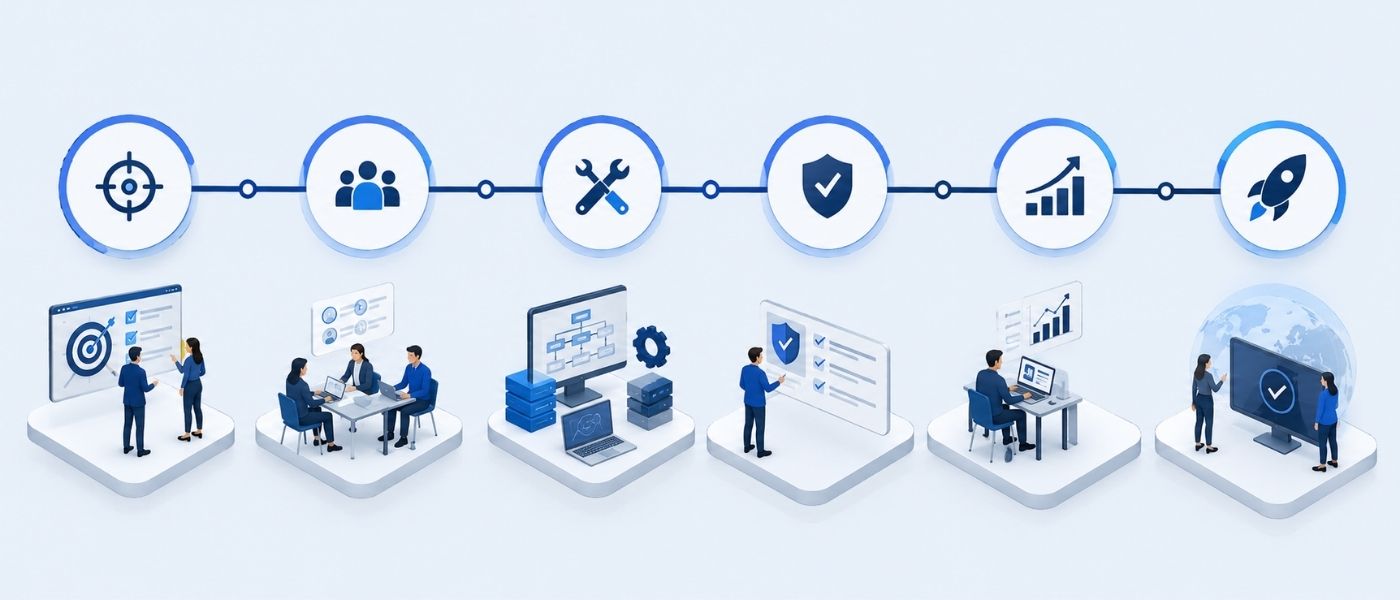
Steps to set up a Dedicated Offshore Development Center:
- Define strategic objectives and functional scope
- Select the right country and city based on talent profile
- Choose between direct build, managed services, or Build-Operate-Transfer (BOT)
- Handle legal entity registration and compliance infrastructure
- Recruit and onboard the founding team
- Establish governance, KPIs, and communication frameworks
- Integrate culture, processes, and tooling with the parent company
Define Objectives and Functional Scope
Is this ODC for product engineering, R&D, QA, data science, DevOps, or customer support? The answer determines talent profile, location, governance model, and integration approach. Companies that begin with vague scope—”we need offshore developers”—consistently struggle to build high-performing teams because they recruit for the wrong skills and integrate with the wrong processes. Be specific: define what the ODC will own, what it will support, and what decisions it will make autonomously.
- Choose Location Based on Talent Profile, Not Just Cost
India is the default choice for most global companies—and often the right one—but city selection within India matters significantly. Bengaluru and Hyderabad are the strongest markets for product engineering, AI/ML, and cloud. Pune is well-suited for engineering support and manufacturing tech. Chennai has a growing GCC ecosystem. NCR is better for enterprise sales support and business process functions. Eastern Europe (Poland, Romania) offers strong engineering culture with EU timezone proximity, at a higher cost point than India.
- Select the Right Engagement Model
Three primary models exist:
Direct Build(you handle entity setup, office, and recruitment—highest control, longest ramp, most risk);
Managed ODC(a partner provides infrastructure and staffing under your direction—faster, but you don’t own the entity); and
Build-Operate-Transfer (BOT)(a partner builds and operates the center for 12–24 months, then transfers ownership to you—combines speed with long-term ownership). For most first-time ODC setups, BOT delivers the best risk-adjusted outcome.
- Handle Legal, Compliance, and Entity Registration
In India, a foreign company typically establishes either a Private Limited Company (most common for ODCs), a Liaison Office, or a Branch Office under the Companies Act 2013. PF, ESI, Professional Tax, TDS, GST, Shops & Establishment registration, and DPDPA 2023 compliance obligations all activate from the first hire. Getting this right at setup—rather than retrofitting it under audit pressure—saves 3–6 months of operational disruption later.
- Recruit Your Founding Team Carefully
The founding 5–10 people in an ODC disproportionately shape its culture, performance standards, and retention trajectory. Over-index on hiring senior, high-ownership engineers for founding roles—even if it means paying above local market rates initially. The ODC Country/Site Lead role in particular requires someone who can bridge technical credibility with the parent company and people leadership with the local team. This is not a role to fill with a junior hire.
- Establish Governance, KPIs, and Communication Cadence
Define upfront: who approves what, at what spend threshold, with what lead time. Build a compliance calendar (35+ statutory deadlines annually in India). Set KPIs that are output-driven—release velocity, defect rates, system uptime, employee retention—not input-driven (hours worked, tickets closed). Establish a weekly rhythm of cross-team syncs that respects both time zones without forcing the offshore team into permanently unsociable hours.
- Invest in Cultural Integration from Day One
Cultural integration is not an HR afterthought—it’s an operational performance variable. Global managers assigned to work with India teams benefit from explicit orientation on communication norms, feedback culture, and decision-making styles. Reciprocal visits in the first 6 months—sending global HQ leaders to the ODC and ODC leads to HQ—accelerate team cohesion faster than any number of video calls.
The ODC Growth Flywheel: How Value Compounds Over Time
he companies that get the most from their offshore development centers don’t treat them as a fixed cost line—they actively invest in evolving the ODC’s capability and ownership as the relationship matures. Here’s what that evolution looks like in practice:
01
Early Stage (Months 1–12): Cost Optimization and Stability
The ODC begins with a lean team—typically 8–20 engineers—handling well-defined execution tasks. The focus is on hiring the right founding members, establishing process discipline, and proving the model internally. Cost savings are real and visible from month three.
02
Growth Stage (Year 1–2): Capability Expansion
As trust builds, the ODC takes on more complex work: owning product modules, contributing to architecture decisions, leading QA and DevOps functions. Teams expand into specialized domains—AI/ML, data engineering, cloud infrastructure. Retention at this stage indicates whether the culture and growth environment are working.
03
Maturity Stage (Year 2–4): Innovation Hub
The ODC transitions from execution partner to co-innovator. Engineers contribute to product roadmap discussions, file patents, lead internal R&D initiatives, and mentor junior colleagues. The team is no longer “offshore”—it’s simply part of the global engineering organization that happens to be located in India.
04
Strategic Stage (Year 4+): Global Capability Center
At scale, the ODC evolves into a Global Capability Center (GCC)—a strategic business unit that may serve as the operational hub for entire product lines, customer-facing functions, or regional expansion initiatives. Several companies—including major US fintechs and SaaS enterprises—have shifted their engineering center of gravity to their India GCCs over a decade-long evolution from a small ODC.
Real-World Applications: How Industries Use Dedicated Offshore Development Centers
Fintech
Regulatory-compliant payment platforms, fraud detection systems, core banking APIs, and ISO 27001-aligned security infrastructure built by dedicated offshore teams with BFSI domain expertise.
Healthcare & Life Sciences
HIPAA-compliant telemedicine platforms, AI-powered diagnostics, clinical trial data pipelines, and EHR system integrations—with offshore teams that hold relevant domain certifications.
E-commerce & Retail
Personalization engines, recommendation systems, supply chain optimization tools, and global customer support operations running across time zones from a single ODC.
SaaS & Product Companies
Continuous product development, 24/7 system reliability engineering, rapid feature iteration, and customer success tooling built by teams that own product outcomes—not just ticket queues.
Manufacturing & Industrial
IIoT platform development, predictive maintenance systems, ERP customization, and digital twin infrastructure—built by offshore engineering teams with relevant industrial domain knowledge.
Media & EdTech
Streaming infrastructure, content recommendation algorithms, LMS platforms, adaptive learning systems, and global content operations managed by dedicated offshore product teams.
ODC Challenges—and What Actually Fixes Them
The ODC model has genuine challenges. What separates successful implementations from failed ones isn’t the absence of these challenges—it’s how systematically they’re addressed.
Cultural and Communication Misalignment
India’s high-context communication culture means disagreements are rarely surfaced directly, “yes” often signals acknowledgment rather than agreement, and hierarchy shapes who speaks in meetings. Global managers who don’t understand this misread project status, miss escalations, and erode trust without knowing why.
Fix: Structured cultural orientation for global managers (not just offshore hires), explicit escalation protocols, and regular skip-level check-ins from HQ leadership.Intellectual Property Protection
IP risk in an ODC is real but manageable—and far lower than in traditional outsourcing. The risk concentrates in two areas: weak employment contract IP assignment clauses, and inadequate access controls on codebases and data systems.
Fix: IP assignment clauses in every employment contract, role-based code access controls, DPDPA 2023-compliant data governance, and regular security audits. Legal templates should be reviewed by an India-qualified IP attorney, not repurposed from a US or UK template.Talent Retention in Competitive Markets
Bengaluru and Hyderabad have annual software engineering attrition rates of 18–25%. For an ODC, high attrition is operationally damaging: it erodes the institutional knowledge that makes the model valuable.
Fix: Competitive total compensation (base + variable + equity or phantom equity for senior roles), visible career growth paths into global roles, and genuine ownership of product outcomes rather than task execution. Engineers who feel like product builders stay longer than those who feel like service providers.Governance Complexity at Scale
As the ODC grows from 20 to 200+ people, informal governance breaks down. Approval bottlenecks multiply, compliance obligations scale, and the parent company’s control mechanisms struggle to keep pace.
Fix: Invest in governance infrastructure early—a documented approval matrix with India-delegated authority, a compliance calendar with named owners, quarterly compliance reviews with a CA or labor law firm, and an escalation path that doesn’t require global HQ sign-off on routine operational decisions.Integration Failure with the Parent Organization
ODCs that operate as isolated execution units—receiving tickets, delivering code, and having no visibility into product direction—consistently underperform and retain talent poorly. The team doesn’t feel like part of the company; they feel like a vendor.
Fix: Include ODC leadership in product planning, architecture reviews, and roadmap discussions. Rotate global engineers through the offshore location and vice versa. Treat the ODC site lead as a member of the engineering leadership team, not as a middle manager.The Build-Operate-Transfer Model: Fastest Path to a Stable ODC
For most global companies establishing their first India ODC, the Build-Operate-Transfer (BOT) model offers the best risk-adjusted outcome. Understanding it in detail helps decision-makers structure the engagement correctly from the outset.
How the BOT Model Works
A specialist partner—such as iValuePlus—takes responsibility for the complete ODC setup: legal entity registration (or leveraging an existing entity), office selection and infrastructure, talent acquisition, HR and payroll administration, IT setup, and statutory compliance. The partner operates the center under the client’s strategic direction for a defined period, typically 12–24 months. At the agreed milestone, full ownership and operational control transfer to the client.
What the Client Controls Throughout the BOT Period
- Team composition, hiring decisions, and technical standards
- Product roadmap and engineering priorities
- Performance management and KPI frameworks
- IP, data security policies, and tool choices
What the Partner Manages
- Legal entity, statutory filings, and compliance calendar
- Office infrastructure, vendor management, and facilities
- Payroll processing, HR administration, and benefits
- IT infrastructure and helpdesk
The result: the client gets a fully operational, compliant ODC in 8–12 weeks instead of 6–9 months, with none of the setup-phase compliance risk. At transfer, they inherit a running operation—not a greenfield to figure out.
The iValuePlus Advantage in Dedicated Offshore Development Centers
At iValuePlus, we specialize in helping global enterprises build Dedicated Offshore Development Centers that go beyond cost savings. Our model ensures:
- End-to-end support: From talent acquisition and infrastructure setup to compliance management.
- Scalable teams: Tailored to client requirements, ensuring flexibility.
- BOT (Build-Operate-Transfer) option: Allowing businesses to eventually own their offshore centers.
- Focus on innovation: Empowering clients to leverage offshore centers as strategic innovation hubs.
For global businesses seeking sustainable growth, iValuePlus delivers a balance of speed, scalability, and strategic value.
Conclusion
In today’s hyper-competitive landscape, businesses cannot afford to view offshoring as a short-term tactic. A Dedicated Offshore Development Center is a long-term growth model, offering global companies the ability to scale, innovate, and remain competitive while optimizing costs.
By strategically setting up and managing an ODC, enterprises not only mitigate risks and talent shortages but also unlock new opportunities for global expansion. For CXOs and decision-makers, the question is no longer “Should we offshore?”—but rather, “How can we build a long-term growth engine through a Dedicated Offshore Development Center?”
The answer lies in adopting a structured, partner-driven approach—one that transforms an ODC into a strategic pillar of business transformation and innovation.
FAQ
What is a Dedicated Offshore Development Center (ODC)?
A Dedicated Offshore Development Center is a fully staffed, long-term technology team established in a lower-cost country—typically India, Vietnam, or Eastern Europe—that operates as a strategic extension of a company’s in-house team. Unlike outsourcing vendors, an ODC is exclusively aligned with one company’s goals, culture, and product roadmap. The company controls team composition, engineering direction, and KPIs directly.
How is an ODC different from traditional IT outsourcing?
Traditional outsourcing is project-based: a vendor executes a defined scope and the engagement ends. Knowledge leaves with the project. An ODC is permanent infrastructure—a dedicated team that retains institutional knowledge across product cycles, scales with the business on the company’s timeline, and integrates deeply with internal teams. The company owns the strategy; the offshore team executes and evolves it.
How much does it cost to set up a Dedicated Offshore Development Center in India?
Setup costs vary by engagement model. A Build-Operate-Transfer (BOT) model with a partner minimizes upfront capital expenditure—infrastructure, legal setup, and talent acquisition are handled by the partner under a service agreement. Direct builds typically require $50,000–$150,000 in setup investment before reaching operational stability, separate from ongoing team salaries. India ODC operating costs run 50–70% below equivalent US or UK teams on a fully-loaded basis.
What is the Build-Operate-Transfer (BOT) model for an ODC?
In a BOT engagement, a specialist partner builds the offshore development center—handling entity setup, office infrastructure, talent recruitment, and compliance—then operates it for 12–24 months before transferring full ownership to the client. The company controls team direction and product priorities throughout. BOT reduces setup risk, compresses time-to-productivity to 8–12 weeks, and means the client inherits a proven, stable operation rather than starting from scratch.
Which countries are best for setting up an offshore development center?
India is the leading ODC destination globally, with 1.5 million+ engineering graduates annually, English proficiency, a mature IT ecosystem, and the deepest talent pools in AI/ML, cloud, and product engineering. Vietnam and the Philippines offer strong alternatives for mid-market companies. Eastern Europe (Poland, Romania) provides proximity to EU timezones and strong engineering culture at a higher cost than Asia. City selection within India—Bengaluru vs. Pune vs. Hyderabad—matters as much as country selection for the right talent profile.
How long does it take to build a fully operational ODC?
A direct build—entity registration, office setup, talent hiring, compliance activation, and integration—takes 6–9 months to reach operational productivity. A BOT model with an experienced partner compresses this to 8–12 weeks. The primary time variables are legal entity registration in India (4–8 weeks), talent recruitment in competitive markets (longer for senior specialized roles), and IT infrastructure provisioning.
How do you protect intellectual property in an offshore development center?
IP protection requires layered controls: employment contracts with explicit IP assignment clauses (drafted by an India-qualified IP attorney, not adapted from US templates), NDAs for all team members and contractors, role-based access controls on codebases and data systems, compliance with India’s DPDPA 2023 for personal data, and quarterly security audits. Operating through a structured ODC—rather than informal freelance networks—significantly reduces IP exposure by centralizing accountability and documentation.
Recent Post
How to Set Up an Offshore QA Center of Excellence in India: A Practical Guide for Global Teams
Learn how to set up an offshore QA center of...
Managed IT Services for Small Businesses: Complete Guide (2026)
Discover what managed IT services for small businesses actually include,...

iValuePlus Services
iValuePlus is a one-stop solution to address all your needs to access, build and grow your business in the Indian market which is cost-effective & has a huge talent pool. Established in 2019 as a ‘Business Solution provider', our team has delivered successful growth projects in the international market.
Our services include setting up ODC (offshore development center), Staff Augmentation, Talent Acquisition, Digital Marketing, in the IT/ITES domain.