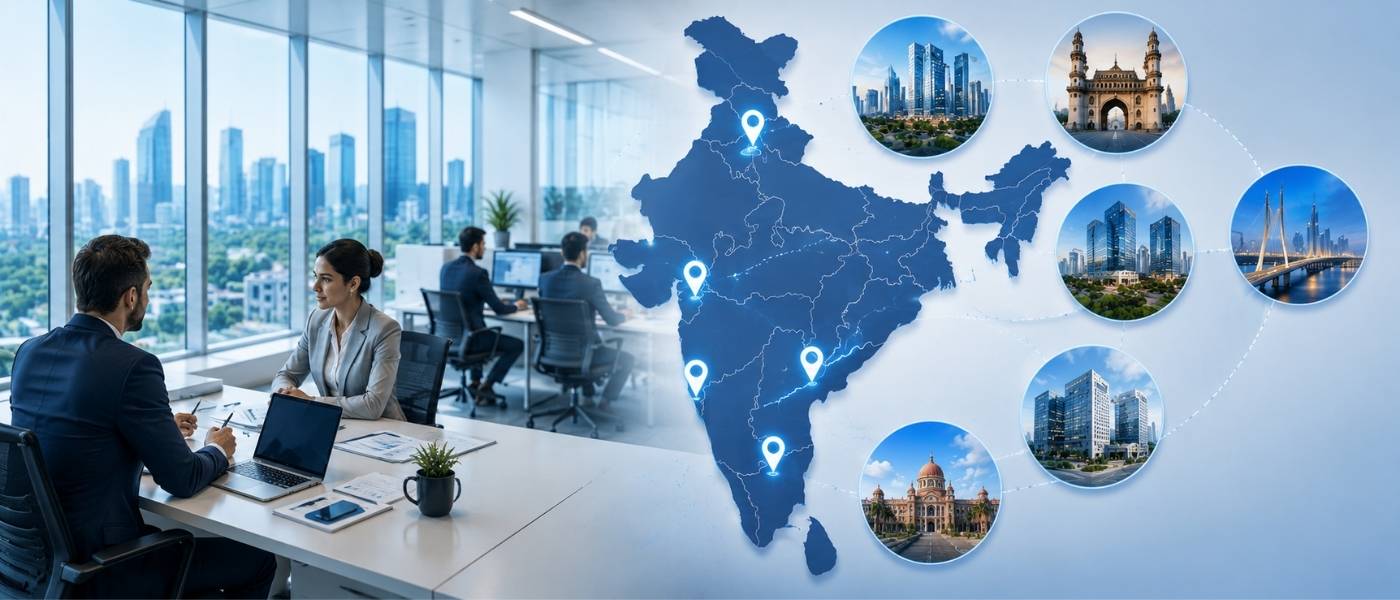

Discover the best city to set up office in India...

From Local to Global: Building a High-Performance Global Operating Model
Why “Going Global” Is No Longer Optional
Enterprises today operate in an environment defined by volatility, talent scarcity, regulatory complexity, and relentless pressure to scale faster without increasing risk. What once worked as a local or regional operating structure is no longer sufficient. Customers, talent, suppliers, and competitors are global—and organizations must evolve accordingly.
This is where a global operating model (GOM) becomes mission-critical.
A high-performance global operating model enables organizations to distribute work intelligently across geographies, leverage global talent, maintain governance and control, and scale operations sustainably. It is not simply about offshoring or cost reduction—it is about re-architecting how the enterprise runs.
This article provides a comprehensive, implementation-focused guide on how enterprises move from local operations to a mature, high-performance global operating model, covering strategy, structure, governance, talent, technology, and risk management.
1. What Is a Global Operating Model?
A global operating model defines how an organization structures, governs, and executes its operations across multiple countries and regions while maintaining alignment with corporate strategy.
It answers five fundamental questions:
- Where should work be done?
- Who owns decision-making and accountability?
- How are processes standardized vs localized?
- What governance and controls ensure consistency and compliance?
- How does the model scale over time?
A strong global operating model aligns:
- Strategy
- Structure
- Talent
- Technology
- Governance
Without alignment across these dimensions, global expansion often leads to fragmentation, inefficiency, and risk.
2. From Local to Global: The Evolution of Operating Models
Most enterprises follow a predictable maturity path.
Stage 1: Localized Operations
- Teams operate independently by geography
- Decision-making is decentralized
- Limited process standardization
- Minimal cross-border coordination
Limitations:
High costs, duplicated effort, inconsistent quality, and poor scalability.
Stage 2: Multi-Regional Operations
- Regional hubs emerge
- Some shared processes
- Partial governance frameworks
Limitations:
Regional silos, uneven performance, limited global visibility.
Stage 3: Global Operating Model
- Clear global ownership and accountability
- Centralized governance with local execution
- Shared services, GCCs, or offshore centers
- Standardized processes with controlled localization
Outcome:
Scalable, resilient, and high-performance enterprise operations.
3. Why Enterprises Fail Without a Global Operating Model
Organizations that expand globally without a defined operating model often encounter:
- Loss of operational control
- Inconsistent customer experience
- Escalating compliance and regulatory risk
- Inefficient use of talent and capital
- Slower decision-making
A global operating model is not an administrative exercise—it is a risk mitigation and value creation mechanism.
4. Core Principles of a High-Performance Global Operating Model
4.1 Global by Design, Not by Accident
Successful enterprises design their operating model before scaling—not after problems arise. This means proactively defining governance, escalation paths, and ownership.
4.2 Centralized Strategy, Distributed Execution
High-performing global operating models separate:
- Strategic control (centralized)
- Operational execution (distributed)
This balance allows speed without sacrificing oversight.
4.3 Process Standardization with Intelligent Localization
Not everything should be global. The key is deciding:
- What must be standardized globally
- What can be adapted locally
This avoids rigidity while preserving consistency.
4.4 Measurable Accountability
Every role, team, and center must have:
- Clear KPIs
- Defined outcomes
- Transparent reporting
5. Structural Components of a Global Operating Model
5.1 Onshore–Offshore–Nearshore Mix
A robust global operating model uses the right location for the right work:
- Onshore: Strategy, leadership, customer-facing roles
- Offshore: Engineering, IT, analytics, finance, HR, operations
- Nearshore: Time-zone-sensitive or language-dependent roles
5.2 Global Capability Centers (GCCs)
GCCs are a cornerstone of modern global operating models. They enable enterprises to:
- Build long-term capabilities
- Retain IP and institutional knowledge
- Drive innovation, not just execution
5.3 BOT and Hybrid Models
For companies early in their global journey, Build-Operate-Transfer (BOT) models provide:
- Faster market entry
- Reduced setup risk
- Gradual ownership transfer
BOT is often the bridge between local operations and a full global operating model.

6. Governance: The Backbone of Global Operations
6.1 Governance Structure
A strong governance framework typically includes:
- Global executive sponsors
- Regional or offshore delivery heads
- Functional owners
- Risk and compliance leads
Governance must be structured, documented, and enforced.
6.2 Decision Rights and Escalation
Define clearly:
- Who decides?
- Who executes?
- Who escalates?
- Who approves?
Ambiguity in decision rights is one of the most common causes of global operating model failure.
6.3 Performance Governance
High-performance models use:
- Outcome-based KPIs
- SLA and OLAs
- Regular cadence reviews
- Data-driven dashboards
7. Talent Strategy in a Global Operating Model
7.1 Workforce Segmentation
Not all roles are equal. Enterprises must classify roles into:
- Strategic
- Core operational
- Transactional
This determines location, investment level, and management approach.
7.2 Global Talent Acquisition
A global operating model requires:
- Market-specific hiring strategies
- Strong employer branding
- Local HR expertise
India, in particular, has become central due to its scale, skill depth, and leadership maturity.
7.3 Leadership and Capability Building
High-performing global models invest in:
- Offshore leadership development
- Succession planning
- Cross-border rotations
This reduces dependency on headquarters and increases resilience.
8. Technology as an Enabler of the Global Operating Model
Technology provides the visibility and control needed to operate globally.
Key Enablers:
- ERP and financial systems
- HRIS and payroll platforms
- Workforce analytics
- Collaboration and productivity tools
- Security and access management
Without the right technology stack, global models become opaque and unmanageable.
9. Risk, Compliance, and Control
9.1 Regulatory Compliance
Global operating models must account for:
- Labor laws
- Tax regulations
- Data privacy requirements
- Industry-specific compliance
This is especially critical in offshore and GCC environments.
9.2 Data Security and IP Protection
Key controls include:
- Role-based access
- Secure infrastructure
- Compliance certifications
- Strong contractual frameworks
9.3 Business Continuity and Resilience
Distributed operations enhance resilience—but only if:
- Backup locations exist
- Knowledge is documented
- Disaster recovery plans are tested
10. Measuring Success of a Global Operating Model
A mature global operating model delivers measurable outcomes:
- Reduced cost per unit of output
- Faster time-to-market
- Higher talent retention
- Improved compliance scores
- Better customer experience
Measurement must be continuous, not periodic.
11. Common Pitfalls and How to Avoid Them
Pitfall | How to Avoid |
Treating offshore as low-cost labor | Build capability, not headcount |
Weak governance | Define roles and escalation clearly |
Over-centralization | Balance control with autonomy |
Cultural disconnect | Invest in integration and leadership |
Poor scalability | Standardize before scaling |
12. The Future of Global Operating Models
By 2026 and beyond, global operating models will:
- Become more outcome-driven
- Integrate AI and automation deeply
- Emphasize ESG and workforce well-being
- Shift from cost arbitrage to innovation enablement
Enterprises that modernize early will outperform peers in agility and resilience.
Conclusion
Moving from local operations to a high-performance global operating model is not a one-time transformation—it is an ongoing strategic capability.
Organizations that succeed:
- Design before they scale
- Govern before they optimize
- Invest in people, not just processes
A well-executed global operating model enables enterprises to grow faster, operate smarter, and remain resilient in an increasingly complex world.
In the modern enterprise, how you operate globally is as important as what you sell globally.
Recent Post
How to Set Up an Offshore QA Center of Excellence in India: A Practical Guide for Global Teams
Learn how to set up an offshore QA center of...
Managed IT Services for Small Businesses: Complete Guide (2026)
Discover what managed IT services for small businesses actually include,...

iValuePlus Services
iValuePlus is a one-stop solution to address all your needs to access, build and grow your business in the Indian market which is cost-effective & has a huge talent pool. Established in 2019 as a ‘Business Solution provider', our team has delivered successful growth projects in the international market.
Our services include setting up ODC (offshore development center), Staff Augmentation, Talent Acquisition, Digital Marketing, in the IT/ITES domain.