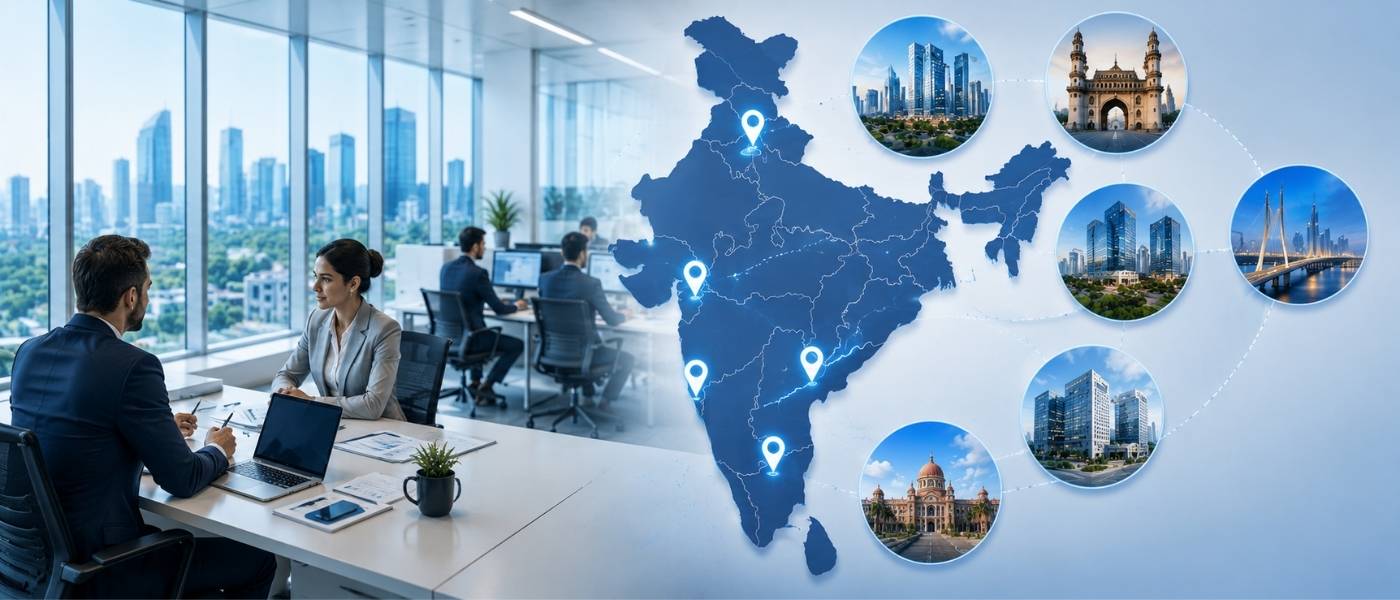

Discover the best city to set up office in India...
Categories

How Global Operating Models Reduce Risk and Improve Control
Risk Is No Longer Local—Operations Can’t Be Either
In today’s interconnected business environment, risk no longer emerges from a single geography, function, or decision. It is systemic. Regulatory shifts, talent shortages, cyber threats, geopolitical instability, and cost volatility now affect organizations across markets simultaneously.
As enterprises expand internationally, many discover that risk increases faster than growth when operations are fragmented, reactive, or poorly governed. This is why leading global companies are rethinking how they structure and manage their operations.
At the center of this shift is the global operating model—a deliberate, enterprise-wide framework that defines how work is distributed, governed, controlled, and scaled across geographies.
When designed correctly, a global operating model does far more than enable growth. It becomes a risk-mitigation and control mechanism, allowing organizations to:
- Reduce operational and compliance risk
- Improve visibility and accountability
- Standardize controls without sacrificing agility
- Strengthen governance across borders
This article explores how global operating models reduce risk and improve control, and why they are becoming a foundational element of resilient, future-ready enterprises.
1. Understanding Risk in Global Enterprises
1.1 The Expanding Risk Landscape
Global businesses face a broader and more complex risk environment than ever before, including:
- Regulatory and labor law risk across multiple jurisdictions
- Data privacy and cybersecurity threats
- Talent and attrition risk
- Vendor and third-party dependency
- Operational inconsistency and process breakdowns
- Financial and tax exposure
Many of these risks are structural, not incidental. They arise from how operations are designed and managed.
1.2 Why Fragmented Operating Structures Increase Risk
Organizations that expand globally without a clear operating model often experience:
- Duplication of processes and roles
- Inconsistent policies and controls
- Lack of ownership and unclear decision rights
- Poor visibility into offshore or regional operations
These issues make it difficult to detect, prevent, or respond to risk in a timely manner.
A global operating model addresses these challenges at the design level, not as an afterthought.
2. What Is a Global Operating Model—Through a Risk and Control Lens
A global operating model defines how an enterprise:
- Structures its global workforce
- Allocates responsibilities across regions
- Governs decision-making
- Standardizes processes and controls
- Manages compliance and risk consistently
From a risk perspective, it answers critical questions:
- Who is accountable for what—and where?
- How are risks identified, escalated, and mitigated?
- Which controls are global vs local?
- How do we ensure consistency without rigidity?
3. How Global Operating Models Reduce Risk
3.1 Standardization of Processes and Controls
One of the most powerful risk-reduction mechanisms of a global operating model is process standardization.
By defining global standards for:
- HR and payroll
- Finance and accounting
- IT operations
- Data access and security
- Vendor management
organizations reduce:
- Process variability
- Human error
- Dependency on local practices
Standardized processes make risk predictable, measurable, and manageable.
3.2 Clear Ownership and Accountability
Risk thrives in ambiguity.
Global operating models establish:
- Clear role definitions
- Ownership for outcomes and controls
- Defined escalation paths
This clarity ensures that:
- Issues are identified early
- Decisions are made faster
- Accountability is enforceable
In contrast, loosely structured global operations often suffer from “shared responsibility,” which translates into no responsibility.
3.3 Stronger Compliance Across Jurisdictions
Compliance risk is one of the most underestimated threats in global operations.
A global operating model enables:
- Centralized compliance frameworks
- Local execution with global oversight
- Consistent documentation and audit readiness
Whether it is labor law, tax compliance, or data protection, a unified operating model ensures that local compliance aligns with global policy.
3.4 Reduced Dependency Risk Through Structural Design
Many organizations face concentration risk by:
- Relying on a single geography
- Over-depending on one vendor
- Housing critical knowledge in isolated teams
A well-designed global operating model:
- Distributes risk across locations
- Builds redundancy into operations
- Encourages knowledge sharing and documentation
This structural resilience reduces the impact of localized disruptions.
4. How Global Operating Models Improve Control
4.1 Improved Visibility Across the Enterprise
Control begins with visibility.
Global operating models enable:
- Centralized reporting
- Unified dashboards
- Consistent KPIs across regions
Leadership gains real-time insight into:
- Performance
- Costs
- Risks
- Compliance status
This visibility allows for proactive control, rather than reactive firefighting.
4.2 Defined Decision Rights and Governance
Control is not about micromanagement—it is about decision clarity.
Global operating models define:
- Which decisions are global
- Which are regional or local
- How conflicts are resolved
This prevents:
- Decision paralysis
- Shadow governance
- Power struggles across regions
Clear governance ensures that control scales with the organization.
4.3 Centralized Oversight with Local Execution
One of the biggest misconceptions is that control requires centralization of execution.
In reality, high-performing global operating models:
- Centralize standards, policies, and oversight
- Decentralize execution to regions and offshore centers
This balance allows organizations to:
- Maintain control
- Respond quickly to local needs
- Avoid operational bottlenecks
4.4 Technology-Enabled Control Mechanisms
Modern global operating models are powered by technology.
Key enablers include:
- ERP and financial control systems
- Access management and security tools
- Analytics and risk dashboards
Technology ensures that controls are:
- Embedded
- Automated
- Auditable
This reduces reliance on manual checks and individual discretion.

5. Role of Offshore and Global Delivery Models in Risk Reduction
5.1 Global Capability Centers (GCCs)
GCCs provide:
- Full ownership and control
- Direct governance
- Strong IP and data protection
When integrated into a global operating model, GCCs:
- Reduce vendor risk
- Improve process consistency
- Strengthen long-term control
5.2 Build-Operate-Transfer (BOT) Models
BOT models reduce risk during global expansion by:
- Leveraging partner expertise in setup and compliance
- Minimizing early-stage execution risk
- Transitioning to full control over time
BOT is particularly effective for organizations building global operations for the first time.
5.3 Offshore Development/Delivery Centers (ODCs)
Offshore development centres can reduce execution risk when:
- Scope is well-defined
- Governance is strong
- Performance is closely monitored
However, without a global operating model, ODCs can also increase dependency and control risk.
6. Governance Structures That Enable Risk Control
6.1 Multi-Tier Governance Framework
Best-practice global operating models use:
- Executive steering committees
- Operational governance forums
- Delivery-level management
Each layer focuses on:
- Strategy
- Performance
- Risk and compliance
This layered approach ensures control without bureaucracy.
6.2 Risk and Compliance Embedded in Governance
Rather than treating risk as a separate function, mature organizations:
- Embed risk reviews into operational meetings
- Track compliance metrics alongside performance KPIs
- Make risk ownership part of leadership roles
This integration strengthens both control and accountability.
7. Talent, Culture, and Control
7.1 Why Culture Matters for Risk
Many risks—data breaches, compliance failures, quality issues—are human, not technical.
A global operating model promotes:
- Shared values and standards
- Ethical behavior
- Accountability across locations
Culture becomes a first line of defense against risk.
7.2 Reducing Attrition and Knowledge Risk
High attrition weakens control by:
- Losing institutional knowledge
- Increasing dependency on individuals
Global operating models address this through:
- Career pathing
- Skill development
- Knowledge management practices
8. Measuring Risk Reduction and Control Effectiveness
Key indicators include:
- Reduction in compliance incidents
- Audit outcomes
- Process consistency scores
- Variance in performance across regions
- Speed of issue resolution
Advanced organizations track risk-adjusted performance, not just cost or output.
9. Common Mistakes That Undermine Risk Control
- Expanding globally without redesigning the operating model
- Treating offshore teams as isolated units
- Weak or inconsistent governance
- Over-centralization that slows execution
- Underinvestment in technology and reporting
Avoiding these mistakes requires intentional operating model design.
10. The Strategic Advantage of Risk-Optimized Global Operating Models
Organizations with mature global operating models:
- Scale faster with fewer disruptions
- Enter new markets with confidence
- Maintain compliance without excessive overhead
- Respond to crises more effectively
Risk management becomes a competitive advantage, not a constraint.
Conclusion
In a global, distributed enterprise, risk cannot be managed through policies alone. It must be designed into the operating structure.
A well-designed global operating model:
- Reduces risk structurally
- Improves control systemically
- Enables growth without chaos
For modern enterprises, the global operating model is no longer an internal construct—it is a strategic safeguard that protects value, reputation, and long-term success.
Recent Post
How to Set Up an Offshore QA Center of Excellence in India: A Practical Guide for Global Teams
Learn how to set up an offshore QA center of...
Managed IT Services for Small Businesses: Complete Guide (2026)
Discover what managed IT services for small businesses actually include,...

iValuePlus Services
iValuePlus is a one-stop solution to address all your needs to access, build and grow your business in the Indian market which is cost-effective & has a huge talent pool. Established in 2019 as a ‘Business Solution provider', our team has delivered successful growth projects in the international market.
Our services include setting up ODC (offshore development center), Staff Augmentation, Talent Acquisition, Digital Marketing, in the IT/ITES domain.