
Discover the best city to set up office in India...

How Resource Augmentation Services Help Businesses Scale Without Risk
Scaling a business has never been about ambition alone. It’s about timing, capability, and risk control.
In 2026, the biggest constraint on growth is no longer capital—it’s access to the right talent at the right time, without locking the business into irreversible cost structures. Traditional hiring models struggle to keep up with volatile demand, fast-evolving skills, and global competition. Pure outsourcing often sacrifices control and institutional knowledge.
This is why resource augmentation services have emerged as the preferred scaling model for modern businesses.
This page explains—at a CXO and operator level—how resource augmentation enables companies to:
- Scale teams quickly without long-term hiring risk
- Access specialized skills on demand
- Maintain execution control without operational drag
- Convert fixed workforce costs into flexible, outcome-aligned investments
If you are evaluating how to scale without over-hiring, over-spending, or over-committing, this guide is designed for you.
What “Scaling Without Risk” Actually Means
Before comparing models, it’s important to define risk in the context of growth.
For most businesses, scaling risk comes from four sources:
- Financial Risk
Fixed salaries, benefits, severance, and idle capacity - Execution Risk
Hiring the wrong skill, slow ramp-up, or productivity gaps - Timing Risk
Missing market windows due to long recruitment cycles - Structural Risk
Teams that cannot flex up or down as demand changes
Traditional hiring concentrates all four risks internally.
Resource augmentation distributes and reduces them.
Why Traditional Hiring Breaks at Scale
The Structural Weakness of Full-Time Hiring
Traditional hiring assumes:
- Stable, predictable demand
- Long skill relevance cycles
- Linear growth trajectories
In reality:
- Projects spike and stall
- Skills evolve every 12–18 months
- Growth happens in waves, not straight lines
Hiring full-time for uncertain demand creates organizational fragility.
The Hidden Cost of “Permanent” Talent
Beyond salaries, traditional hiring includes:
- Recruitment fees
- Onboarding time (often 3–6 months to productivity)
- Benefits, payroll taxes, compliance
- Attrition and replacement cost
- Managerial overhead
These costs are incurred regardless of utilization.
As organizations confront this mismatch, many begin shifting toward staff augmentation services, which allow businesses to retain execution control while avoiding long-term payroll rigidity and bench risk.
Why Outsourcing Alone Is Not the Answer
Outsourcing solves cost predictability—but introduces new risks.
Common outsourcing limitations:
- Reduced control over priorities
- Vendor-driven delivery decisions
- Limited integration with internal teams
- Knowledge loss at contract end
Outsourcing works well for clearly defined, non-core functions.
It struggles when:
- Speed matters
- Priorities change frequently
- Deep collaboration is required
Resource Augmentation Services: The Middle Path
Resource augmentation services provide skilled professionals who:
- Work directly within your teams
- Follow your tools, processes, and priorities
- Are employed and managed administratively by the provider
- Scale up or down based on your needs
You retain what matters most:
- Strategy
- Execution control
- IP ownership
- Delivery accountability
You offload:
- Hiring risk
- HR overhead
- Payroll and compliance
- Bench risk
Hiring vs Outsourcing vs Resource Augmentation
Dimension | Traditional Hiring | Outsourcing | Resource Augmentation |
Speed to Deploy | Slow (months) | Medium | Fast (weeks) |
Cost Structure | Fixed | Contractual | Flexible |
Skill Specialization | Limited | Variable | High |
Execution Control | High | Low–Medium | High |
Scalability | Rigid | Medium | High |
Knowledge Retention | High | Low | High |
Risk Exposure | High | Medium | Low |
Team Integration | Full | Partial | Full |
Key Insight:
Resource augmentation preserves the control advantages of hiring while delivering the flexibility advantages of outsourcing.
How Resource Augmentation Reduces Risk
- Financial Risk Reduction
- No long-term salary commitments
- No severance or redeployment cost
- Pay only for required capacity
This converts workforce cost from fixed → variable.
- Skill Risk Reduction
- Access specialists with proven experience
- Replace or upgrade skills as needs evolve
- Avoid long learning curves
Skill mismatches are easier to correct.
- Timing Risk Reduction
- Faster onboarding than hiring
- Parallel deployment of multiple roles
- Immediate productivity
Market opportunities are not lost to recruitment delays.
In fast-moving environments, this flexibility enables fast global team growth without long hiring cycles, keeping delivery momentum intact while internal teams focus on core priorities.
- Structural Risk Reduction
- Scale teams up or down without reorganization
- Align workforce size to pipeline reality
- Avoid over-staffing during slow cycles
This creates organizational elasticity.

Where Resource Augmentation Works Best
Resource augmentation is most effective when:
Demand Is Variable
Projects, product launches, seasonal spikes
Skills Are Specialized
IT, data, cloud, marketing, analytics, finance
Speed Matters
Competitive markets, time-sensitive delivery
Control Is Non-Negotiable
Client-facing work, core systems, IP-driven initiatives
Typical Functions Using Resource Augmentation
- Software development & IT
- Digital marketing & growth teams
- Data engineering & analytics
- Finance & accounting support
- Product & UX teams
- QA, DevOps, cloud operations
The common thread: high skill + changing demand.
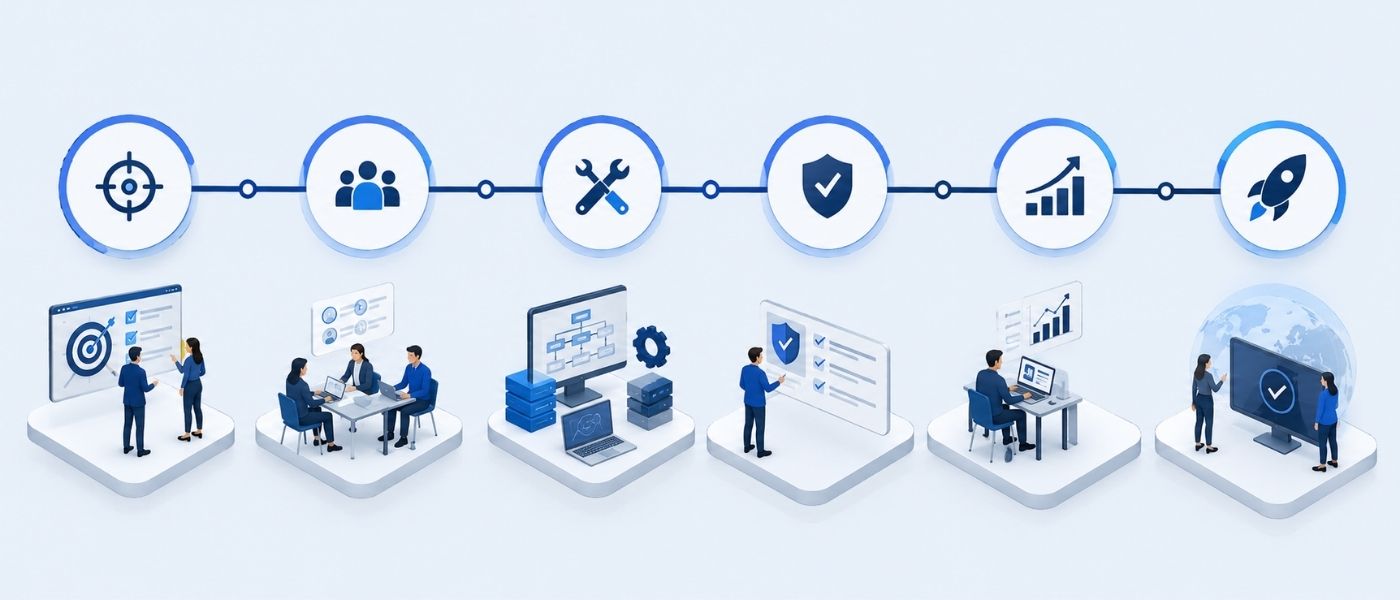
Operating Model: How Resource Augmentation Works in Practice
Step 1: Define Capability Gaps
Not job titles—outcomes and skills
Step 2: Map Required Capacity
How many people, for how long, at what seniority
Step 3: Rapid Talent Deployment
Profiles vetted, onboarded, embedded into teams
Step 4: Active Governance
KPIs, sprint reviews, delivery metrics
Step 5: Scale or Release
Adjust capacity as business needs change
This model is repeatable, auditable, and low-risk.
Governance: The Difference Between Success and Friction
Successful resource augmentation requires:
- Clear ownership of outcomes
- Defined communication cadence
- Performance metrics tied to delivery
- Documentation and knowledge capture
When governance is strong, augmented teams feel indistinguishable from internal teams.
Cost Comparison
Cost Element | Hiring | Augmentation |
Recruitment | High | Minimal |
Onboarding Time | Long | Short |
Benefits & Compliance | Yes | No |
Idle Capacity Cost | Yes | No |
Exit Cost | High | Low |
Result:
Augmentation lowers downside risk without sacrificing capability.
Why Companies Choose iValuePlus for Resource Augmentation
As businesses mature in their use of resource augmentation, partner quality becomes critical.
iValuePlus approaches resource augmentation not as “staff supply,” but as capability enablement.
Organizations work with iValuePlus when they need:
- Fast access to vetted, role-ready professionals
- Strong governance and delivery alignment
- Flexibility without loss of control
- A partner who understands scaling, not just staffing
iValuePlus’ resource augmentation services are structured to:
- Integrate seamlessly with internal teams
- Reduce operational and compliance overhead
- Scale up or down without friction
The value lies not just in talent access but in risk-aware execution models.
Decision Checklist: Is Resource Augmentation Right for You?
- You need to scale faster than hiring allows
- Workload is project-based or variable
- Skills are specialized or evolving
- You want control without HR complexity
- Cost predictability matters
If you checked 3 or more, resource augmentation is likely the right model.
Common Mistakes
Mistake 1: Treating augmented resources as vendors
→ Treat them as part of your delivery team
Mistake 2: Vague expectations
→ Define outputs, timelines, and KPIs clearly
Mistake 3: No governance
→ Weekly cadence, clear ownership, visibility
Mistake 4: No knowledge capture
→ Document processes and decisions throughout
The Future of Scaling: Hybrid Teams by Default
By 2028:
- Fixed teams will shrink
- Augmented and fractional roles will rise
- Workforce planning will be capability-driven, not headcount-driven
Resource augmentation is not a temporary fix—it is the default scaling model for modern organizations.
Conclusion
Resource augmentation services help businesses scale without risk because they align talent with reality not assumptions.
They:
- Preserve control
- Reduce downside exposure
- Increase speed and adaptability
- Support sustainable growth
For companies navigating uncertainty, this is not just safer—it’s smarter.
FAQs
What are resource augmentation services?
They provide on-demand skilled professionals who work as part of your team while remaining employed by the service provider.
How is this different from outsourcing?
Outsourcing transfers execution to a vendor. Resource augmentation keeps execution under your control.
Is resource augmentation only for IT?
No. It is widely used in marketing, finance, analytics, product, and operations.
Does resource augmentation replace hiring?
Not entirely. It complements hiring by filling gaps and handling variability.
How fast can teams be scaled?
Often within weeks, depending on skill requirements.
Is IP secure?
Yes—work is done under your governance and systems.
Recent Post
How to Set Up an Offshore QA Center of Excellence in India: A Practical Guide for Global Teams
Learn how to set up an offshore QA center of...
Managed IT Services for Small Businesses: Complete Guide (2026)
Discover what managed IT services for small businesses actually include,...

iValuePlus Services
iValuePlus is a one-stop solution to address all your needs to access, build and grow your business in the Indian market which is cost-effective & has a huge talent pool. Established in 2019 as a ‘Business Solution provider', our team has delivered successful growth projects in the international market.
Our services include setting up ODC (offshore development center), Staff Augmentation, Talent Acquisition, Digital Marketing, in the IT/ITES domain.