
Discover the best city to set up office in India...

What to Look for in an Offshore Team Setup Partner in India
Why Choosing the Right Offshore Partner Matters
The offshore team setup decision is one of the most consequential operational choices a scaling technology company makes — and it’s one where the selection process rarely gets the rigour it deserves.
Most companies approach offshore partner selection the way they approach buying software: browse options, request proposals, compare rates, and choose. The problem is that offshore team setup is not a product — it’s a relationship with significant operational depth. A partner who looks identical on paper can perform very differently in practice, and the consequences of a mismatch — missed onboarding timelines, quality inconsistency, compliance gaps, cultural friction — compound over months before they become visible enough to act on.
India remains the leading destination for offshore team setup in 2026, and for good structural reasons: talent depth, English proficiency, a maturing regulatory environment, and time zone flexibility that enables meaningful overlap with both European and US working hours. But the depth of the India partner market means the variance in quality is high. There are excellent offshore partners and there are very poor ones, and the signals that distinguish them are not always obvious in a standard vendor evaluation.
This guide provides a specific, honest framework for evaluating offshore team setup partners in India — covering the ten factors that most reliably differentiate strong partners, the red flags that consistently precede poor outcomes, and a six-step selection process that de-risks the decision before a long-term commitment is made.
What Is an Offshore Team Setup Partner?
An offshore team setup partner is a company that manages the operational complexity of building a remote team in another country on your behalf. In India, this typically includes talent sourcing and screening, employment or employer-of-record structuring, compliance with Indian labour and data protection law, infrastructure setup, and ongoing performance governance. The partner handles the local market knowledge that would take a first-time India employer years to develop — allowing the client to access India’s talent pool at speed and with reduced risk.
What this means in practice differs by engagement model. A staff augmentation partner places individual developers within your team structure and manages their employment; you manage their work. An ODC partner builds and operates a dedicated offshore unit, with more of the day-to-day management on their side. A BOT partner builds and operates an entity that will eventually be transferred to your full ownership.
The common thread across all models: the partner brings local market infrastructure — hiring pipelines, employer brand, compliance knowledge, real estate relationships, payroll systems — that would take a first-time India employer considerable time and cost to replicate independently.
Why India Is the Preferred Destination for Offshore Teams
Talent depth that extends beyond technology
India produces approximately 1.5 million engineering graduates annually, with deep talent pools in full-stack development, data science, DevOps, cloud architecture, AI/ML, and mobile engineering. Beyond technology, India’s GCC ecosystem has developed strong capabilities in financial operations, legal services, compliance, customer experience, and R&D support. The breadth of available function types has expanded significantly in the past five years.
English as the working language of Indian business
India’s engineering education is conducted in English. Most senior professionals have spent years working with international clients and are accustomed to the communication norms — async documentation, structured status reporting, direct escalation — that make remote collaboration functional. This is not universal across all experience levels and function types, but it is reliably true for the experienced professionals that quality offshore partners source.
A regulatory environment that has matured
India’s company registration, employer-of-record frameworks, and data protection regulation have become considerably more structured over the past decade. The Digital Personal Data Protection Act (DPDP Act 2023, operational 2025) has added compliance requirements that need to be managed — but has also created a clearer framework than previously existed. Offshore partners with current compliance expertise are a genuine asset in this environment.
Time zone flexibility that supports real collaboration
India Standard Time (IST, UTC+5:30) creates meaningful overlap with UK mornings and US afternoons when offshore teams flex their working hours — a standard practice for experienced India-based teams. For pure async collaboration, the gap can be structured to produce faster feedback loops than same-timezone teams with poor documentation habits.
Key Factors to Consider When Choosing an Offshore Partner
The ten factors below are sequenced by the order in which they typically reveal themselves in the evaluation process — starting with the evidence you can gather before a conversation, progressing to what you learn in structured evaluation.
Proven Experience and Track Record
What it means: A partner’s actual history of setting up offshore teams in your industry or function type, evidenced by case studies with named metrics — not logo walls and generic testimonials.
Why it matters: First-time India market entrants make predictable mistakes: suboptimal city selection for your function type, compensation benchmarking errors that cause early attrition, compliance gaps that require retrospective correction. Partners with a track record in your domain have already encountered and solved these problems.
How to evaluate: Request two to three case studies specific to your function type or industry. Ask for team size at setup, time to first productive hire, attrition rate in the first year, and what the biggest challenge was. If the partner cannot produce specific case studies — only generic claims of ‘extensive experience’ — treat that as a signal. Ask to speak with a current client directly, not a reference they have prepped.
Talent Quality and Hiring Capabilities
What it means: The depth and structure of the partner’s hiring pipeline, screening methodology, and calibration process for the specific skills and seniority levels you need.
Why it matters: Your offshore team’s output is a direct function of who gets hired. The difference between a partner with an active, calibrated hiring pipeline for your tech stack and one that uses generic job boards with minimal screening is measured in months of timeline and significant quality variance.
How to evaluate: Ask to see their technical screening process for a sample role — not a description of it, but the actual interview stages, assessment criteria, and pass/fail thresholds. Ask what their typical time-to-shortlist is for a senior role in your tech stack. Ask what percentage of candidates presented are accepted by clients. Ask what happens when a placed developer doesn’t perform — is there a replacement guarantee, and what are the terms?
Range of Services
What it means: The breadth of engagement models offered — staff augmentation, dedicated teams, ODC setup, BOT — and the depth of operational support within each.
Why it matters: Your needs will evolve. A partner capable only of staff augmentation becomes a constraint when you’re ready to scale to a dedicated team. A partner who offers every model but has depth in only one is similarly limited. Understanding the partner’s actual capability versus their claimed service range is important for long-term fit.
How to evaluate: Ask what percentage of their current client base uses each service model. Ask for a client who started with staff augmentation and moved to a dedicated team or ODC — what did that transition look like? Partners with genuine multi-model depth can point to real examples of clients who evolved their engagement over time.
Scalability and Flexibility
What it means: The partner’s ability to grow a team from a handful of developers to a full engineering organisation, and to flex the engagement structure as your needs change.
Why it matters: Fast-growth companies can move from needing two developers to needing twenty within a single product cycle. A partner whose hiring pipeline and management infrastructure cannot keep pace creates a bottleneck at exactly the wrong moment. Equally, a partner who cannot flex engagement terms when your requirements shift creates contractual friction.
How to evaluate: Ask: What’s the largest team you’ve scaled from scratch within a twelve-month period? What’s your typical time to add five developers to an existing engagement? What happens if we need to reduce team size by thirty percent — what are the contractual and operational implications? The answers tell you whether scale and flex are genuine capabilities or aspirational claims.
Communication and Collaboration
What it means: The structure and reliability of communication — not just English proficiency, but async protocols, escalation paths, reporting cadence, and the quality of written communication at every level of the team.
Why it matters: Communication failure is the leading cause of offshore project delays — and it is almost always a protocol failure, not a language failure. The question is not ‘do your developers speak English?’ but ‘what structure do you put around async communication to ensure nothing important gets lost or delayed?’
How to evaluate: In your evaluation conversations, observe how the partner communicates: Are they precise and specific in their answers? Do they follow up in writing? Do they proactively flag concerns or ambiguities? Ask to see a sample status report from an ongoing engagement. Ask how they handle a situation where a developer hits a blocker that threatens sprint delivery. These observations are better predictors of communication quality than any self-assessment.
Security and Compliance
What it means: The maturity and completeness of the partner’s data security practices and their compliance documentation — IP assignment, NDA, data processing agreements, access controls, and endpoint security.
Why it matters: A data breach or IP dispute involving an offshore partner is expensive, legally complex, and reputationally damaging. The risk is not hypothetical: third-party involvement is consistently associated with higher breach severity in IBM’s annual Cost of a Data Breach research. Prevention is contractual and procedural — partners with mature security practices implement it before problems arise, not in response to them.
How to evaluate: Before any commercial conversation, ask to see their standard NDA, IP assignment clause, and data processing agreement. Assess whether these are specific and complete, or generic and vague. Ask about their access control policy — how is developer access to client systems provisioned and revoked? Ask about device management and endpoint security requirements. Partners who produce these materials readily and discuss them knowledgeably have invested in compliance; those who treat them as formalities have not.
Infrastructure and Technology Support
What it means: The physical and digital infrastructure the partner provides — office facilities, secure development environments, IT equipment, and tooling integration — and their flexibility to align with your tech stack.
Why it matters: Infrastructure gaps create friction at scale. A partner who provides only individual placements with no managed infrastructure creates a different operational reality than one who provides a managed development environment with secure access, version control, CI/CD integration, and IT support. The right level of infrastructure provision depends on your engagement model — but you should understand exactly what is and isn’t included before signing.
How to evaluate: Ask for a detailed description of what infrastructure is included in the engagement fee, and what is additional. Ask specifically about: secure office environment and equipment; network and VPN configuration; integration with your CI/CD pipeline, issue tracker, and documentation system; IT support response times; and disaster recovery or business continuity procedures. The more specific their answers, the more mature their infrastructure practice.
Cost Transparency
What it means: Clear, itemised commercial terms that distinguish the core engagement fee from optional services, and that identify the factors that cause fees to change over time.
Why it matters: Offshore engagements that start with an attractive headline rate frequently reveal unexpected costs during the engagement: management overhead fees, tooling licences, workspace charges, recruitment fees for replacements, and escalation surcharges. These aren’t always hidden maliciously — they reflect genuine costs that weren’t discussed explicitly. But they erode the value of the engagement and create friction in the relationship.
How to evaluate: Before signing, ask for a complete list of what is and is not included in the quoted fee. Ask specifically about: fees for team lead or account management; charges for developer replacement if someone leaves; tooling and infrastructure costs; any minimum commitment periods or early termination penalties. A partner who is transparent about the full cost structure — including the parts that aren’t flattering — is more trustworthy than one who presents only the headline rate.
Cultural Compatibility
What it means: The degree to which the partner’s working culture, communication norms, and professional values align with your organisation — and their track record of building culturally aligned offshore teams for international clients.
Why it matters: Cultural misalignment manifests in specific, observable ways: developers who don’t proactively raise concerns, teams with a high-context communication style working with clients who expect low-context directness, professional expectations around working hours or decision-making authority that differ from the client’s norms. These differences are manageable — but only if they’re identified and addressed explicitly, not assumed away.
How to evaluate: During evaluation, ask the partner how they handle cultural onboarding for developers joining international client teams. Ask for an example of a cultural misalignment they encountered in a past engagement and how they resolved it. Assess how their team communicates with you during the sales process — the communication style you experience in a sales context is a reasonable proxy for what you’ll experience in delivery.
Governance and Reporting
What it means: The partner’s framework for tracking team performance, reporting to the client, managing escalations, and maintaining accountability across the engagement lifecycle.
Why it matters: Governance is where good offshore engagements are protected and poor ones deteriorate. Without a defined reporting structure, KPI framework, and escalation path, problems compound silently. By the time they’re visible, they’re expensive to correct. Partners who invest in governance infrastructure — not just as a client-facing report but as an internal management discipline — consistently deliver more stable engagements.
How to evaluate: Ask the partner to describe their governance framework in specific terms: What KPIs do they track by default? How frequently are performance reviews conducted? What is the escalation path if a developer is underperforming? Who is the client’s single point of contact, and what is their response SLA? Ask to see a sample governance report from an active engagement. Partners with mature governance practices answer these questions readily and specifically.
Red Flags to Avoid
These are patterns that appear consistently in post-mortems of failed offshore engagements. They don’t guarantee failure — but they strongly correlate with it.
Red Flag | What It Actually Signals |
Vague or absent case studies | Any partner claiming ‘extensive experience’ should be able to produce case studies with named metrics: team size, timeline, function delivered, outcome. Generic testimonials and logo walls are not evidence. Ask for a case study in your industry. If they can’t provide one, treat that as a signal. |
Reluctance to run a pilot | Reputable offshore partners welcome a short pilot engagement as a standard part of their sales process. Partners who resist pilots — pushing for long-term contracts before demonstrating capability — typically have something to hide, usually quality inconsistency or high post-onboarding attrition. |
No structured compliance documentation | Ask to see their standard NDA, IP assignment clause, and data processing agreement before the conversation reaches contract stage. Partners with mature compliance practices produce these without friction. Partners who treat these as afterthoughts will treat your data security the same way. |
Unclear governance and reporting structure | If you ask ‘how will you report on team performance?’ and receive a vague answer about ‘regular updates,’ that’s insufficient. A competent partner should be able to describe their reporting cadence, KPI framework, and escalation process without prompting. Governance gaps don’t stay small — they compound. |
Mismatch between sales team and delivery team | The bait-and-switch pattern is common: senior consultants handle the sales process, junior staff handle delivery. Ask specifically who will manage your account, who will conduct technical interviews, and who will be your day-to-day point of contact. If the answer changes between the pitch and the contract, negotiate for commitments in writing. |
Offshore Team Setup Models: Choosing the Right Structure
The engagement model you choose determines the balance of control, speed, cost, and management investment. There is no universally correct model — the right choice depends on your team structure, budget, timeline, and how much operational management capacity you can allocate to the offshore relationship.
Factor | Staff Augmentation | Dedicated Team | ODC | BOT |
Client control | High | High | Full | Grows to Full |
Setup speed | Days–weeks | 1–2 weeks | 2–4 months | 3–6 months (build) |
Operational ownership | Client | Shared | Client | Partner → Client |
Best for | Plugging specific skill gaps | Product squads | Long-term scale | First India entry |
IP risk | Low (with contracts) | Low | Lowest | Low (with contracts) |
Flexibility | High | Medium | Lower | Structured |
Step-by-Step Process to Choose the Right Partner
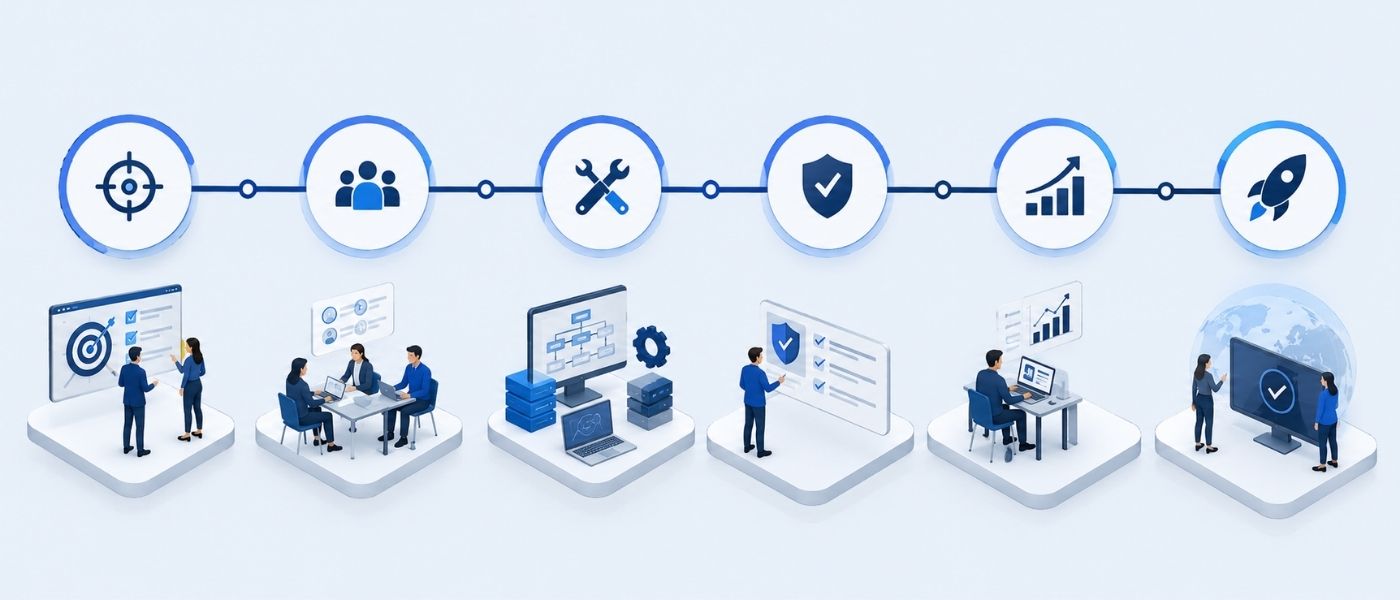
- Define your goals with precision — Before contacting any vendor, document what you’re building: the functions you need to offshore, the tech stack or domain expertise required, the team size and structure, your timeline, your timezone overlap requirements, and your definition of a successful engagement at 30, 90, and 180 days. The quality of your brief determines the quality of proposals you receive — and your ability to compare them meaningfully.
- Shortlist vendors through channels that expose track record — Avoid relying solely on search rankings or cold inbound. Use Clutch.co for verified client reviews, NASSCOM’s registered vendor directory for credentialed India-based partners, and peer referrals from CTOs or engineering leaders in your network who have offshore teams. The goal at this stage is a shortlist of four to six vendors with verifiable evidence of relevant work — not the largest number of vendors who responded to your RFP.
- Evaluate capabilities with specific questions, not general conversations — Apply the ten evaluation factors outlined in this article as a structured interview guide. Ask each vendor the same specific questions and record their answers for comparison. The differences in specificity, transparency, and depth of response will be more revealing than the proposals themselves.
- Conduct technical interviews with your own engineers — For any engagement involving software development, the technical evaluation should be designed and conducted by someone on your engineering team with relevant domain expertise — not delegated to the vendor’s HR process. Include a code review exercise, an architecture discussion, and a problem-solving scenario. Assess how candidates reason through uncertainty, not just whether they arrive at correct answers.
- Start with a pilot project — A two-to-four week paid pilot on a real but low-stakes workstream gives you signal that no evaluation process can replicate: actual output quality, communication cadence and proactivity, responsiveness to feedback, estimation accuracy, and documentation habits. Define the evaluation criteria for the pilot before it starts — what does a successful pilot look like? Evaluate not just the deliverable but how the team worked throughout the process.
- Finalise the long-term partnership with clarity on terms — When you decide to proceed, ensure the contract covers: IP assignment and NDA terms; data processing agreement compliant with your applicable regulations; service level agreements for response time, escalation, and attrition management; clear scope of included and excluded services; minimum commitment and termination provisions; and governance reporting cadence and format. Have legal counsel review before signing.

How the Right Partner Impacts Business Growth
The downstream effects of a strong offshore partner selection are measurable and compounding:
- Faster scaling — a partner with an active India hiring pipeline and calibrated screening process reduces time-to-hire from months to weeks, allowing product velocity to increase without the lag of sequential hiring.
- Reduced total cost — not just reduced labour cost, but reduced cost of mistakes: fewer compliance errors, lower attrition-driven re-hiring costs, fewer production incidents caused by inadequate onboarding.
- Improved productivity — offshore developers who are properly onboarded, given clear requirements, and supported by structured communication protocols reach full velocity faster and sustain it longer.
- Better quality delivery — quality is a process output, not a talent input. Partners who implement CI/CD integration, code review standards, and documented quality gates consistently deliver more reliable output than those who rely on individual developer diligence.
- Competitive advantage — the compounding effect of a high-performing offshore team is engineering velocity at a cost structure that allows reinvestment in product, marketing, or further talent. This is the strategic case for offshore team setup, and it’s what a strong partner enables.
How iValuePlus Helps You Set Up Offshore Teams in India
iValuePlus provides end-to-end offshore team setup services in India, designed around the premise that the partner’s value is not just access to talent — it’s the process infrastructure that makes the talent perform.
What this means in practice:
- We begin every engagement with a requirements assessment that documents your tech stack, team structure, communication preferences, timezone requirements, and what ‘good’ looks like for this specific role — before we source a single candidate
- Our technical screening process is calibrated to your standards, not a generic filter — we can share sample screening criteria and let you add to or modify them before hiring begins
- Our standard engagement contracts include IP assignment, NDA, and data processing terms as baseline provisions — not negotiation add-ons
- We assign a dedicated account manager as your single point of escalation — with a defined response SLA — from day one
- We provide structured governance reporting covering team performance, attrition metrics, velocity indicators, and escalation log on a cadence agreed at engagement start
- We support all major engagement models — staff augmentation, dedicated teams, ODC setup, and BOT — and can discuss transition between models as your requirements evolve
Future Trends in Offshore Team Setup
- AI-driven talent acquisition is changing what partner infrastructure looks like — Offshore partners who use AI-assisted sourcing, skills-matching, and candidate screening are reducing time-to-shortlist substantially compared to those relying on manual processes. When evaluating partners, ask specifically about their use of AI in hiring — not as a buzzword, but as a question about how they reduce the time between your requirement brief and a qualified candidate shortlist.
- Remote-first organisations are normalising offshore-quality collaboration standards — The distinction between ‘in-house remote’ and ‘offshore’ is narrowing as companies with distributed domestic teams develop the async documentation, tooling, and communication infrastructure that offshore collaboration requires. This creates an opportunity: companies that have already invested in remote-first practices have most of the foundation needed to make offshore teams highly effective.
- Hybrid workforce models are becoming the standard GCC architecture — The most effective offshore setups in 2026 combine a small strategic leadership layer in the home market with a larger execution team in India. Offshore partners who support this model — helping clients embed India-based team leads with authority and context, not just execution capacity — are delivering more durable capability than those who build headcount without leadership depth.
- Increased focus on security is raising the compliance bar for all partners — India’s DPDP Act (operational 2025), the EU AI Act, and sector-specific regulations are creating compliance requirements that offshore partners need to understand and operationalise on behalf of their clients. Partners who treat compliance as a contractual formality — signing templates without understanding their implications — are increasingly a liability. Ask prospective partners to explain the DPDP Act’s implications for your engagement specifically. The quality of their answer is a useful calibration.
FAQ
Q: How do I verify an offshore partner’s claimed experience?
Request case studies with specific, verifiable details: client industry, function type, team size, timeline from first hire to full productivity, attrition rate in the first year, and a description of a challenge they encountered. Ask to speak with a current client independently — not a reference they’ve prepared, but a client you find via their LinkedIn or Clutch profile. Ask the partner what their biggest failure in an offshore engagement was and what they learned. Partners with genuine track records answer these questions directly. Those without tend toward vague generalities.
Q: What is the right offshore engagement model for a startup versus an enterprise?
Startups with limited management bandwidth typically benefit most from staff augmentation: individual developers placed within the existing team, managed by the client’s engineering lead, with the partner handling employment, payroll, and compliance. This model gives maximum control with minimal operational overhead on the partner side. Enterprises with larger India ambitions — particularly those building out a long-term capability centre — benefit from dedicated teams, ODC structures, or BOT models that provide a more autonomous, scalable offshore unit. The choice depends less on company size and more on the management capacity available to oversee the offshore relationship and the timeline for India becoming a permanent operational presence.
Q: How long does it take to get an offshore team in India operational?
For staff augmentation through an established partner, the first developer can typically start within two to four weeks of a clear requirement brief — assuming the partner has an active pipeline for your tech stack. Building a dedicated team of five to eight developers typically takes four to eight weeks. ODC setup, including infrastructure, entity or employer-of-record structuring, and initial hiring, typically takes two to four months. BOT engagements have the longest lead time — the build phase typically runs three to six months before the team reaches full operational capacity. These are typical ranges; specific timelines depend on the complexity of the role, the partner’s pipeline, and the client’s speed in conducting technical interviews and making hiring decisions.
Q: What contracts should be in place before an offshore team starts work?
At minimum: a master services agreement covering the scope, term, and commercial terms of the engagement; an NDA covering source code, business information, and client data; an IP assignment clause explicitly transferring all created work product to the client; a data processing agreement compliant with GDPR and India’s DPDP Act if relevant; service level agreements covering response time, escalation, attrition management, and replacement terms; and an acceptable use policy for the client’s systems. Have your legal counsel review vendor-supplied contracts — they are written to protect the vendor, not the client.
Q: What is the best way to evaluate an offshore partner before committing long-term?
A paid pilot project is the most reliable evaluation tool available. Define a two-to-four week scope on a real but low-stakes workstream, agree on evaluation criteria in advance (output quality, communication cadence, responsiveness to feedback, estimation accuracy, documentation quality), and assess the process as much as the deliverable. The way a team works during a pilot — how they ask questions, how they flag blockers, how they respond to feedback — is a reliable predictor of how they will perform over a twelve-month engagement. No proposal, reference call, or interview process provides equivalent signal.
Conclusion
The offshore team setup decision is not primarily a cost decision — it is a strategic capability decision. The partner you choose determines the quality of talent you can access, the speed at which you can scale, the reliability of the compliance and IP protection surrounding your IP, and the governance discipline that keeps the engagement performing over time.
The companies that build offshore teams that consistently outperform are not the ones that found the cheapest partner. They are the ones that invested in a rigorous selection process — evaluated on capability and process, ran a pilot, negotiated complete contracts, and built a governance structure that maintained accountability throughout the engagement.
The framework in this article is the starting point for that process. The next step is applying it — with the same rigour you would bring to hiring a senior engineering leader, because the partner you choose will have more influence on your offshore team’s performance than any individual hire.
READY TO START EVALUATING OFFSHORE PARTNERS?
Get in touch wiith us today. We’ll share our hiring methodology, governance framework, and compliance documentation before any commercial discussion — and we’ll scope a pilot engagement that lets you evaluate actual output before a long-term commitment. www.ivalueplus.com/offshore-development-centre
Recent Post
How to Set Up an Offshore QA Center of Excellence in India: A Practical Guide for Global Teams
Learn how to set up an offshore QA center of...
Managed IT Services for Small Businesses: Complete Guide (2026)
Discover what managed IT services for small businesses actually include,...

iValuePlus Services
iValuePlus is a one-stop solution to address all your needs to access, build and grow your business in the Indian market which is cost-effective & has a huge talent pool. Established in 2019 as a ‘Business Solution provider', our team has delivered successful growth projects in the international market.
Our services include setting up ODC (offshore development center), Staff Augmentation, Talent Acquisition, Digital Marketing, in the IT/ITES domain.