
Discover the best city to set up office in India...
Categories

Outsourcing IT Services: A Practical Framework for Risk-Free Execution
Why Outsourcing IT Services Requires a Structured Framework
Outsourcing IT services has moved far beyond a cost-saving tactic. In 2026, it is a core operational strategy for organizations navigating cloud transformation, cybersecurity threats, distributed teams, and rapid digital scaling.
However, despite its benefits, IT outsourcing failures remain common. Organizations struggle with:
- Poor service quality
- Security vulnerabilities
- Vendor lock-in
- Escalating hidden costs
- Misaligned SLAs
- Lack of governance and accountability
The difference between success and failure lies in execution.
This article presents a practical, risk-free framework for outsourcing IT services, covering:
- Strategic readiness
- Vendor selection
- Governance models
- Security and compliance
- SLA design
- Cost controls
- Risk mitigation
- Continuous optimization
This is not theory. It is an execution playbook.
What Outsourcing IT Services Really Means Today
Outsourcing IT services involves transferring responsibility for specific IT functions to an external specialist provider under defined governance, SLAs, and security frameworks.
Commonly outsourced IT services include:
- IT helpdesk and support
- Infrastructure management
- Cloud operations
- Network and security monitoring
- Application support and maintenance
- DevOps and SRE
- Data management and analytics
- Endpoint and device management
Modern outsourcing emphasizes co-managed models, not full abdication of control.
Why Organizations Outsource IT Services
Key business drivers include:
- Cost optimization
- Access to specialized skills
- 24/7 support capability
- Faster scalability
- Improved uptime and reliability
- Security and compliance readiness
- Focus on core business initiatives
However, these benefits materialize only with structured execution.
Common Risks in Outsourcing IT Services (And Why They Happen)
Before designing a framework, it is critical to understand the risks.
Operational Risks
- Inconsistent service quality
- Delayed incident resolution
- Knowledge silos
- Poor documentation
Security Risks
- Data breaches
- Inadequate access controls
- Weak incident response
- Non-compliance with regulations
Financial Risks
- Hidden costs
- Scope creep
- Poor cost visibility
- Vendor dependency
Strategic Risks
- Loss of internal capability
- Vendor lock-in
- Misalignment with business goals
Governance Risks
- Weak SLAs
- Lack of escalation mechanisms
- No performance accountability
A risk-free approach addresses each category systematically.

The Risk-Free Outsourcing IT Services Framework
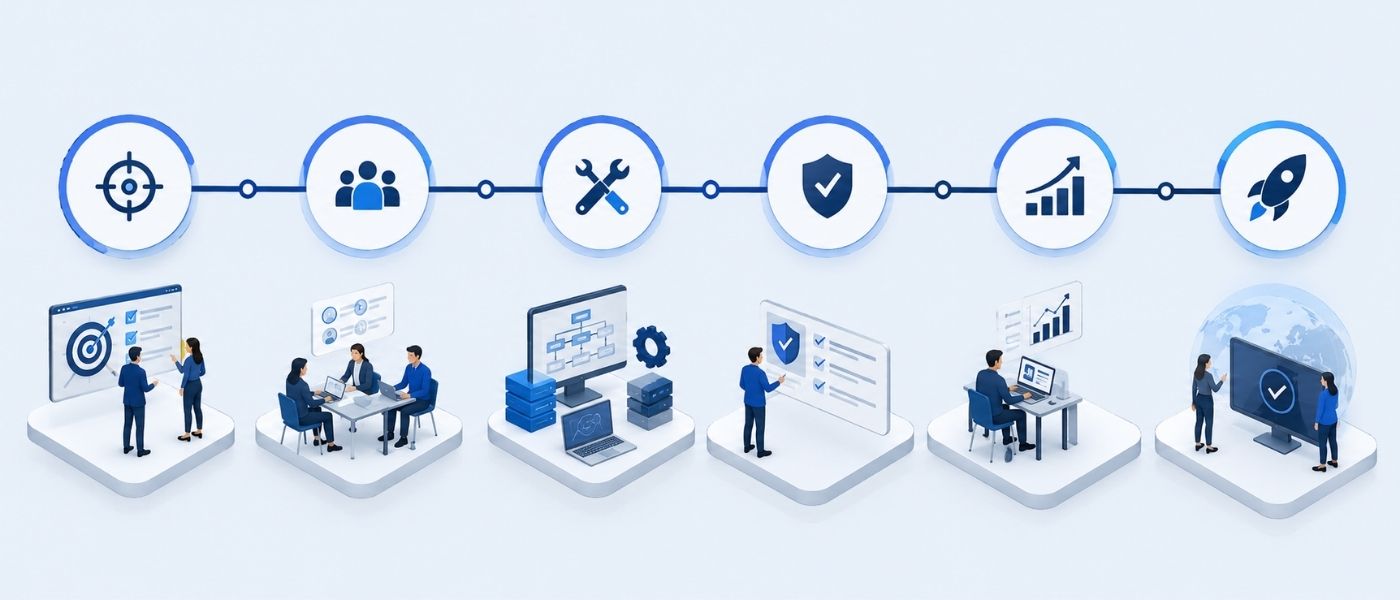
A successful outsourcing model is built on seven execution pillars:
- Strategic Readiness Assessment
- Scope Definition & Service Segmentation
- Vendor Selection & Due Diligence
- Governance & Operating Model Design
- Security, Compliance & Risk Controls
- SLA, KPI & Commercial Structuring
- Continuous Performance Management
Each pillar reduces a specific category of risk.
Pillar 1: Strategic Readiness Assessment
Determine What Should Be Outsourced (And What Should Not)
Not all IT functions should be outsourced.
Ideal for outsourcing:
- Standardized, repeatable operations
- 24/7 monitoring and support
- Infrastructure maintenance
- L1/L2 helpdesk
- Cloud operations
- Application support
Better kept in-house:
- IT strategy and architecture
- Vendor management
- Security policy ownership
- Business-critical IP
Business Alignment Check
Before outsourcing IT services, answer:
- What business outcomes are expected?
- Is the goal cost reduction, resilience, or scale?
- How will success be measured?
Outsourcing without outcome clarity leads to misalignment.
Pillar 2: Scope Definition & Service Segmentation
Why Scope Clarity Is Critical
Ambiguous scope is the #1 cause of outsourcing disputes.
Define scope across:
- Services included
- Services excluded
- Service boundaries
- Responsibility matrices
RACI Framework for IT Outsourcing
Every outsourced service should have a RACI model:
- Responsible – Vendor execution
- Accountable – Client IT owner
- Consulted – Security, compliance, architecture
- Informed—Business stakeholders
This prevents blame-shifting.
Service Segmentation Model
Break IT services into:
- Core operations
- Critical support
- Strategic enhancements
Different SLA and governance models apply to each.
Pillar 3: Vendor Selection & Due Diligence
Technical Due Diligence
Evaluate:
- Technology stack expertise
- Cloud certifications
- Security tooling
- Incident management maturity
- Documentation practices
Operational Maturity Assessment
Ask vendors to demonstrate:
- ITIL or equivalent frameworks
- Ticketing and escalation workflows
- Knowledge management systems
- Onboarding processes
Security & Compliance Assessment
Mandatory checks:
- ISO 27001 / SOC 2
- Data handling policies
- Access control mechanisms
- Incident response playbooks
- Regulatory experience (GDPR, HIPAA, etc.)
6.4 Commercial Transparency
Avoid vendors who:
- Hide pricing behind vague bundles
- Resist SLA penalties
- Cannot explain cost drivers
Pillar 4: Governance & Operating Model Design
Why Governance Determines Success
Governance ensures:
- Accountability
- Performance tracking
- Issue escalation
- Strategic alignment
Without governance, outsourcing IT services becomes unmanaged delegation.
Multi-Layer Governance Model
A mature model includes:
- Operational governance (daily/weekly)
- Tactical governance (monthly reviews)
- Strategic governance (quarterly steering committees)
Client-Side Ownership Structure
Always retain:
- Service owners
- Security owners
- Vendor relationship managers
Outsourcing does not remove responsibility.
Pillar 5: Security, Compliance & Risk Controls
Shared Responsibility Model
Security must follow a shared responsibility framework:
- Vendor handles operational security
- Client retains policy ownership
Access & Identity Management
Best practices include:
- Zero trust access
- Role-based permissions
- Time-bound access
- MFA for all systems
Data Protection Measures
Mandatory controls:
- Encryption at rest and in transit
- Secure backups
- Data residency compliance
- Regular audits
Incident Response Integration
Ensure:
- Defined response times
- Joint incident drills
- Communication protocols
- Root cause analysis
Pillar 6: SLA, KPI & Commercial Structuring
Designing Effective SLAs
SLAs must be:
- Measurable
- Outcome-oriented
- Enforceable
Key SLA metrics include:
- Incident response time
- Resolution time
- System availability
- First-call resolution
- Security incident handling
KPI Framework Beyond SLAs
Track:
- User satisfaction
- Cost per ticket
- Automation rate
- Ticket backlog trends
- Root cause reduction
Commercial Models for Outsourcing IT Services
Common pricing models:
- Fixed monthly retainer
- Per-user pricing
- Per-ticket pricing
- Hybrid models
Avoid purely variable pricing without caps.
Pillar 7: Transition, Knowledge Transfer & Onboarding
Transition Planning
A structured transition includes:
- Shadow support
- Reverse shadowing
- Parallel run periods
- Sign-off checkpoints
Knowledge Management
Insist on:
- SOP documentation
- Architecture diagrams
- Runbooks
- Escalation guides
Knowledge loss is a hidden risk.

Continuous Performance Management & Optimization
Regular Performance Reviews
Conduct:
- Monthly operational reviews
- Quarterly strategic reviews
- Annual contract optimization
Automation & Tooling Evolution
Encourage vendors to:
- Introduce AI-based monitoring
- Automate repetitive tasks
- Improve self-service portals
Risk Re-Assessment
Re-evaluate:
- Security posture
- Compliance exposure
- Cost structures
- Vendor dependency
Outsourcing is dynamic, not static.
Cost Control & ROI Measurement
Total Cost of Ownership (TCO)
Include:
- Vendor fees
- Tooling costs
- Internal oversight effort
- Transition costs
ROI Metrics
Measure:
- Cost savings vs baseline
- Uptime improvement
- Incident reduction
- Time-to-resolution
- Internal productivity gains
Outsourcing IT Services vs In-House Teams
Factor | In-House | Outsourced |
Cost | High fixed | Variable, lower |
Scalability | Limited | High |
24/7 Coverage | Expensive | Built-in |
Skill Depth | Limited | Broad |
Risk | Internal | Shared |
Hybrid models often deliver the best balance.
The Future of Outsourcing IT Services
Key trends:
- AI-driven IT operations (AIOps)
- Predictive incident management
- Zero-trust security models
- Outcome-based pricing
- Co-managed IT ecosystems
Vendors will act as strategic partners, not service providers.
Conclusion
Outsourcing IT services succeeds when treated as a governed operating model, not a procurement exercise.
A risk-free execution requires:
- Clear strategy
- Defined scope
- Strong governance
- Security-first mindset
- Performance accountability
- Continuous optimization
Organizations that apply this framework achieve:
- Lower costs
- Higher reliability
- Better security
- Faster scalability
- Improved IT maturity
Outsourcing IT services is not about giving up control—it is about building a smarter control system.
Recent Post
How to Set Up an Offshore QA Center of Excellence in India: A Practical Guide for Global Teams
Learn how to set up an offshore QA center of...
Managed IT Services for Small Businesses: Complete Guide (2026)
Discover what managed IT services for small businesses actually include,...

iValuePlus Services
iValuePlus is a one-stop solution to address all your needs to access, build and grow your business in the Indian market which is cost-effective & has a huge talent pool. Established in 2019 as a ‘Business Solution provider', our team has delivered successful growth projects in the international market.
Our services include setting up ODC (offshore development center), Staff Augmentation, Talent Acquisition, Digital Marketing, in the IT/ITES domain.