
Discover the best city to set up office in India...

QA Automation Explained: Strategy, Frameworks & Implementation | iValuePlus
In today’s digital-first economy, software failures are expensive. Downtime damages reputation. Bugs reduce customer trust. Delayed releases hurt revenue.
That’s why QA automation is no longer optional — it’s mission-critical.
Organizations that invest in professional QA automation services release faster, reduce defects, and scale confidently. Companies that rely solely on manual testing struggle to keep up with modern DevOps, CI/CD, and cloud-native architectures.
At iValuePlus, QA automation is not just a testing practice — it is a strategic business accelerator. Our enterprise-grade QA automation services help companies build stable, scalable, and high-performance applications.
In this guide, we’ll explain:
- What QA automation truly means in 2026
- The right QA automation strategy
- Frameworks that drive scalability
- Step-by-step implementation
- Why partnering with iValuePlus delivers measurable ROI
What Is QA Automation — And Why It Matters More Than Ever
QA automation refers to the use of advanced tools and frameworks to automatically execute test cases, validate results, and generate reports — without repetitive manual intervention.
Modern applications are:
- Cloud-native
- Microservices-based
- API-driven
- Deployed multiple times per day
Manual testing cannot sustain this velocity.
QA automation ensures:
- Faster testing cycles
- Continuous validation
- Higher accuracy
- Reduced production defects
- Stronger DevOps alignment
Businesses that fail to adopt QA automation fall behind competitors who ship faster and safer. Learn how QA Center of Excellence can help organizations standardize and scale QA effectively.
The Business Case for QA Automation
Let’s move beyond theory and talk results.
Companies implementing structured QA automation typically achieve:
- 40–60% faster release cycles
- 30–50% reduction in post-production defects
- Significant reduction in regression testing time
- Lower long-term testing costs
- Improved product reliability
When executed correctly, QA automation delivers measurable ROI within 6–12 months.
But success depends on strategy and execution — and this is where many organizations fail.
Why Most QA Automation Initiatives Fail
Common reasons include:
- No clear automation strategy
- Poor framework design
- Inadequate tool selection
- Lack of CI/CD integration
- Insufficient maintenance planning
- Skill gaps within teams
Automation without structure creates chaos.
This is why partnering with an experienced QA automation service provider like iValuePlus — and building a scalable, secure, and predictable QA framework — eliminates risk and accelerates results.
iValuePlus QA Automation Strategy: Built for Enterprise Scale
At iValuePlus, our QA automation approach is strategic, scalable, and ROI-focused.
We don’t just write scripts.
We engineer quality ecosystems.
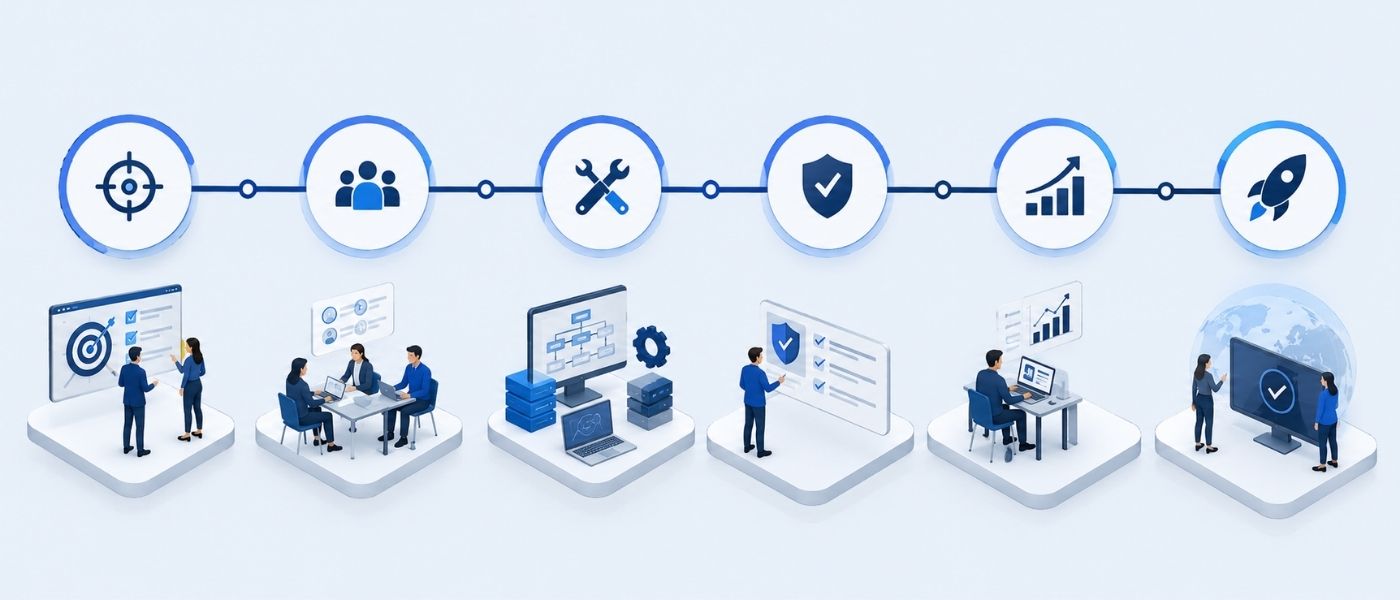
Step 1: Automation Readiness Assessment
We evaluate:
- Application architecture
- Business workflows
- Risk-prone modules
- Technical stack compatibility
- DevOps maturity
This ensures QA automation aligns with business goals.
Step 2: Custom Framework Design
We design scalable QA automation frameworks including:
- Hybrid automation architecture
- Modular test design
- Data-driven structures
- Reusable components
- Cloud execution capability
Our frameworks are built for maintainability and long-term efficiency.
Step 3: Tool Selection & Integration
We select enterprise-grade tools based on:
- Web, mobile, API, or microservices needs
- Technology stack compatibility
- CI/CD integration capability
- Parallel execution support
Our QA automation services integrate seamlessly into your DevOps pipelines.
Step 4: CI/CD & Continuous Testing Integration
Every code commit triggers automated testing.
We enable:
- Continuous integration testing
- Automated regression testing
- Real-time reporting dashboards
- Deployment validation
This reduces release risk and ensures consistent quality.
Step 5: Performance & Security Automation
QA automation must go beyond functional testing.
iValuePlus integrates:
- Load testing
- Stress testing
- API validation
- Security vulnerability checks
We ensure your application performs under real-world conditions.

QA Automation Frameworks That Drive Results
Modern enterprises need scalable frameworks.
We implement:
Hybrid Automation Framework
Combines data-driven and modular approaches for flexibility.
Keyword-Driven Architecture
Simplifies test case management and documentation.
Behavior-Driven Development (BDD) Framework
Aligns business and technical teams.
Cloud-Based Automation Environments
Supports distributed testing and remote execution.
Our QA automation frameworks reduce maintenance costs and improve stability.
QA Automation + DevOps: The Competitive Edge
DevOps without QA automation is risky.
iValuePlus ensures:
- Testing embedded in CI/CD
- Faster feedback loops
- Stable release cycles
- Zero deployment surprises
Our QA automation services enhance DevOps maturity and operational efficiency.
Industries We Support with QA Automation
Our QA automation expertise serves:
- SaaS platforms
- E-commerce businesses
- Fintech companies
- Healthcare systems
- Logistics & supply chain platforms
- Enterprise ERP applications
Each industry demands unique testing strategies — and we tailor QA automation accordingly.
Measurable ROI with iValuePlus QA Automation
Our clients report:
- Reduced defect leakage
- Faster release timelines
- Increased test coverage
- Lower maintenance costs
- Improved application performance
QA automation becomes a growth enabler — not just a testing function.
Why Choose iValuePlus for QA Automation?
Here’s what differentiates us:
- Dedicated QA automation experts
- Enterprise-grade frameworks
- DevOps-aligned execution
- Transparent reporting dashboards
- Scalable offshore delivery model
- Cost-efficient solutions without quality compromise
We act as an extension of your technology team.
If you’re serious about scaling with confidence, our QA automation services are built to deliver consistent, measurable outcomes. Explore our full QA service suite for more.
Implementation Timeline: What to Expect
A typical QA automation rollout includes:
Week 1–2: Strategy & Framework Planning
Week 3–4: Tool Setup & Initial Script Development
Month 2: CI/CD Integration & Regression Automation
Month 3+: Full-scale automation expansion
Within months, organizations experience significant acceleration.
The Future of QA Automation in 2026 and Beyond
Emerging advancements include:
- AI-driven test generation
- Self-healing test scripts
- Predictive defect analytics
- Autonomous quality validation
iValuePlus continuously upgrades QA automation capabilities to keep clients ahead of technological shifts.
QA Automation Is a Strategic Investment
In 2026, speed without quality is dangerous.
Quality without automation is slow.
The only sustainable path forward is structured, scalable QA automation.
Whether you’re modernizing legacy systems, scaling a SaaS platform, or accelerating DevOps adoption — QA automation must be central to your strategy.
And when implemented by experts, it becomes a powerful growth engine.
If you’re ready to:
- Reduce release risk
- Accelerate deployment
- Improve software reliability
- Scale with confidence
Partner with iValuePlus QA automation experts and transform your quality assurance process into a competitive advantage.
Recent Post
How to Set Up an Offshore QA Center of Excellence in India: A Practical Guide for Global Teams
Learn how to set up an offshore QA center of...
Managed IT Services for Small Businesses: Complete Guide (2026)
Discover what managed IT services for small businesses actually include,...

iValuePlus Services
iValuePlus is a one-stop solution to address all your needs to access, build and grow your business in the Indian market which is cost-effective & has a huge talent pool. Established in 2019 as a ‘Business Solution provider', our team has delivered successful growth projects in the international market.
Our services include setting up ODC (offshore development center), Staff Augmentation, Talent Acquisition, Digital Marketing, in the IT/ITES domain.