
Discover the best city to set up office in India...

10 Signs Your Company Needs DevOps Consulting Right Now
Your company needs DevOps consulting if you experience any combination of these: software releases take weeks or months, deployment failures regularly impact users, development and operations teams work in silos, you have no CI/CD pipeline, cloud costs are rising without explanation, or your engineers spend most of their time on repetitive operational work instead of building features. Three or more of these signs appearing together is a clear signal that a structured DevOps transformation — guided by an experienced consultant — will deliver measurable ROI faster than internal trial-and-error.
Key Takeaways
- Slow release cycles and frequent deployment failures are the two most financially damaging DevOps anti-patterns, yet both are directly fixable through CI/CD implementation and pipeline automation.
- Siloed development and operations teams don’t just cause friction — they cause outages, because no single team owns the full deployment chain.
- DORA research shows elite DevOps performers deploy 208x more frequently and recover from incidents 2,604x faster than low performers — the performance gap is enormous and directly impacts revenue.
- DevOps consulting for startups is especially high-ROI because it prevents technical debt accumulation rather than requiring expensive remediation later.
- The right DevOps consultant doesn’t just implement tools — they build your team’s internal capability so the improvement is permanent.
- Managed DevOps services give companies access to senior DevOps expertise at a fraction of the cost of building an equivalent in-house team.
What Is DevOps Consulting?
DevOps consulting is the engagement of external experts to assess, design, and implement DevOps practices within your organisation. A DevOps consultant brings structured methodology and hands-on technical experience across the tools and processes that engineering teams often lack: CI/CD pipeline design, infrastructure-as-code, cloud architecture, container orchestration, monitoring and observability, and the cultural practices that make development and operations work as a single unified function.
Unlike hiring a DevOps engineer, a DevOps consultant’s role is diagnostic and transformational. They examine your entire software delivery lifecycle — from code commit to production deployment — identify where bottlenecks, failures, and inefficiencies occur, and design a roadmap to fix them systematically. Crucially, a good consultant builds your team’s capability rather than creating dependency.
DevOps consulting is not limited to enterprises. DevOps consulting services for small businesses and startups are increasingly common — and often more impactful — because they establish the right foundations before technical debt compounds.
The 10 Warning Signs Your Company Needs DevOps Consulting
Most companies don’t experience a single catastrophic event that signals the need for DevOps help. Instead, the warning signs accumulate gradually — each one slightly normalised — until the combined drag on velocity, reliability, and team morale becomes undeniable. Here are the ten most telling indicators.
1. Your Release Cycles Are Measured in Weeks or Months, Not Days
If shipping a new feature or a bug fix to production takes more than a week — and especially if it involves a scheduled release window, multiple manual handoffs, or a deployment freeze — your software delivery process has structurally broken down. Slow release cycles are not a consequence of complex software; they are a consequence of a manual deployment process, lack of CI/CD pipeline, and absence of automated testing.
The downstream effects are severe: your team loses the ability to respond quickly to customer feedback, compete with faster rivals, or fix production issues without waiting for the next release window. Delayed time to market isn’t an engineering problem alone — it is a revenue problem.
What DevOps consulting fixes: A DevOps consultant designs and implements a CI/CD pipeline that automates build, test, and deployment steps — reducing release cycles from weeks to hours and making deployments a non-event rather than a high-risk ceremony.
2. Frequent Deployment Failures Are Causing Production Outages
Every production outage caused by a bad deployment carries a quantifiable cost: downtime at $5,600 per minute on average (Gartner), damaged customer trust, emergency all-hands engineering effort, and leadership scrutiny. If your team has normalised post-deployment rollbacks, hotfixes, or production firefighting as a regular occurrence, the root cause is almost always the same: insufficient automated testing, no automated rollback strategy, and a manual deployment process with too many opportunities for human error.
Frequent deployment failures also have a compounding cultural effect — teams become risk-averse, release less frequently to avoid the risk, which paradoxically increases the size of each deployment and the risk of the next failure.
What DevOps consulting fixes: Automated test suites (unit, integration, end-to-end), blue-green or canary deployment strategies, feature flags, and automated rollback mechanisms — together reducing deployment failure rate and mean time to recovery (MTTR) dramatically.
3. Development and Operations Teams Work in Silos — and Blame Each Other
The clearest cultural sign that DevOps transformation is needed: when something breaks in production, the first conversation is about which team is at fault rather than how to fix it. Poor collaboration between development and operations is not a personality problem — it is a structural one. When developers are not responsible for what they ship to production and operations teams are not involved in design decisions, both teams are optimising for different — often conflicting — goals.
In practice this manifests as: developers throwing code “over the wall” to ops; ops resisting change because it creates instability; no shared monitoring dashboards; no joint on-call rotation; and no shared definition of “done” that includes deployment, monitoring, and support.
What DevOps consulting fixes: Shared tooling, shared observability dashboards, joint on-call protocols, and a unified software delivery lifecycle where both teams have visibility and accountability across the entire pipeline — not just their own domain.
4. You Have No CI/CD Pipeline — or the One You Have Is Broken
Many companies have the intent of CI/CD without the substance: a Jenkins instance that nobody maintains, a GitHub Actions workflow that triggers but doesn’t gate, or a deployment script that one engineer runs manually from their laptop. A CI/CD pipeline that isn’t enforced, monitored, and maintained is not a pipeline — it is a false sense of security.
Without a functioning CI/CD pipeline, every deployment carries manual risk, test coverage is inconsistent, and there is no single authoritative path from code to production. This makes software deployment automation impossible and release management dependent on individual heroics rather than reliable process.
What DevOps consulting fixes: A fully managed CI/CD pipeline design and implementation — covering source control integration, automated build triggers, test automation gates, environment promotion strategies, and deployment automation — built on tools suited to your stack and team.
5. Your Cloud Costs Are Rising Faster Than Your User Base
Rising cloud costs without a corresponding growth in usage or revenue is a reliable signal of cloud infrastructure mismanagement. The typical culprits: over-provisioned instances running at 15% utilisation, dev/test environments running 24/7 instead of on-demand, no reserved or savings plan coverage, untracked egress costs, and workloads not optimised for the cloud-native services available. Gartner estimates approximately 30% of cloud spend is wasted in the average organisation.
Cloud infrastructure optimisation is a core competency of DevOps consulting that many teams underestimate. The right architecture decisions — right-sizing, autoscaling, spot instances, container consolidation — can reduce cloud spend by 30–50% without any reduction in performance.
What DevOps consulting fixes: Cloud cost observability tooling, right-sizing assessments, environment lifecycle automation, reserved instance strategy, and — where applicable — architectural re-design to leverage managed cloud services instead of self-managed infrastructure.
6. Infrastructure Is Managed Manually — No Infrastructure-as-Code
If your infrastructure is provisioned by logging into a cloud console and clicking through settings, you have infrastructure drift, no audit trail, and no reliable way to recreate environments consistently. Manual infrastructure management is the single biggest contributor to environment-specific bugs (“it works on staging but not production”), compliance gaps, and slow incident recovery — because rebuilding a broken environment from memory or tribal knowledge takes hours or days.
Infrastructure-as-code (IaC) tools like Terraform, Pulumi, or AWS CloudFormation codify your infrastructure so it can be version-controlled, reviewed, tested, and reproduced reliably across every environment.
What DevOps consulting fixes: Full infrastructure automation through IaC — designing your Terraform or equivalent codebase, establishing environment parity between dev, staging, and production, and integrating infrastructure changes into the same CI/CD pipeline as application code.
7. You Have No Meaningful Monitoring or Observability
Monitoring and observability gaps are one of the most underappreciated engineering risks. “Monitoring” in many companies means: a few CloudWatch alarms, an Uptime Robot check on the homepage, and customer support tickets as the primary signal that something is broken. This means your users are discovering production problems before you are.
True observability means you can answer three questions at any moment: Is the system healthy? If not, where exactly is the failure? And what changed recently that might have caused it? This requires metrics, structured logs, distributed tracing, and alerting that is tuned to catch real problems without generating alert fatigue.
What DevOps consulting fixes: End-to-end observability stack implementation — metrics (Prometheus/Datadog/CloudWatch), structured logging (ELK/Loki), distributed tracing (Jaeger/X-Ray), and alert configuration that detects real incidents with minimal false positives.
8. Security Is a Last-Mile Check, Not Part of the Pipeline
Security bottlenecks in delivery pipelines are increasingly a business-critical problem, not just an IT concern. When security review happens at the end of a release cycle — or worse, is skipped entirely under deadline pressure — vulnerabilities ship to production. This is the pattern behind most software supply chain attacks and the reason regulators increasingly hold engineering leadership accountable for security practices.
DevSecOps — integrating security checks into the CI/CD pipeline itself — catches vulnerabilities at the point of code commit or dependency addition, when they are cheapest to fix, rather than after deployment.
What DevOps consulting fixes: Security integrated into the pipeline through SAST (static analysis), SCA (dependency scanning), container image scanning, secrets management (Vault, AWS Secrets Manager), and compliance-as-code — so security is a quality gate, not a late-stage review.
9. Your Team Spends More Time on Repetitive Operational Work Than Building Features
When engineers spend their weeks on repetitive operational work — manually provisioning servers, manually running deployments, manually creating test data, manually responding to the same class of alerts — the opportunity cost is enormous. Every hour spent on work that could be automated is an hour not spent building the features that create competitive advantage and revenue. This pattern is also a talent retention risk: skilled engineers leave organisations where manual toil dominates their workdays.
Google’s SRE framework recommends that no more than 50% of an operations team’s time should be spent on toil. In companies without DevOps practices, the actual figure is often 70–90%.
What DevOps consulting fixes: Systematic toil elimination through DevOps automation — runbook automation, self-service infrastructure provisioning, automated environment teardown, on-call runbook digitisation, and alert auto-remediation — freeing engineering capacity for product work.
10 Scaling Is Painful — Infrastructure Cannot Keep Up With Growth
Infrastructure scaling issues don’t always announce themselves with a crash. More often they appear as: response times degrading during peak hours, database queries slowing as data volume grows, Kubernetes clusters hitting resource limits, or deployment times increasing linearly as the codebase grows. These are scaling problems that reflect an architecture not designed for the load it is now experiencing — and they get more expensive the longer they are deferred.
Cloud DevOps services and container-native architectures exist precisely to allow applications to scale horizontally and predictably. When an application cannot scale without manual intervention or significant re-architecture, it is a signal that the infrastructure foundation was laid without DevOps-native patterns.
What DevOps consulting fixes: Cloud-native architecture review and redesign — containerisation (Docker/Kubernetes), autoscaling configuration, database connection pooling, CDN integration, load testing, and capacity planning — so your infrastructure scales with your growth rather than constraining it.
Companies that defer DevOps transformation don’t avoid the cost — they delay it and compound it. Technical debt accumulates, talented engineers leave out of frustration, and eventually a major production incident or a failed funding audit forces an emergency remediation that costs significantly more than a proactive engagement would have. The question is not whether to invest in DevOps — it is when.

Assessing Your DevOps Maturity Level
Before engaging a DevOps consultant, it helps to understand where your organisation sits on the DevOps maturity spectrum. This is the starting point for any structured DevOps assessment, and it determines where the highest-impact interventions are.
The four DevOps maturity levels are:
- Level 1 — Ad Hoc: Manual deployments, no CI/CD, siloed teams, reactive incident management
- Level 2 — Repeatable: Some automation, basic CI pipeline, inconsistent test coverage, limited monitoring
- Level 3 — Defined: Full CI/CD pipeline, IaC in use, shared monitoring, moderate test automation
- Level 4 — Optimising: Automated everything, DevSecOps embedded, comprehensive observability, continuous improvement culture
Most companies seeking DevOps consulting for the first time sit at Level 1 or early Level 2. A structured engagement typically moves an organisation from Level 1 to Level 3 within 3–6 months.
What a DevOps Consultant Actually Does
There is a significant difference between what most people imagine DevOps consultants do (install Jenkins) and what a comprehensive DevOps consulting engagement actually covers.
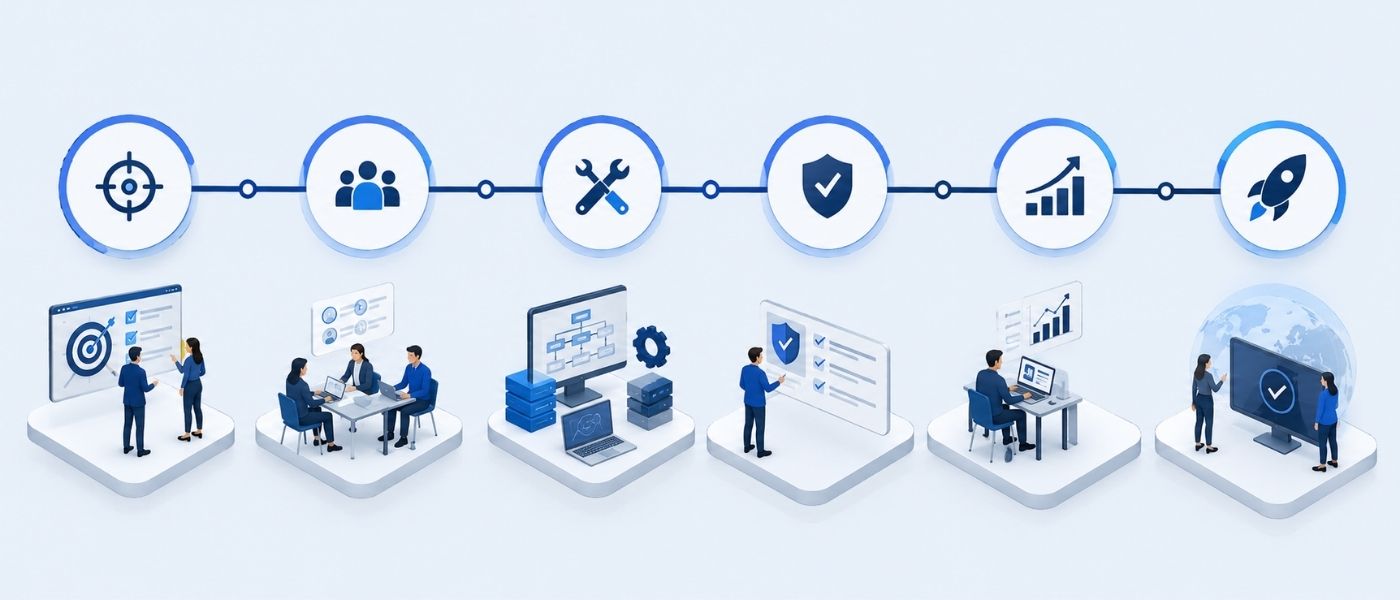
Phase 1: Discovery and DevOps Assessment
A structured engagement begins with a thorough DevOps assessment — reviewing your current deployment process, toolchain, team structure, incident history, cloud architecture, and codebase. The output is a gap analysis: where are you today, what are the specific bottlenecks, and what is the priority sequence for improvement? This phase typically takes 1–2 weeks and produces a concrete roadmap.
Phase 2: Strategy and Roadmap
A DevOps strategy is not a list of tools — it is a sequenced improvement plan aligned to your business objectives. The consultant will prioritise interventions based on impact and feasibility: typically, CI/CD pipeline implementation first (highest immediate impact on velocity and reliability), followed by infrastructure automation, then observability, then DevSecOps embedding. The roadmap includes timelines, resource requirements, and measurable milestones.
Phase 3: DevOps Implementation
This is the hands-on work: designing and building the CI/CD pipeline, writing Terraform modules, configuring Kubernetes clusters, setting up monitoring stacks, implementing security scanning tools, and establishing the runbooks, standards, and processes your team will use going forward. A good consultant works alongside your engineers throughout this phase, not instead of them.
Phase 4: Knowledge Transfer and Enablement
A DevOps transformation only sticks if your team can own it after the consultant leaves. Knowledge transfer — pair programming, internal documentation, training sessions, and architectural decision records (ADRs) — is non-negotiable in a high-quality engagement. If a DevOps service provider doesn’t explicitly commit to knowledge transfer, the engagement creates dependency rather than capability.
Phase 5: Ongoing Support (Managed DevOps Services)
Many companies move from an initial transformation engagement to a managed DevOps services arrangement — where the provider continues to handle pipeline maintenance, infrastructure updates, security patching, and optimisation while the internal team focuses on product development. This model is especially common among startups and mid-size companies that have the culture but not the headcount for a fully staffed internal DevOps function.
Building an In-House DevOps Team vs. Outsourcing: The Real Comparison
This is the decision most CTOs and VPs of Engineering wrestle with once they’ve acknowledged the DevOps gap. The answer depends on your stage, budget, timeline, and the complexity of your engineering environment.
| Criterion | In-House DevOps Team | Outsourced / Managed DevOps Services |
|---|---|---|
| Time to value | 3–6 months (hiring, onboarding, ramp-up) | 2–4 weeks (engagement kick-off to first deliverable) |
| Annual cost (mid-level team) | ₹40–80L+ per DevOps engineer (India) + infra tooling | Typically 30–60% less for equivalent coverage |
| Breadth of expertise | Limited to individual’s experience; skill gaps common | Team of specialists across cloud, CI/CD, security, IaC |
| Single point of failure | High — if key engineer leaves, knowledge leaves | Low — team-based continuity with documented systems |
| Multi-cloud / multi-stack | One person rarely covers AWS + GCP + Azure + k8s + IaC deeply | Provider covers full stack by design |
| Scalability | Requires additional hires as scope grows | Scales with project scope at marginal cost |
| Best for | Companies with 150+ engineers, complex custom infrastructure | Startups to mid-size companies; teams scaling fast |
The most effective model for many growth-stage companies is a hybrid approach: engage a DevOps consulting partner to design and implement the foundations, then transition to a leaner in-house function for day-to-day management, with the external partner available for strategic advisory and major initiatives. This gives you in-house ownership without the full cost of a large internal DevOps team during the early scaling phase.
How to Choose the Right DevOps Service Provider
Evaluate any DevOps consultant or service provider on these six criteria:
- Tool-specific experience: Hands-on delivery with your actual stack — AWS/GCP/Azure, Kubernetes, Terraform, GitHub Actions/Jenkins, Datadog/Prometheus
- Structured engagement model: Discovery → assessment → roadmap → implementation → knowledge transfer — not ad-hoc support
- Knowledge transfer commitment: Explicit, contractual — the goal is your team’s independence, not ongoing dependency
- Verifiable references: From companies at a comparable stage, in a comparable industry, with measurable outcomes
- Security and compliance awareness: Especially if you operate in regulated sectors (fintech, healthtech, e-commerce)
- Commercial transparency: Clear pricing model — per-project, retainer, or per-engineer — with no hidden scope expansions
Questions to Ask a DevOps Consultant Before Signing
- What does your DevOps assessment process look like, and what does it produce?
- Can you show me examples of CI/CD pipelines or IaC codebases you’ve delivered for similar companies?
- How do you handle knowledge transfer — what documentation and training do you provide?
- What happens if a key person on your team leaves during our engagement?
- How do you measure success — what metrics will we track and review together?
- What is your experience with security integration (DevSecOps) in the pipeline?
- Do you offer managed DevOps services after the initial implementation, and on what terms?
FAQ
- How do you know if your business needs DevOps consulting?
Your business needs DevOps consulting if releases take weeks or months instead of days, deployment failures regularly impact users, development and operations teams work in silos and blame each other during incidents, you have no CI/CD pipeline and deployments are manual, your cloud costs are rising without a corresponding increase in value, or your team spends more time on repetitive operational work than on building features. If three or more of these signs apply simultaneously, a DevOps assessment is overdue — the problems are almost certainly compounding each other.
- When should a company hire a DevOps consultant?
Hire a DevOps consultant when: your internal team lacks the expertise to design and implement CI/CD pipelines, IaC, or cloud-native architecture; the cost of delayed releases or production incidents is becoming a measurable business problem; a new product launch, cloud migration, or scaling initiative requires DevOps capability you don’t currently have; or previous DIY DevOps efforts have stalled or created more technical debt. The earlier in your company’s growth you engage, the lower the cost — because you’re establishing practices rather than fixing accumulated problems.
- What problems does DevOps consulting solve?
DevOps consulting directly solves: slow release cycles (through CI/CD implementation); frequent deployment failures (through automated testing and rollback strategies); poor collaboration between development and operations (through shared tooling, processes, and metrics); lack of CI/CD pipeline (through design and build); infrastructure scaling issues (through IaC and cloud-native architecture); rising cloud costs (through right-sizing and cost observability); monitoring gaps (through observability stack implementation); and security bottlenecks (through DevSecOps integration). Each of these problems has a measurable business impact — consulting ROI is directly traceable to improvements in deployment frequency, MTTR, and operational cost.
- Does my startup need DevOps consulting?
Yes, if your startup is past the proof-of-concept stage and deploying code that real users depend on. Startups that establish DevOps practices early — automated testing, CI/CD, infrastructure-as-code, monitoring — scale significantly faster and with fewer production incidents than those that bolt them on later. DevOps outsourcing for startups is particularly cost-effective because a consultant can design the right architecture from the beginning, preventing the technical debt that slows growth companies down. The cost of a DevOps engagement at the seed or Series A stage is a fraction of what it costs to remediate accumulated technical debt at Series B or C.
- Is DevOps consulting worth it?
DevOps consulting is worth it when the cost of the engagement is less than the cost of the problems it solves — which, for most mid-size companies, is almost always. DORA research consistently shows that high-performing DevOps organisations deploy 208x more frequently, have 106x faster lead times, and 2,604x faster recovery times from failures than low performers. When you add up the cost of deployment failures (downtime, emergency engineering effort, customer churn), slow releases (delayed revenue, competitive disadvantage), and engineering toil (talent cost, opportunity cost), a DevOps consulting engagement typically pays for itself within one to two quarters.
- How to improve a CI/CD pipeline with DevOps consulting?
A DevOps consultant improves a CI/CD pipeline through a structured assessment of your current pipeline (or lack thereof), identifying specific gaps: missing test automation gates, manual approval steps that slow deployment, no environment promotion strategy, insecure handling of secrets, or pipelines that are not enforced consistently. The fix involves implementing the right tooling (GitHub Actions, GitLab CI, Jenkins, CircleCI, or cloud-native options like AWS CodePipeline), designing pipeline stages appropriate to your architecture, adding automated testing at each stage, implementing deployment strategies (blue-green, canary, rolling) to reduce failure risk, and establishing pipeline metrics (pipeline duration, failure rate, deployment frequency) to track improvement.
- How to choose a DevOps consultant?
Evaluate any DevOps consultant on: (1) Demonstrated hands-on experience with your specific stack — not just “we support all clouds” but evidence of real delivery on AWS/GCP/Azure, Kubernetes, Terraform, etc.; (2) A structured engagement model — discovery, assessment, roadmap, implementation, knowledge transfer — not ad-hoc support; (3) An explicit knowledge transfer commitment, so your team owns the outcome; (4) References from companies at a similar stage or in a similar industry, with measurable outcomes; (5) Security and compliance awareness relevant to your sector; and (6) Transparent pricing with clear scope boundaries. Avoid consultants who can’t show you real CI/CD pipelines, real IaC codebases, or real before-and-after DORA metrics from prior engagements.
Ready to Find Out Where Your DevOps Gaps Are?
iValuePlus offers a structured DevOps Assessment that maps your current state, identifies the highest-impact gaps, and produces a prioritised roadmap — all in two weeks. No commitment required beyond the assessment.
Get in Touch Today and Book your DevOps Consultation Now →
Recent Post
How to Set Up an Offshore QA Center of Excellence in India: A Practical Guide for Global Teams
Learn how to set up an offshore QA center of...
Managed IT Services for Small Businesses: Complete Guide (2026)
Discover what managed IT services for small businesses actually include,...

iValuePlus Services
iValuePlus is a one-stop solution to address all your needs to access, build and grow your business in the Indian market which is cost-effective & has a huge talent pool. Established in 2019 as a ‘Business Solution provider', our team has delivered successful growth projects in the international market.
Our services include setting up ODC (offshore development center), Staff Augmentation, Talent Acquisition, Digital Marketing, in the IT/ITES domain.