
Discover the best city to set up office in India...

Still Relying on Manual Testing? It’s Time for QA Automation
In 2026, software releases move faster than ever. DevOps pipelines deploy multiple builds per day. Cloud-native applications scale instantly. Customers expect flawless digital experiences across devices and platforms.
Manual testing simply cannot keep up.
This is why forward-thinking enterprises are shifting to QA automation — not just as a technical upgrade, but as a strategic growth move.
At iValuePlus, we help businesses transition from slow, error-prone manual processes to scalable, high-performance QA automation ecosystems that accelerate innovation and reduce risk.
If you’re still relying on manual testing, it’s time to rethink your strategy.
The Real Cost of Manual Testing
Manual testing has its place — particularly for exploratory and usability testing. But relying on it as your primary testing method in a modern software environment creates serious limitations.
Slower Release Cycles
Manual regression testing takes days — sometimes weeks.As applications grow more complex, the testing effort increases exponentially. This delays releases and reduces your competitive advantage.
Higher Human Error
Even experienced testers can miss defects.Fatigue, repetition, and complex workflows increase the risk of oversight. In contrast, QA automation executes test cases consistently and precisely.
Limited Test Coverage
Manual testing often covers only critical paths due to time constraints. Edge cases and integration scenarios are frequently overlooked.QA automation allows broader coverage across:
- Browsers
- Devices
- APIs
- Load conditions
- Security checks
Higher Long-Term Costs
While manual testing may appear cheaper initially, the cumulative cost of:
- Repetitive work
- Post-release bug fixes
- Production downtime
- Customer dissatisfaction
quickly outweighs the investment in QA automation.
For a comprehensive guide on building structured QA frameworks, check out our QA Center of Excellence Complete Guide.
Why QA Automation Is Essential in 2026
Modern software environments demand:
- Continuous integration
- Continuous deployment
- Microservices validation
- API reliability
- Cloud scalability
Without QA automation, your DevOps pipeline becomes unstable.
QA automation ensures:
- Continuous testing in CI/CD pipelines
- Immediate feedback on code changes
- Faster regression cycles
- Improved deployment confidence
- Reduced defect leakage
Enterprises adopting structured QA automation report up to 50% faster releases and significantly lower production defects.
Manual Testing vs QA Automation: A Strategic Comparison
Criteria | Manual Testing | QA Automation |
Speed | Slow | Fast & Continuous |
Accuracy | Prone to error | Highly consistent |
Scalability | Limited | Easily scalable |
CI/CD Integration | Minimal | Fully integrated |
Long-Term Cost | High | Optimized |
The future clearly favors QA automation but automation must be done correctly.
Why Many Companies Fail at QA Automation
Transitioning from manual testing to QA automation is not just about purchasing tools.
Common mistakes include:
- Automating the wrong test cases
- Poor framework design
- No DevOps integration
- Lack of expertise
- Ignoring maintenance planning
Automation without strategy leads to unstable scripts and wasted investment.
This is where iValuePlus QA automation services make the difference.
How iValuePlus Transforms Manual Testing into Scalable QA Automation
At iValuePlus, we don’t just automate tests — we transform your entire quality assurance process.
Our QA automation services are designed to replace inefficient manual workflows with intelligent, scalable frameworks.
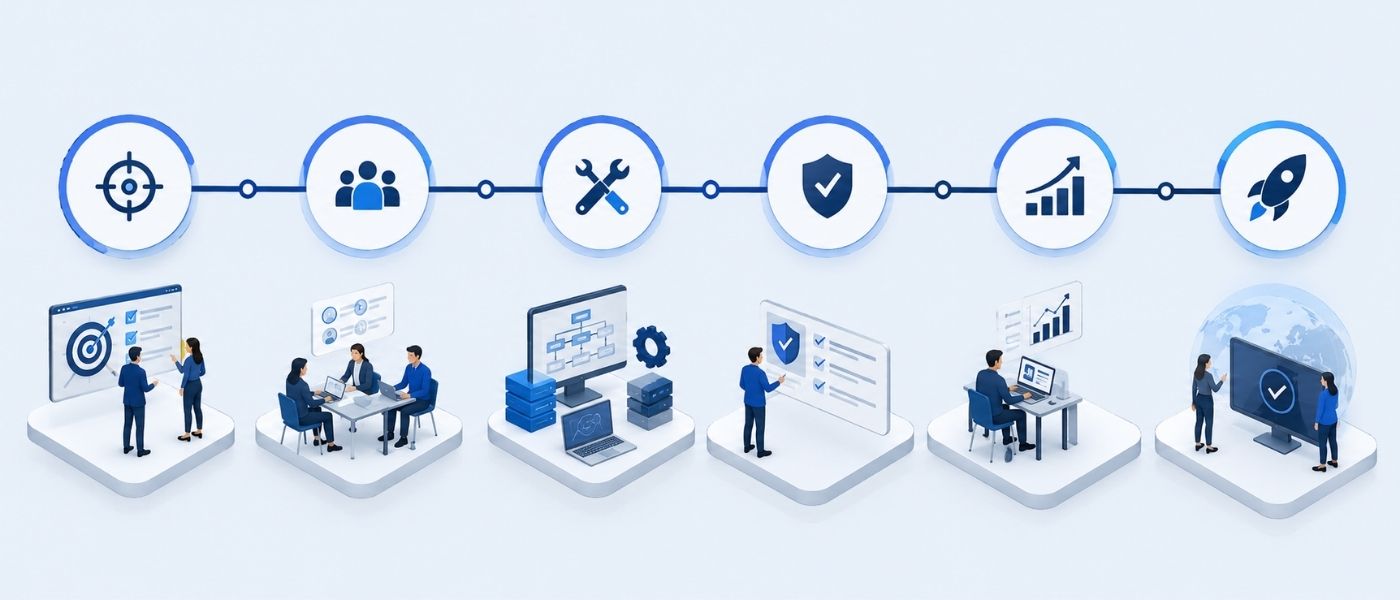
Step 1: Automation Readiness Assessment
We analyze:
- Your current manual testing process
- Application architecture
- High-risk areas
- Regression complexity
- DevOps maturity
This ensures your QA automation strategy aligns with business objectives.
Step 2: Custom QA Automation Framework Development
We build enterprise-grade frameworks that are:
- Modular
- Reusable
- Maintainable
- CI/CD-ready
- Cloud-executable
Our hybrid QA automation frameworks combine data-driven and keyword-driven approaches for flexibility and scalability.
Step 3: Seamless DevOps & CI/CD Integration
QA automation must function within your pipeline.
We integrate automated testing into:
- Continuous integration workflows
- Staging validations
- Production smoke testing
- Deployment gates
This eliminates release uncertainty.
Step 4: Functional, Performance & API Automation
True QA automation extends beyond UI testing.
iValuePlus covers:
- Web automation
- Mobile automation
- API validation
- Load testing
- Stress testing
- Security testing
We ensure complete quality coverage.
The ROI of Switching to QA Automation
Our clients experience:
- Reduced regression time by up to 70%
- Faster time-to-market
- Lower operational risk
- Reduced manual effort
- Increased test coverage
Within months, QA automation becomes a cost-saving and growth-enabling asset.
Industries Benefiting from QA Automation
We deliver QA automation solutions across:
- SaaS platforms
- E-commerce businesses
- Fintech systems
- Healthcare applications
- Enterprise ERP solutions
- Logistics and supply chain platforms
Each industry demands precision — and our QA automation services deliver reliability at scale.

Signs You Need QA Automation Immediately
If you experience:
- Frequent production bugs
- Long regression cycles
- Release delays
- High manual testing workload
- CI/CD instability
- Rapid scaling challenges
It’s time to move to QA automation.
The Future of QA Automation: AI & Intelligent Testing
QA automation in 2026 includes:
- AI-powered test case generation
- Self-healing test scripts
- Predictive defect analytics
- Risk-based prioritization
At iValuePlus, we continuously upgrade automation frameworks to align with emerging technologies.
Why Choose iValuePlus for QA Automation?
Here’s why enterprises trust us:
- Dedicated QA automation specialists
- Enterprise-ready scalable frameworks
- DevOps-aligned implementation
- Transparent reporting dashboards
- Cost-efficient offshore delivery model
- Continuous optimization support
We act as your long-term QA automation partner — not just a service provider.
Transitioning from Manual Testing to QA Automation: What to Expect
Month 1: Strategy & Framework Design
Month 2: Initial Automation & CI/CD Integration
Month 3: Regression Coverage Expansion
Month 4+: Performance Optimization & Scaling
Within 3–6 months, most organizations see measurable acceleration and defect reduction.
Conclusion
Manual testing has value — but relying on it alone in 2026 is risky.
QA automation provides:
- Speed
- Scalability
- Reliability
- Cost efficiency
- Competitive advantage
If your organization wants to release faster without compromising quality, it’s time to move beyond manual testing.
With iValuePlus QA automation services, you gain a strategic partner committed to delivering measurable results.Don’t let outdated testing methods slow your growth.It’s time for QA automation.
Recent Post
How to Set Up an Offshore QA Center of Excellence in India: A Practical Guide for Global Teams
Learn how to set up an offshore QA center of...
Managed IT Services for Small Businesses: Complete Guide (2026)
Discover what managed IT services for small businesses actually include,...

iValuePlus Services
iValuePlus is a one-stop solution to address all your needs to access, build and grow your business in the Indian market which is cost-effective & has a huge talent pool. Established in 2019 as a ‘Business Solution provider', our team has delivered successful growth projects in the international market.
Our services include setting up ODC (offshore development center), Staff Augmentation, Talent Acquisition, Digital Marketing, in the IT/ITES domain.