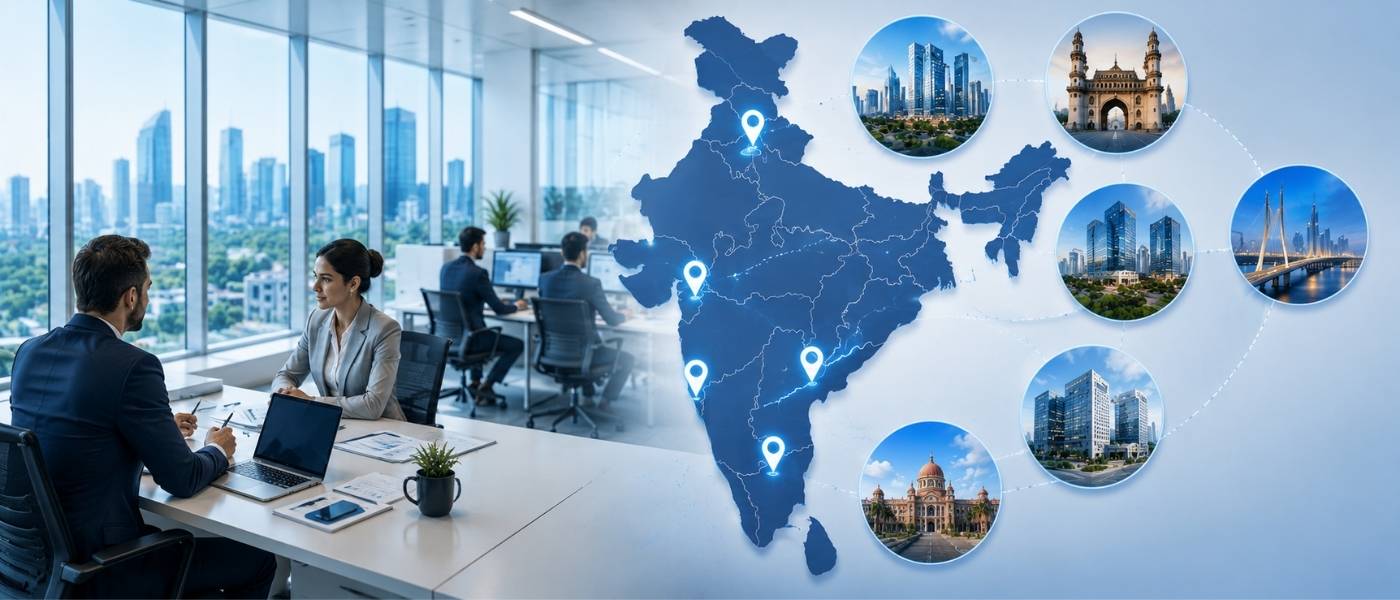

Discover the best city to set up office in India...
Categories

Designing an Offshore Operating Model for Long-Term Growth
Why Offshore Operating Models Fail or Succeed by Design
Offshoring is no longer an experiment. For global enterprises, it is a structural necessity. Yet despite decades of experience, many organizations still struggle to extract sustained value from offshore initiatives. Costs may be reduced initially, but over time issues emerge—governance gaps, rising attrition, quality inconsistencies, compliance exposure, and loss of strategic control.
The root cause is rarely talent or geography. It is almost always poor operating model design.
A well-designed offshore operating model enables long-term growth by aligning global strategy with execution, balancing cost efficiency with control, and embedding resilience into operations. A poorly designed one becomes a fragile, tactical setup that breaks under scale.
This article provides a deep, practical, and future-focused framework for designing an offshore operating model that supports sustainable growth, risk management, and enterprise-scale performance.
1. What Is an Offshore Operating Model?
An offshore operating model defines how work is structured, governed, delivered, and scaled across offshore locations in alignment with business objectives. It is the foundation of any offshore delivery model.
It goes far beyond where people sit. It determines:
- Which functions are offshored—and why
- How offshore teams interact with onshore leadership
- How decisions are made and escalated
- How performance, quality, and compliance are managed
- How talent is hired, developed, and retained
- How risk is controlled as scale increases
At its core, an offshore operating model is a system, not a staffing decision.
2. Why Long-Term Growth Demands a Different Offshore Mindset
2.1 Tactical Offshoring vs Strategic Offshoring
Many offshore initiatives begin with short-term goals:
- Reduce costs
- Fill talent gaps quickly
- Increase delivery capacity
While valid, these objectives alone lead to tactical offshoring, characterized by:
- Vendor dependency
- Fragmented delivery
- Weak governance
- Limited ownership
In contrast, strategic offshoring is designed for long-term growth and focuses on:
- Capability building
- Control and accountability
- Scalability
- Institutional knowledge
Long-term growth is only possible when the offshore operating model is designed intentionally from the outset.
2.2 Why Offshore Complexity Increases Over Time
As offshore operations scale, complexity increases across:
- Headcount and team structure
- Compliance and labor regulations
- Stakeholder coordination
- Knowledge management
- Cost governance
Without a scalable operating model, early success turns into operational drag.
3. Core Principles of a Scalable Offshore Operating Model
A sustainable offshore operating model rests on six foundational principles.
3.1 Strategic Alignment
Every offshore decision must align with:
- Business strategy
- Growth plans
- Product and market roadmap
Offshoring should support where the business is going, not just where it is today.
3.2 Ownership and Accountability
Clear ownership prevents:
- Delivery ambiguity
- Quality erosion
- Governance breakdowns
A strong operating model defines:
- Who owns outcomes
- Who manages performance
- Who is accountable for risk
3.3 Scalability by Design
Scalability should be built into:
- Team structures
- Processes
- Governance models
- Technology platforms
If scaling requires reinvention, the model is flawed.
3.4 Risk and Compliance Embedded, Not Bolted On
Compliance and risk management must be:
- Designed into workflows
- Supported by governance
- Reinforced through technology
Reactive compliance does not scale.
3.5 Talent Sustainability
Attrition is one of the biggest threats to offshore growth.
The model must support:
- Career progression
- Skill development
- Leadership pipelines
- Cultural integration
3.6 Technology as an Enabler
Technology should enable:
- Visibility
- Control
- Automation
- Collaboration
Manual offshore management does not scale.
4. Offshore Operating Model Archetypes
4.1 Offshore Development/Delivery Center (ODC)
Description
Vendor-managed, dedicated teams focused on execution.
Organizations often begin with an offshore development center setup or a dedicated offshore development team to gain speed.
Best for
- Speed
- Short- to mid-term needs
- Clearly defined scopes
Limitations
- Limited control
- Vendor dependency
- Knowledge retention risk
ODCs are effective tactically but rarely sufficient for long-term growth on their own.
4.2 Global Capability Center (GCC)
Description
Captive offshore entity fully owned by the enterprise.
Best for
- Long-term scale
- IP-sensitive work
- Core business functions
Challenges
- Higher upfront investment
- Longer setup timeline
- Requires offshore leadership maturity
GCCs are the gold standard for sustainable offshore growth.
4.3 Build-Operate-Transfer (BOT)
Description
A partner builds and operates the offshore center, then transfers ownership.
Best for
- First-time offshore expansion
- Risk-averse enterprises
- Faster time-to-value
BOT combines speed with ownership and is increasingly reflected in BOT case studies across regulated and high-growth industries.
4.4 Hybrid Offshore Models
High-performing enterprises increasingly use:
- GCCs for core capabilities
- BOT for new functions or regions
- ODCs for overflow or tactical execution
Hybrid models provide flexibility without sacrificing control.

5. Designing the Offshore Operating Model: Step-by-Step Framework
Step 1: Define the Business Objectives
Start with clarity on:
- Growth targets
- Market expansion plans
- Cost optimization goals
- Capability gaps
Offshore design must support these objectives explicitly.
Step 2: Decide What to Offshore—and What Not To
Not all functions should be offshored.
Ideal offshore candidates:
- Scalable and repeatable processes
- Digitally enabled work
- Roles with global demand
Functions requiring heavy local context or regulatory proximity may remain onshore.
Step 3: Select the Right Operating Model
Choose between:
- ODC
- BOT
- GCC
- Hybrid
Based on:
- Time horizon
- Risk tolerance
- Control requirements
- Internal capability maturity
Step 4: Design Governance and Decision Rights
Define:
- Global vs local decision ownership
- Escalation paths
- Performance review cadence
Governance should enable speed, not bureaucracy.
Step 5: Build Talent and Leadership Architecture
Plan for:
- Role mix and seniority levels
- Local leadership development
- Succession planning
Leadership depth offshore is essential for long-term growth.
Step 6: Embed Compliance and Risk Controls
Include:
- Employment law compliance
- Payroll and statutory governance
- Data protection and security
Local expertise is critical here.
Step 7: Enable with Technology
Implement platforms for:
- HR and payroll
- Performance management
- Collaboration
- Analytics and reporting
Technology provides visibility and control at scale.
6. Governance Models That Support Long-Term Growth
6.1 Multi-Layer Governance Structure
Effective offshore governance includes:
- Executive steering committee
- Operational review forums
- Delivery-level management
Each layer has clear accountability.
6.2 Performance and Outcome Measurement
Move beyond headcount metrics.
Track:
- Productivity
- Quality
- Speed
- Business impact
Outcome-based governance drives maturity.
7. Managing Talent for Offshore Sustainability
7.1 Hiring for Growth, Not Just Skill
Recruit for:
- Learning agility
- Cultural fit
- Leadership potential
Offshore teams should grow with the business.
7.2 Career Pathing and Skill Development
Clear growth paths reduce attrition and improve engagement.
Include:
- Skill certifications
- Leadership training
- Cross-functional exposure
7.3 Culture and Inclusion
Offshore teams must feel:
- Included
- Trusted
- Valued
Culture is a strategic lever, not a soft issue.

8. Financial Management and ROI Optimization
Long-term offshore success depends on:
- Cost transparency
- Budget ownership
- Predictable unit economics
Track ROI across:
- Cost savings
- Productivity gains
- Speed-to-market improvements
- Risk reduction
9. Common Pitfalls That Undermine Offshore Growth
- Treating offshore as a cost center
- Weak governance
- Over-reliance on vendors
- Ignoring leadership development
- Scaling before stabilizing
Avoiding these pitfalls requires discipline and design rigor.
10. The Future of Offshore Operating Models
By 2026 and beyond:
- Offshore centers will own core business outcomes
- BOT will remain the dominant entry strategy
- GCCs will evolve into value and innovation hubs
- AI will optimize workforce planning and performance
Offshore operating models will be central to enterprise competitiveness.
Conclusion
Designing an offshore operating model for long-term growth is not a one-time initiative—it is a strategic capability.
Organizations that:
- Design intentionally
- Govern rigorously
- Invest in talent and technology
will unlock sustainable scale, resilience, and competitive advantage.
Those that offshore tactically will continue to chase short-term savings—while long-term value remains out of reach.
Recent Post
How to Set Up an Offshore QA Center of Excellence in India: A Practical Guide for Global Teams
Learn how to set up an offshore QA center of...
Managed IT Services for Small Businesses: Complete Guide (2026)
Discover what managed IT services for small businesses actually include,...

iValuePlus Services
iValuePlus is a one-stop solution to address all your needs to access, build and grow your business in the Indian market which is cost-effective & has a huge talent pool. Established in 2019 as a ‘Business Solution provider', our team has delivered successful growth projects in the international market.
Our services include setting up ODC (offshore development center), Staff Augmentation, Talent Acquisition, Digital Marketing, in the IT/ITES domain.