
Discover the best city to set up office in India...
Categories

Global Operating Model: A Strategic Guide for Scalable Enterprises
Why the Global Operating Model Is Now a Boardroom Priority
In 2026, enterprise success is no longer determined solely by product innovation or market reach. It is increasingly defined by how effectively an organization operates across borders—how it deploys talent, manages risk, delivers value to customers, and scales without breaking.
At the heart of this capability lies the global operating model.
A global operating model is not just an org chart or a delivery structure. It is the system-level design that governs how work is distributed, how decisions are made, how teams collaborate across geographies, and how value flows from strategy to execution.
Enterprises that design their global operating model intentionally achieve:
- Faster go-to-market
- Superior cost-to-value ratios
- Better access to global talent
- Stronger resilience against disruption
- Sustainable long-term scalability
Those that do not often struggle with:
- Fragmented operations
- Slow execution
- Rising costs
- Governance breakdowns
- Inconsistent customer experience
This article provides a deep, practical, and technical guide to understanding, designing, and evolving a global operating model that supports modern enterprise growth.
1. What Is a Global Operating Model?
1.1 Definition and Scope
A global operating model defines how an organization structures, governs, and executes work across multiple countries and regions. It integrates people, processes, technology, and governance into a unified system that supports business strategy.
It answers fundamental questions such as:
- Which functions are centralized, regionalized, or localized?
- Where is work performed—and why?
- How are decisions made across geographies?
- How is accountability maintained globally?
- How do global teams collaborate at scale?
Unlike traditional operating models, a global operating model must balance global efficiency with local responsiveness.
1.2 Why Traditional Operating Models No Longer Work
Legacy operating models were designed for:
- Single-country or region-heavy businesses
- Physical offices and co-located teams
- Stable markets and predictable growth
Modern enterprises face:
- Rapid market shifts
- Cross-border compliance complexity
- 24/7 customer expectations
- Intense cost and talent pressure
A global operating model addresses this complexity by enabling coordinated execution across borders.
2. Why Global Operating Models Matter More Than Ever
2.1 Talent Has Gone Global
Talent scarcity in the US, UK, and EU has forced organizations to look globally for:
- Technology talent
- Digital and data specialists
- Operations and support professionals
A global operating model enables organizations to tap into offshore and nearshore talent pools without losing control or consistency.
2.2 Cost Pressures Require Structural Solutions
Rising labor, infrastructure, and compliance costs cannot be solved through incremental optimization alone.
A well-designed global operating model:
- Optimizes cost structures structurally
- Reduces duplication
- Improves utilization of global resources
2.3 Resilience Is Now a Strategic Requirement
Geopolitical risk, supply chain disruption, and economic volatility have made resilience a strategic imperative.
Global operating models enable:
- Geographic diversification
- Business continuity
- Faster recovery from disruption
3. Core Components of a Global Operating Model
A robust global operating model is built on five interconnected pillars.
3.1 People and Talent Architecture
This defines:
- Workforce distribution by geography
- Skill and role allocation
- Leadership and reporting structures
Key considerations:
- Which roles should be global, regional, or local?
- How is leadership distributed?
- How are career paths managed globally?
3.2 Process Design and Standardization
Processes must be:
- Globally consistent where possible
- Locally adaptable where necessary
This includes:
- Core business processes
- Support functions
- Governance workflows
Standardization enables scale, while flexibility enables market responsiveness.
3.3 Technology and Digital Enablement
Technology is the backbone of any global operating model.
Key enablers include:
- Cloud platforms
- Collaboration and communication tools
- ERP and CRM systems
- Analytics and reporting platforms
Without digital enablement, global operating models fail to scale.
3.4 Governance and Decision Rights
Governance defines:
- Who decides what
- How decisions are escalated
- How conflicts are resolved
Clear governance prevents:
- Duplication
- Delays
- Power struggles
3.5 Financial and Risk Management
A global operating model must support:
- Cost transparency
- Budget ownership
- Compliance and risk mitigation
This is especially critical in offshore and multi-country operations.
4. Common Global Operating Model Archetypes
Enterprises adopt different global operating models depending on strategy and maturity.
4.1 Centralized Global Model
Characteristics:
- Core functions centralized in one or two hubs
- High standardization
- Strong cost control
Best suited for:
- Efficiency-driven organizations
- Mature, stable businesses
Limitations:
- Lower local responsiveness
4.2 Regionalized Model
Characteristics:
- Regional hubs with autonomy
- Moderate standardization
Best suited for:
- Diverse markets
- Customer-centric strategies
Limitations:
- Higher cost
- Risk of fragmentation
4.3 Hybrid Global Model
Characteristics:
- Global centers for scale
- Regional and local teams for market needs
This is the most common and effective model for large enterprises today.
5. Role of Offshore and Global Delivery Centers
5.1 Offshore Delivery as a Core Operating Lever
Offshore centers are no longer peripheral. In modern global operating models, they often own:
- Product engineering
- IT operations
- Finance and accounting
- HR and payroll
- Digital marketing and analytics
5.2 Global Capability Centers (GCCs)
GCCs are captive centers fully owned by the enterprise.
They enable:
- Full control
- IP protection
- Deep integration with core strategy
GCCs are ideal for organizations seeking long-term scale and strategic ownership.
5.3 Build-Operate-Transfer (BOT) Model
BOT is a phased approach to building a GCC.
It allows enterprises to:
- Enter new geographies quickly
- Reduce setup and compliance risk
- Transition to full ownership over time
BOT is increasingly used by organizations designing their global operating model for the first time.
5.4 Offshore Development / Delivery Centers (ODCs)
ODCs are vendor-managed, execution-focused teams.
They offer:
- Speed
- Flexibility
- Lower upfront investment
ODCs are best used as tactical components within a broader global operating model.

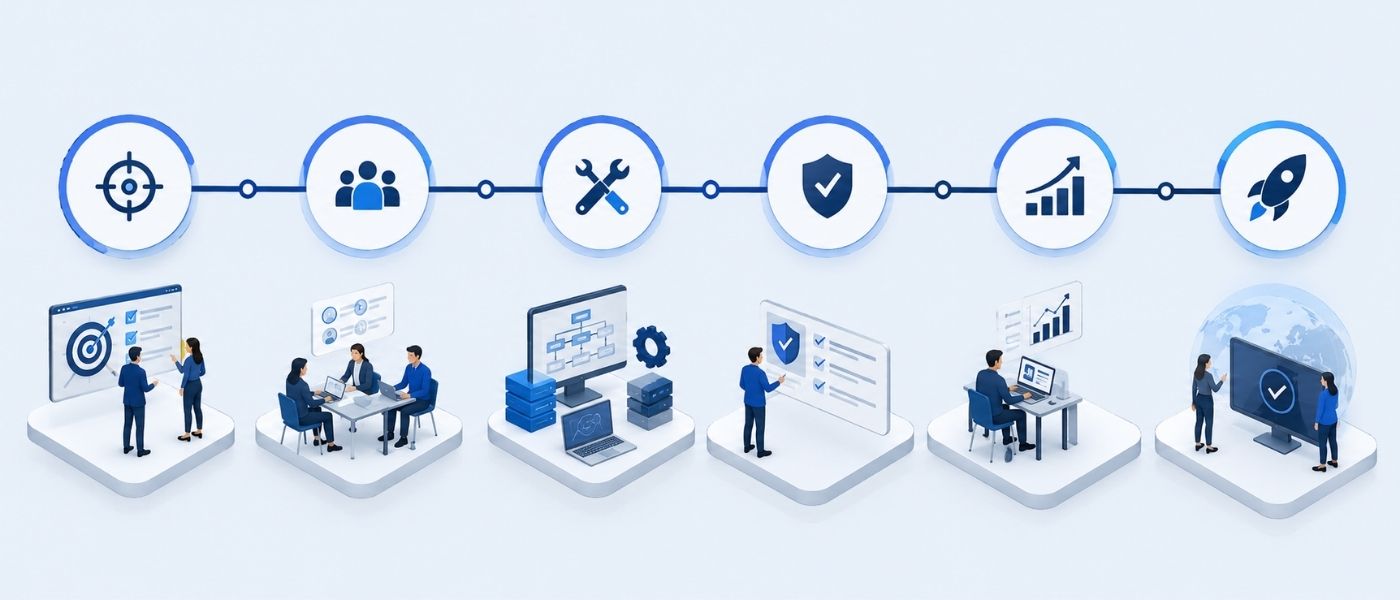
6. Designing a Global Operating Model: Step-by-Step Framework
Step 1: Align with Business Strategy
The operating model must support:
- Growth objectives
- Market entry plans
- Product and service strategy
Step 2: Define Global vs Local Scope
Decide which functions should be:
- Globalized
- Regionalized
- Localized
Step 3: Select the Right Operating Models
Choose between:
- GCC
- BOT
- ODC
- Hybrid approaches
Step 4: Build Governance and KPIs
Define:
- Decision rights
- Performance metrics
- Escalation paths
Step 5: Enable with Technology
Implement platforms that support:
- Collaboration
- Transparency
- Automation
7. Governance in a Global Operating Model
7.1 Why Governance Is the Make-or-Break Factor
Many global operating models fail not because of poor design, but because of weak governance.
Effective governance ensures:
- Alignment
- Accountability
- Speed
7.2 Best-Practice Governance Structure
Includes:
- Executive steering committee
- Operational governance forums
- Delivery-level management
Clear cadence and documentation are critical.
8. Managing Talent and Culture Across the Global Operating Model
8.1 Cultural Integration
Culture does not scale automatically.
Best practices:
- Unified values and principles
- Leadership visibility across regions
- Inclusion of offshore teams in strategy discussions
8.2 Career Pathing and Retention
Retention is a structural issue.
Global operating models must offer:
- Clear career progression
- Skill development
- Global mobility opportunities
9. Compliance, Risk, and Security Considerations
A global operating model must account for:
- Labor laws
- Data privacy regulations
- Tax and statutory compliance
Partnering with local experts and building compliance into the model is essential.

10. Measuring the Effectiveness of a Global Operating Model
Key metrics include:
- Cost-to-serve
- Productivity and utilization
- Speed-to-market
- Quality and customer satisfaction
- Risk and compliance indicators
Advanced organizations track outcome-based metrics, not just headcount.
11. Common Pitfalls in Global Operating Model Design
- Over-centralization
- Underestimating governance complexity
- Ignoring cultural integration
- Treating offshore teams as secondary
- Designing for today, not future scale
Avoiding these pitfalls requires intentional design and leadership commitment.
12. The Future of Global Operating Models
By 2026 and beyond:
- Hybrid global operating models will dominate
- GCCs will evolve into value and revenue centers
- BOT will remain the preferred entry model
- AI will optimize workforce allocation and decision-making
The global operating model will increasingly become a competitive differentiator.
Conclusion
A global operating model is not an internal construct—it is a strategic asset that shapes how an enterprise grows, competes, and adapts.
Organizations that:
- Design their global operating model intentionally
- Align it with business strategy
- Invest in governance, technology, and culture
will outperform peers in speed, efficiency, and resilience.
Those that rely on ad-hoc or legacy structures will struggle to scale in an increasingly global and complex world.
Recent Post
How to Set Up an Offshore QA Center of Excellence in India: A Practical Guide for Global Teams
Learn how to set up an offshore QA center of...
Managed IT Services for Small Businesses: Complete Guide (2026)
Discover what managed IT services for small businesses actually include,...

iValuePlus Services
iValuePlus is a one-stop solution to address all your needs to access, build and grow your business in the Indian market which is cost-effective & has a huge talent pool. Established in 2019 as a ‘Business Solution provider', our team has delivered successful growth projects in the international market.
Our services include setting up ODC (offshore development center), Staff Augmentation, Talent Acquisition, Digital Marketing, in the IT/ITES domain.