
Discover the best city to set up office in India...
Categories

Why Pre-GCC Planning Matters for a Sustainable Global Capability Center in India
The GCC Opportunity and Why Most Enterprises Get the First Step Wrong
In India, the Global Capability Center sector is no longer a specialized strategy to Fortune 500 enterprises. In 2025, more than 1,700 GCCs are operating across India and generate over $64 billion of annual revenue and employing more than two million employees. Companies from BFSI tech, healthcare manufacturing, retail and manufacturing are setting up GCCs not in order to reduce costs, but to create a genuine competitive capabilities that are close to the world’s top talent.
However, the rate of failure among new GCCs is still high. The primary reason isn’t the lack of people in India or the complexity of regulatory requirements nor the infrastructure. There is a lack of planning prior to when the installation commences.
The Pre-GCC stage is a planned plan of feasibility and strategy that must be completed prior to any legal entity leasing office space, a lease or hiring commitments — is what differentiates GCCs that grow from those that stagnate. If you’re looking into an Global Capability Center setup in India This guide will help you understand exactly what this phase has to include.
What is a Global Capability Center (GCC)?
An Global Capability Center is an owned by the enterprise and usually located in offshore locations that performs specific functions for the parent organization. Contrary to outsourcing, in which an outside party is responsible for the service the service, the GCC is a GCC is a captive organization where the company controls intellectual property, processes, talent as well as strategic directions.
The roles GCCs are responsible for have gotten more complex. In the beginning, GCC models were focused on IT support desks and back-office processing. Today’s GCCs operate AI and teams of data scientists including security operations, product engineering as well as finance transformation and digital product development typically at the same and level as headquarters teams, but with only a fraction of the cost.
GCC vs Traditional Outsourcing: The Key Differences
Dimension | GCC (Captive) | Outsourcing |
IP Ownership | Enterprise retains full IP | Shared or vendor-owned |
Talent Control | Hire, manage, culture-set | Vendor manages talent |
Strategic Alignment | Deep, long-term | Contract-defined scope |
Cost Structure | Higher upfront, lower long-term | Lower upfront, higher long-term |
Scalability | Fully flexible | Dependent on vendor terms |
Why India Remains the Dominant GCC Location in 2025
India’s GCC dominance isn’t accidental. It’s the result of more than three decades of technological industrial development, policy formulation by the government as well as investment in education and the maturation of infrastructure. The result is a system which no other country replicates on a large scale.
The Strategic Advantages India Offers
- Talent depth: More than 5 million STEM students graduate each year with strong concentrations in software engineering data science, finance, data science and digital design.
- Cost efficiency: Savings of 50-65% over similar US teams or UK teams, when accounting for the cost of quality control and oversight
- English ability: India ranks among the five top countries in the world for business English and reducing friction in communication across time zones
- Mature ecosystem established GCC communities in the major cities give access to talent vendors, vendor networks, as well as industry benchmarking
- Government support: State-level incentive such as SEZ benefits Single-window clearances IT park infrastructure
- Time zone coverage The time zone It is IST (UTC+5:30) offers a significant time overlap between European morning hours as well as US evening hours.
Which Cities Lead for GCC Setup in India?
The selection of a city is among the most important decisions made for GCC planning. Every major hub has distinct profile of talent as well as a cost structure and the maturity of infrastructure.
City | Best For | Notes |
Bengaluru | R&D, product engineering, AI/ML | Highest talent depth; highest cost |
Hyderabad | IT services, fintech, pharma tech | Strong infrastructure; lower attrition |
Pune | Engineering, manufacturing tech, analytics | Proximity to Mumbai; growing GCC hub |
Chennai | BFSI, automotive, manufacturing | Strong Tamil Nadu govt incentives |
Gurugram / NCR | Finance, consulting, HR shared services | Best for US-market timezone overlap |
Kochi / Coimbatore | Mid-market GCCs, cost-sensitive operations | Emerging; lower cost than Tier 1 cities |
For a full city-by-city breakdown with talent data and cost benchmarks, see: Best cities in India to set up a Global Capability Center.

What Pre-GCC Planning Actually Involves
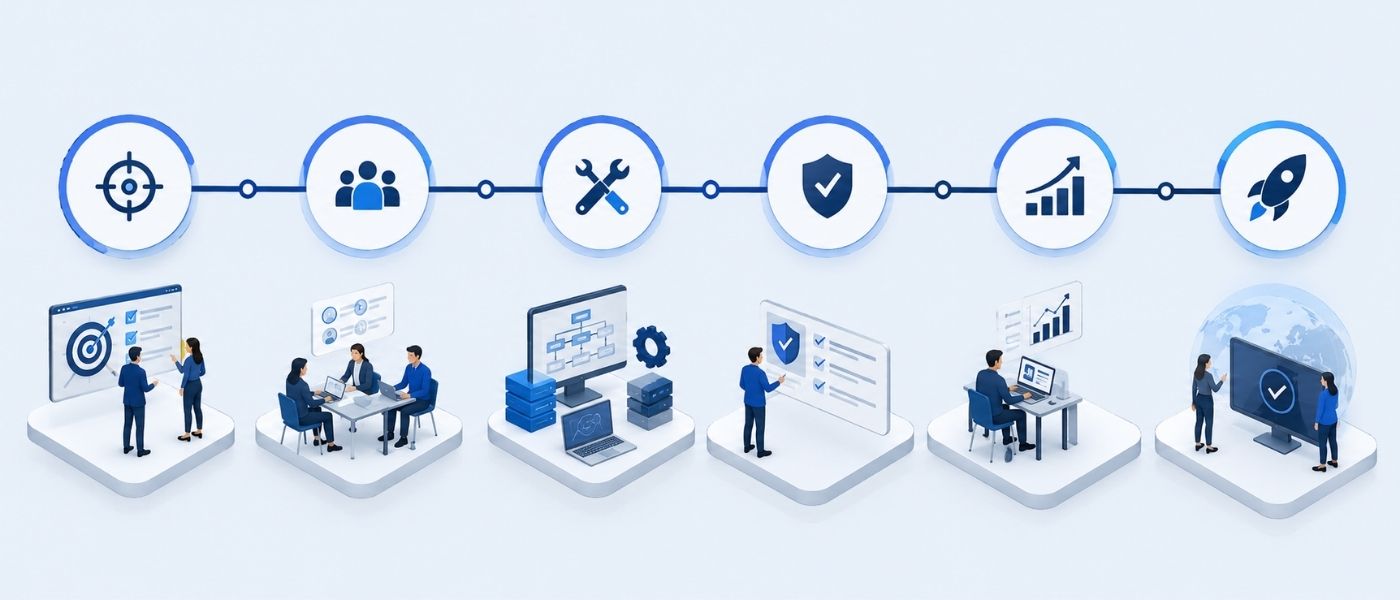
Pre-GCC planning isn’t one-time meetings or a high-level feasibility plan. When done properly, it’s an organized plan that spans a period of time — usually lasting between 8 and 16 weeks that provides concrete, action-ready outputs in six areas.
Domain 1: Strategic Alignment
The most frequent GCC failure is a confusion to what GCC is designed to accomplish and what the business that it is a part of actually requires from it. Planning for the GCC ahead of time starts with answering an incredibly simple question What business issue does this GCC solve and what is the best way to determine if it’s solving it?
This involves interviewing key stakeholders across the roles that the GCC will be serving and mapping the existing process issues as well as defining operational metrics for the GCC’s target and setting up a 3-year value realization plan before any hires are made.
Domain 2: Operating Model Selection
There isn’t a universally accepted GCC operating model that is universally correct. The ideal choice will depend on the risk-appetite of the business as well as its budget, timeline and long-term goals.
- Model of Captive: Enterprise owns the entity and employs the team and oversees every aspect of the operation. Most control; the highest set-up complexity and expense.
- Build-Operate-Transfer (BOT): A specialist partner builds and operates the GCC for an agreed period (typically 2-3 years), then transfers ownership to the enterprise. It reduces the risk of early stage failure; it requires careful contract structure.
- Managed by a partner A partner is able to retain the operational control on a regular basis. Low commitment; suited for areas where the business does not require direct control over talent.
- Hybrid: Combines private ownership of strategic functions along with partners in the management of commodity functions. It is gaining popularity with mid-market businesses.
Model selection for operating must be made in the Pre-GCC phase — not after the entity is registered and leases have been signed. Modifying models during set-up can be costly and can be disruptive.
Domain 3: Compliance and Legal Readiness
The Indian regulatory environment for foreign-owned enterprises is well-structured however, it requires a skilled navigation. The pre-GCC compliance process covers the choice of type of entity (Private Limited vs. LLP or Branch Office), foreign direct investment (FDI) approval requirements as well as transfer pricing frameworks GST registration, compliance with labour laws in the state of choice as well as data localisation requirements in the context of the Indian Digital Personal Data Protection Act (DPDPA).
Enterprises should also know the specific requirements for licensing. A thorough explanation of the process can be found in our article: how to get an GCC licence within India. Making this mistake can cause months of delays and a huge legal fees.
Domain 4: Talent Assessment
A city that has a lot of general IT talent may not be necessarily the ideal city to host your GCC. The pre-GCC talent assessment is more in-depth by mapping out the specific skills that the GCC requires, comparing the demand and supply of the skills required in cities of interest and analyzing salary data by the role and level of seniority, evaluating attrition rates in similar GCCs and establishing an accelerated hiring strategy that is based on the local market for talent.
A GCC which is planning to recruit 200 Python data engineers in the city in which fifteen GCCs are already in the race to hire the same pool of talent will be faced with a completely different time-to-hire as well as a different cost model than the budgetary model.
Domain 5: Cost-Benefit Analysis and ROI Modelling
The financial modeling for pre-GCC needs to be precise but not direction-based. It must include costs for setting up (entity registration office fit-out IT infrastructure, the initial hiring) and operating costs that are steady-state (salaries benefits, salaries as well as technology, real estate and management overhead) and cost of transition (knowledge transfer cost, duplication of running expenses as the business ramps up) and a reasonable timeframe for breaking even versus the expense of the job on the domestic market.
Companies that rely on the high-level ’60 percent cost savings assumptions, without developing an bottom-up model often find that the actual savings are more like 30-40%. This is still important, but not as much as the board of directors approved.
Domain 6: Governance and Leadership Design
A GCC that is not clearly defined governance framework will drift. Governance design for pre-GCC includes the structure of reporting that is shared between GCC and the parent company as well as the authority and role that the local GCC management team, the escalation pathways for strategic and operational decisions as well as performance measurement frameworks and the approach to cultural integration which will stop GCC from becoming an isolated entity. GCC in becoming an independent off-shore unit instead of being an integral element of the business.
Pre-GCC Planning Checklist for Enterprise Decision-Makers
This checklist will help you assess your pre-GCC preparation prior to making a decision to set up.
- Define the GCC’s mission What functions, what outcomes are the results, and what 3 year timeframe to target
- Perform a build-vs.-buy analysis: GCC vs outsourcing vs hybrid
- Select the model of operation either captive, BOT, partner-led, hybrid, or captive
- Choose a couple of cities for consideration and conduct a cost and talent analysis
- Complete type selection for the entity as well as FDI regulatory review
- Get the required registrations and licences (GCC licence GST, Shops & Establishments Act)
- Create a bottom-up, three-year financial model that includes the operating, set-up and cost of transition
- Plan the structure of governance including reporting lines and leadership roles, as well as performance frameworks
- Plan a gradual hiring strategy with realistic timeframes in accordance with local talent market information
- Determine an exit strategy or transition plan in the event that your GCC model requires a change.
Pre-GCC Planning for European and Mid-Market Enterprises
The Indian GCC sector was the main focus of US-based technology firms. This is rapidly changing. European businesses including firms from Germany and Poland, Germany Netherlands, Poland, Scandinavia and the UK currently comprise the fastest-growing segment in new GCC installations in India.
Mid-market companies (annual revenue of PS100M to PS1B) are also making their way into in the GCC market in increasing numbers, acknowledging that this model is no only for multinational companies with more than 50,000 employees.
What European Enterprises Need to Know
- GDPR compliance needs to be integrated into the GCC’s framework for handling data from the beginning. India’s DPDPA has some similarities, but it’s not the same
- Pricing requirements for transfer between European parent companies as well as Indian GCC subsidiaries require expert assistance; OECD arm’s length pricing rules are in place
- European work culture differences (flat hierarchy, strong worker consultation norms) require deliberate cultural bridging in governance design
- Language: Despite the fact that English is the main language used in the majority of Indian GCCs European companies that serve markets with no English should consider the multilingual ability when hiring employees.
The Pre-GCC fundamental approach is identical regardless of the parent company’s headquarters. The elements, including the regulatory framework, integration of culture approach, functional scopevary based on context.
When to Use a Pre-GCC Partner and What to Expect from One
Enterprises with GCC experience, typically the ones running their third or second GCC Sometimes, they plan Pre-GCC plans with internal teams. For new GCC participants A specialist partner offers capabilities that require many years to develop internally.
What a Credible Pre-GCC Partner Delivers
- Set up of the entity and navigation through regulatory Company registration, FDI approvals, licencing State-level incentive applications
- The location intelligence system: exclusive Demand and supply data real estate benchmarking infrastructure assessment
- Financial modeling: Bottom-up cost models based on live information from the market, and not averages of industry
- Assessment of the talent market Analysis of supply by role as well as salary benchmarking data on attrition according to function, and by city
- Governance design: reporting structure templates, KPI frameworks, leadership job specifications
- Transition planning: knowledge transfer methodology, ramp-up scheduling, dual-running cost modelling
What to Watch For in Partner Selection
Avoid partners who provide Pre-GCC “assessments” completed in less than 4 weeks; are not able to give out
References to GCCs they have established within your sector. mostly staffing or real estate companies
who have added “GCC advisories’ on their list; or have no internal compliance or legal capabilities.
Pre-GCC is an intricate multi-disciplinary process. A reputable partner has completed this many times before.
FAQ
How long does pre-GCC plan typically last?
For the first time GCC new entrant, a thorough program of planning for the GCC takes 8-16 weeks. The length of time reflects how complex the activities being planned, the amount of cities that are being assessed and the capacity of the business to supply the necessary input data (existing documenting processes and headcount statistics and Budget parameters). In rushing this process, a timeframe of less than eight weeks will almost always result in gaps that are resurfaced as costly problems in the process of setting up.
What’s the average price of pre-GCC planning?
Consultancy fees for Pre-GCC from specialist firms usually vary from USD 50,000 to USD 200,000, depending on the scope, seniority of the partner and the depth of market research that is required. It is typically paid off in one year after the beginning of GCC operations by avoiding errors in setup, speedier hiring, and smarter real estate decision-making. Contrast this with the cost of a disaligned GCC running for 18 months prior to requiring an overhaul of the structure.
Does a middle-market business (under 500 workers) establish an GCC within India?
Yes, and the number of GCCs doing this is rising. Mid-market GCCs generally start with 20-50 seats instead of the 200-500 seat launch that is common for large companies. The pre-GCC approach is similar; however, the financial model should take into account the greater costs per seat in smaller sizes and operating models (BOT or participant-led) is usually more suitable than an entirely captive model until the GCC gets to the point of the point of critical size.
What’s the distinction between an GCC or the ODC (Offshore Development Centre)?
GCC is a GCC is a wholly controlled subsidiary owned by the parent company It has a formal legal status located in India employing employees directly. An ODC typically is an exclusive team within the third-party vendor’s company that is ring-fenced to a specific client, but not owned by the client. GCCs are more secure, offer better management, IP protection, and long-term cost savings. ODCs have faster set-up and lower commitment to early stages. The choice that is best for you depends on the purpose, size and strategic significance of the work to be offshored.
What Indian city is the best for your first GCC?
There isn’t one solution — it’s all dependent on the role and the skill profile needed. Bengaluru is the leader in R&D, AI, and product engineering, however it also is the most expensive and has the highest attrition. Hyderabad has a great combination of depth of talent and costs. Pune is a good choice for engineering and analytics functions. In terms of HR shared and finance solutions, Gurugram (NCR) provides high-quality talent as well as US timing zone overlap. The talent assessment process prior to the GCC must include a logical analysis of two cities prior to a final decision being taken.
Does a GCC license mandatory for India?
It’s based in the form. Businesses operating in SEZs (SEZs) need specific SEZ approvals. Companies operating outside of SEZs require the standard registration of entities and professional tax registration GST registration and specific state-specific Shops and Establishments Act compliance. Certain industries (BFSI and healthcare, BFSI,) are subject to additional requirements. The registration and licensing process is different for each state and type.
Planning a GCC in India? Begin by preparing for the GCC.
Our team has helped companies from the beginning of feasibility up to GCC operations across BFSI and healthcare, technology manufacturing and BFSI. We provide live data on talent as well as compliance knowledge and a systematic approach which reduces the time it takes to achieve operational maturity.
Recent Post
How to Set Up an Offshore QA Center of Excellence in India: A Practical Guide for Global Teams
Learn how to set up an offshore QA center of...
Managed IT Services for Small Businesses: Complete Guide (2026)
Discover what managed IT services for small businesses actually include,...

iValuePlus Services
iValuePlus is a one-stop solution to address all your needs to access, build and grow your business in the Indian market which is cost-effective & has a huge talent pool. Established in 2019 as a ‘Business Solution provider', our team has delivered successful growth projects in the international market.
Our services include setting up ODC (offshore development center), Staff Augmentation, Talent Acquisition, Digital Marketing, in the IT/ITES domain.